We're building the future of agentic promotions. Sign up for early access!
Sign up
We're building the future of agentic promotions. Sign up for early access!
Sign up 
Gift card liability is the unredeemed value of gift cards you’ve sold, cash you’ve collected but haven’t earned yet, sitting on your balance sheet as a debt until the customer spends it.
Selling a gift card feels like a sale. The money lands in your bank account, your daily numbers look great, and everyone moves on.
Most brands only think about that liability when an accountant or an auditor brings it up. By then it’s too late to shape it. The size of your liability, how fast it converts to revenue, and how much of it you can legally keep are all shaped by decisions you make while running the program: how you issue cards, where customers store them, and how often you remind them the balance exists.
Gift card liability is the total value of gift cards you’ve sold that customers haven’t redeemed yet. Because you’ve collected payment but haven’t delivered any goods or services, that unredeemed value sits on your balance sheet as deferred revenue, a current liability representing the obligation you still owe your customers.
It’s worth separating three numbers that often get confused. Gift card sales are the total face value you’ve issued. Gift card revenue is the portion that’s been redeemed and earned. Gift card liability is what’s left over: sold, paid for, and still outstanding.
See How 99minds Tracks Gift Card Liability in Real Time
Get one accurate outstanding balance across every store, channel, and currency, instead of stitching it together at month-end.
Gift card money arrives before the revenue does. If you’re reading your bank balance as a proxy for how the business is performing, a strong gift card season will flatter you. That’s fine until you spend money on inventory that you technically still owe customers.
If your breakage estimate is a guess, you’ll be asked to justify it. A liability figure you can’t reconcile card by card is a finding waiting to happen, and correcting a misstated liability after the fact is an ugly conversation.
It’s an assumed liability in most purchase agreements. Buyers price it in, diligence teams scrutinize it, and a messy gift card ledger can slow down or discount a deal.
This is the part most accounting-led coverage skips. Every dollar of liability is a customer with a standing reason to come back to you. Treated as a reporting problem, it’s just a number on a page. Treated as a program, it’s a pipeline of guaranteed future visits.
The test is simple: have you delivered anything yet? With a normal sale, payment and delivery happen together. The customer hands over money, you hand over a product, and the transaction closes. Nothing is owed in either direction.
A gift card breaks that symmetry. You’ve taken the money, but all the customer has is a promise that you’ll provide goods or services later, at a time they choose. Until they redeem it, you’re holding their money and carrying an obligation. That’s the textbook definition of a liability, and it’s why the sale of a gift card creates no revenue at all on the day it happens.
A gift card moves through a predictable lifecycle, and your liability changes at every stage:
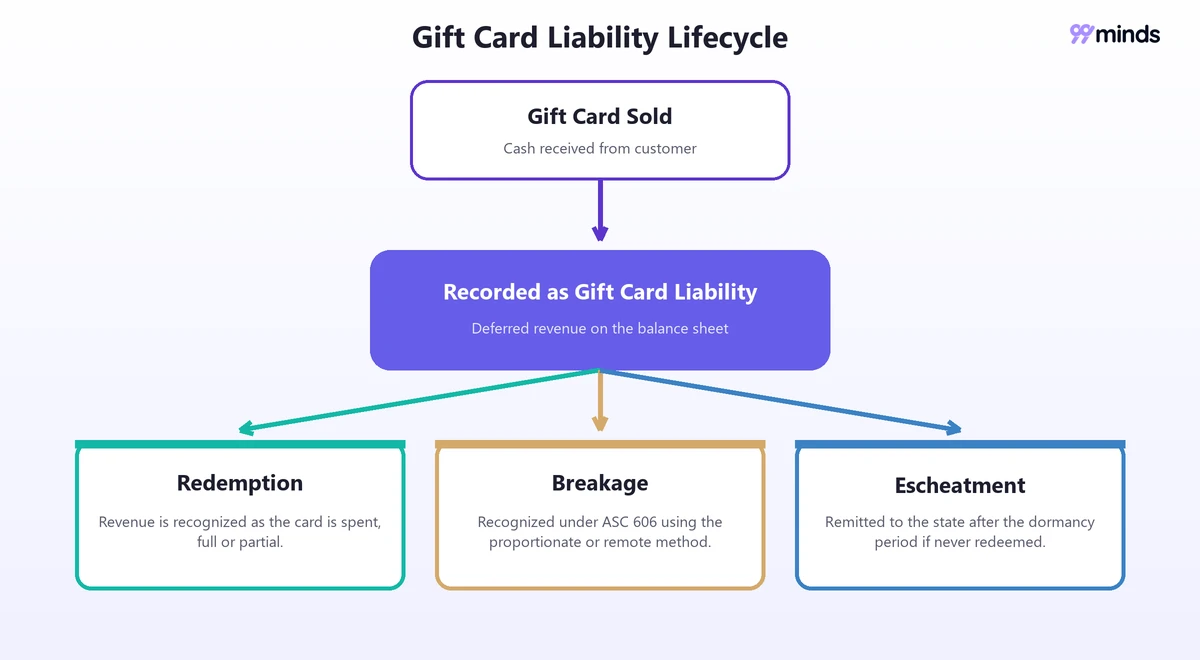
The two branches at the end are the ones that catch people out. Whether a dormant balance becomes your revenue or the state’s property isn’t your choice; it depends on law, not accounting preference.
Before the journal entries, here’s the whole thing in plain English: the sale creates a liability, redemption converts that liability into revenue, and breakage converts the portion you’ll never owe into revenue as well. Three moments, three entries.
Under ASC 606, a gift card is a contract liability. You’ve received consideration for a performance obligation you haven’t satisfied yet, so no revenue is recognized at sale. Revenue gets recognized as the customer redeems.
Breakage has two possible treatments, and which one applies to you depends on your data. If you expect to be entitled to breakage, meaning you have enough history that recognizing it won’t risk a significant revenue reversal later, you recognize it in proportion to the pattern of redemption. If you don’t have that basis, you wait and recognize the balance when the likelihood of the customer redeeming becomes remote. Most established programs use the proportional method; most new ones can’t.
For tax, the rules diverge. The Tax Cuts and Jobs Act of 2017 added Section 451(c) to the Internal Revenue Code, and the regulations under it cover gift cards explicitly. Accrual-method taxpayers get two options: full inclusion, where gift card sales are income in the year received, or a deferral method that pushes the remainder to the following tax year. If you use the deferral method tied to an applicable financial statement, your tax recognition can’t come later than your book recognition, so the two have to stay in step. Talk to your tax advisor before choosing, because the non-AFS deferral method works differently.
If you sell into markets outside the US, IFRS 15 mirrors ASC 606 closely enough that the treatment is effectively the same, which matters if you’re consolidating results across regions.
None of this changes the entries below, only when the numbers show up on which statement, and getting that timing right across ASC 606, tax, and IFRS is most of what gift card accounting actually comes down to.
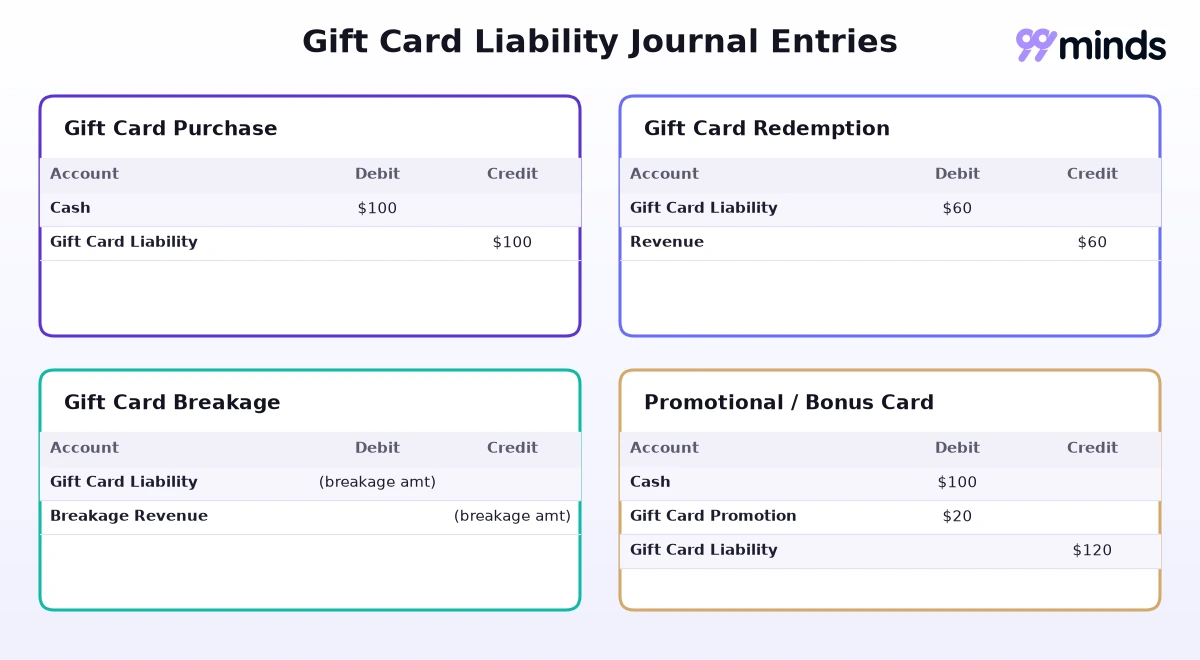
A customer buys a $100 gift card:
| Account | Debit | Credit |
|---|---|---|
| Cash | $100 | |
| Gift Card Liability | $100 |
No revenue, no cost of goods sold, nothing on the income statement. You’ve swapped a promise for cash, and both sides of the balance sheet have grown.
The customer spends $60 of that $100 card:
| Account | Debit | Credit |
|---|---|---|
| Gift Card Liability | $60 | |
| Revenue | $60 | |
| Cost of Goods Sold | (cost of items) | |
| Inventory | (cost of items) |
The remaining $40 stays in the liability account until it’s spent, recognized as breakage, or escheated. Partial redemptions are where most manual tracking falls apart, because a single card can sit in a half-used state for years across multiple channels.
When you recognize breakage on balances you’ve determined will never be redeemed:
| Account | Debit | Credit |
|---|---|---|
| Gift Card Liability | (breakage amount) | |
| Breakage Revenue | (breakage amount) |
No goods change hands and there’s no cost of goods sold, which is why breakage flows almost entirely to the bottom line. That’s also why it’s tempting to overestimate, and why auditors look closely.
Two exclusions matter here, and both are commonly missed: state-escheatable balances, covered further down, and promotional bonus value, covered next.
Say you run a “buy $100, get a $20 bonus card” promotion in December. The entry looks like this:
| Account | Debit | Credit |
|---|---|---|
| Cash | $100 | |
| Gift Card Promotion (contra liability) | $20 | |
| Gift Card Liability | $120 |
The contra liability account keeps the bonus value visible and separate from real customer money. The part people get wrong is what happens next: under ASC 606, a bonus gift card that spends like cash is an in-substance cash incentive, which makes it a reduction of the transaction price rather than a marketing expense. So as the bonus portion gets redeemed, you release the contra account against revenue, not against a marketing line.
The difference matters. Treat it as marketing spend and you’ll report $120 of revenue and $20 of expense. Treat it correctly and you report $100 of revenue. Net income is identical either way, but the revenue line is the number auditors and buyers look at first. If you fold the $20 into your normal liability pool instead, you’ll overstate both your obligation and, later, your breakage, which is the exact mistake that turns a well-planned gift card promotions campaign into a compliance headache at close.
| Gift Card Liability = Total Issued Gift Card Value − Redeemed Gift Card Value − Recognized Breakage |
If you’d rather not run this by hand every month, our free gift card liability calculator does the arithmetic and shows the workings.
Here’s the calculation on a real set of numbers. Assume you’ve issued $100,000 in gift cards, you expect 92% of that value to eventually be redeemed, and customers have redeemed $46,000 so far.
| Step | Calculation | Result |
|---|---|---|
| Total issued | Given | $100,000 |
| Expected redemption pool | $100,000 × 92% | $92,000 |
| Expected total breakage | $100,000 × 8% | $8,000 |
| Redeemed to date | Given | $46,000 |
| Share of pool consumed | $46,000 ÷ $92,000 | 50% |
| Breakage recognized | $8,000 × 50% | $4,000 |
| Revenue recognized to date | $46,000 + $4,000 | $50,000 |
| Outstanding liability | $100,000 − $46,000 − $4,000 | $50,000 |
Notice what the proportional method does. You don’t wait until cards expire to book breakage, and you don’t book it all up front either. You recognize it at the same pace your customers are redeeming, which is exactly what ASC 606 asks for.
One caveat on the numbers above: the 8% breakage is a round figure chosen to make the arithmetic readable, not a recommended assumption. Here’s how to work out what yours actually is.
This is where most programs go wrong, and the error is usually in the same direction: too optimistic.
A lot of published guidance suggests starting with a 5% to 10% breakage assumption, and a 5% to 15% never-redeemed range circulates widely in vendor content without a primary source behind it. The independent research points lower. Javelin research cited by PaymentsJournal puts average breakage closer to 1.5%. Treating a generic 10% as your breakage rate can overstate revenue badly, and it’s the kind of assumption an auditor will ask you to evidence.
A few rules that will keep you honest:
The five rules above are really just how gift card breakage estimation works in practice, and a standalone breakage calculator can help you model different redemption assumptions before you lock in a rate.
Gift card liability sits under current liabilities, usually labeled as deferred revenue, unearned revenue, or a dedicated liability line. It’s classified as current because gift cards are redeemable on demand, and you have no way of knowing that a given customer won’t walk in tomorrow.
Some brands with long redemption tails split the balance, keeping the portion expected to be redeemed within 12 months as current and the remainder as non-current. That’s a reasonable presentation if your cohort data supports it, and it gives readers a more honest picture of when the obligation will actually be settled.
On the income statement, gift cards show up twice: as ordinary revenue when cards are redeemed, and as breakage revenue when unredeemed balances are recognized. Flag that split to anyone reading your gross margin trend, because a big breakage quarter can make the underlying business look better than it is.
The cleanest way to hold these two in your head: liability is what you owe, breakage is the part of it you’ll never have to pay.
They move together. Every dollar of breakage you recognize reduces the liability by a dollar and increases revenue by a dollar at the same moment. The liability account shrinks, the income statement grows, and no product leaves the warehouse.
Breakage is not a target, though. Recognizing breakage means accepting that a customer paid you and never got anything for it, and while that’s real revenue, it’s also a customer who didn’t come back. A redeemed card brings someone through the door, and shoppers routinely spend beyond the card’s balance when they do. Redemption is worth more than breakage on almost every measure that matters, which is the whole argument for actively driving it rather than waiting it out.
Here’s the rule that overrides everything else in this article: if a balance has to be remitted to the state as unclaimed property, it was never yours to recognize as breakage. Escheatment wins. Booking breakage on an escheatable balance means recognizing revenue on money you’re legally required to hand over, and that’s a restatement waiting to happen.
The complication is that unclaimed property law is set at the state level and the rules vary widely. Broadly, states fall into three groups:
Now the part that’s widely misreported, including in some guides that rank for this topic. Which state gets the money is not decided by where the card was sold. It follows the federal priority rules the Supreme Court set out in Texas v. New Jersey: first claim goes to the state of the owner’s last known address in your books and records, and where you hold no address, it goes to your state of incorporation.
Because most gift cards carry no purchaser or recipient address at all, the practical default for a lot of issuers is their state of incorporation rather than a patchwork of every state they ship to. Place of purchase enters the picture only in states that have adopted a presumption treating the store where the card was bought as the owner’s address, which is a state-specific overlay on the priority rules, not the rule itself. If you’re incorporated in Delaware and selling nationwide, that distinction changes your exposure substantially.
On top of the state rules sits the federal CARD Act, implemented through Regulation E at 12 CFR 1005.20, which sets a floor: gift card funds can’t expire sooner than five years after issuance or five years after the last load, whichever is later; inactivity fees can’t be charged until there’s been a full year without activity; and no more than one such fee can be charged in any calendar month. Note that loyalty, award, and promotional gift cards are carved out of these protections, so the bonus card in the promotional example above may not be covered.
Everything above is a US framework. If you sell into the UK, the EU, or other markets, unclaimed property runs on a completely different structure: some countries have no gift-card-specific dormancy-remittance regime at all, others fold it into general unclaimed-funds legislation that was never written with gift cards in mind. IFRS 15 governs the revenue-recognition side internationally the same way ASC 606 does domestically, but escheatment is a separate, jurisdiction-by-jurisdiction question you’ll need local counsel for in every market you sell into.
None of this replaces advice. Unclaimed property rules change, and the interaction between the priority rules and individual state statutes gets technical fast. Confirm your position with your own counsel or the unclaimed property administrator in the states that actually apply to you.
Almost every guide on this topic assumes a consumer buying a card for a friend. If you run a corporate program, selling bulk cards to companies for employee rewards, client gifts, or channel incentives, the liability behaves completely differently and needs to be tracked separately.
A single corporate order can add more to your liability in one afternoon than a month of consumer sales. That lumpiness distorts any blended rate you’re calculating, and it can make a quarter-over-quarter liability comparison meaningless unless you can isolate corporate issuance.
Consumer gift cards get redeemed fast and early. Corporate cards get distributed by an employer or account manager on their own schedule, so redemption depends on someone else’s internal process. A batch bought in December and handed out at a March sales kickoff won’t follow a consumer redemption curve at all.
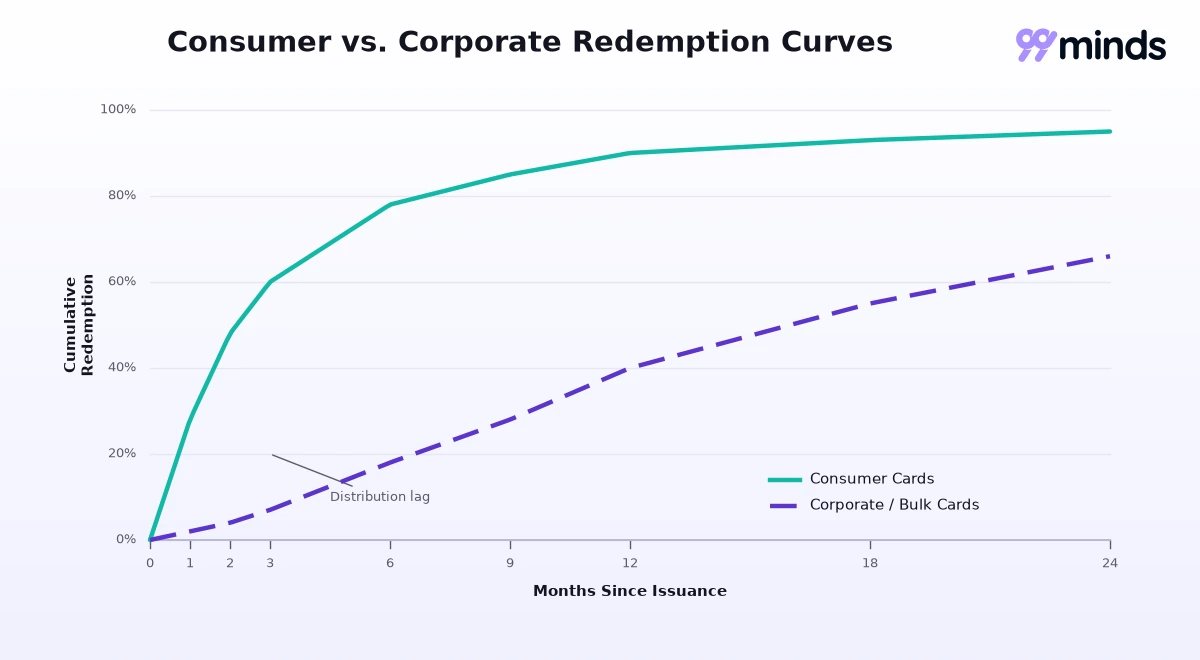
Cards age from issuance, not from distribution. If your dormancy clock starts when the corporate buyer paid, a batch can be months into its dormancy window before a single recipient has even seen it. Track issuance and distribution as separate events or your escheatment reporting will be wrong.
Corporate deals often come with negotiated terms that consumer cards never have: custom expiry, refundability on unused cards, reissue rights, or minimum redemption guarantees. Each of those changes what you actually owe, and none of them show up in a standard gift card ledger.
The practical answer is cohort-level tracking. Corporate batches need to be tagged, reported, and estimated separately from retail issuance, or your breakage rate is built on a blend of two populations that behave nothing alike.
The 99minds multi-shop gift card platform supports bulk issuance with batch-level reporting for exactly this reason, so negotiated terms on larger corporate programs stay tracked alongside standard retail issuance rather than falling outside the ledger.
Where a customer keeps their gift card turns out to matter a lot to your balance sheet.
A plastic card in a drawer is invisible. A card in Apple Wallet or Google Wallet sits on the phone the customer already checks dozens of times a day, and it can push a reminder when they’re near your store. The expectation is that higher visibility drives higher redemption, which means your liability converts to revenue faster. Worth measuring in your own cohort data rather than assuming.
That last point is the one to internalize. Pushing cards into digital wallets deliberately trades breakage revenue for redeemed revenue, and since a redeemed card brings a customer back while a broken one doesn’t, that’s a good trade.
99minds’ mobile wallet marketing platform issue straight to the customer’s wallet at purchase, the same mobile wallet passes brands now use well beyond gift cards, for loyalty cards, event tickets, and membership passes.
If a card is redeemable across several brands or entities you operate, you need to answer two questions clearly: which entity carries the liability while the card is outstanding, and how the balance is allocated when it’s redeemed at one of them. Without a defined settlement trail between entities, you’ll end up with the same dollar counted in two places or in neither.
A liability denominated in euros and reported in dollars moves with the exchange rate, independent of anything your customers do. If you’re selling multi-currency gift cards, the revaluation needs to be part of your monthly close rather than a year-end surprise.
Low-balance nudges, expiry warnings where applicable, and wallet pass updates all pull redemption forward. Finance teams tend to see these as marketing spend. They’re actually the most direct lever you have on the liability line.
Gift card liability is harder to pin down than most balance sheet items, for two structural reasons.
The first is that the number is assembled from systems that don’t talk to each other. Cards get sold on your website, at the POS, through third-party distributors, and as customer service goodwill, and each of those leaves its own record. Layer on refunds issued back to a card, reissues for lost cards, and manual adjustments, and the balance moves constantly without a single clean paper trail.
The second is that part of the figure is a forecast. A card issued three years ago can still be redeemed tomorrow, so you can never fully close the book on a cohort, and the breakage portion of your liability rests on an estimate you’ll be asked to defend. No other current liability on your balance sheet works this way.
Understate the liability and you’ve recognized revenue you haven’t earned. Overstate it and you’re hiding profit. Either way the correction lands in whichever period is least convenient.
When your POS, ecommerce platform, and accounting system each hold a different outstanding balance, month-end close turns into an investigation, and the longer a discrepancy runs, the harder its origin is to find.
When a card shows $50 in one channel and $30 in another, a customer gets told their money isn’t there. Balance disputes are expensive to resolve and they damage trust in the program itself.
Breakage you never recognize is revenue you were entitled to and never took. Plenty of brands carry years of genuinely dead balances simply because nobody has the cohort data to support writing them off.
Missed escheatment filings carry penalties and interest, and unclaimed property audits can reach back years. Fraud shows up here too, in the form of the gift card scams that hit the liability line directly: balance manipulation, cloned card numbers, and unauthorized reissues, all of which cost you real money.
Declined cards, balances that don’t sync between online and in-store, and slow dispute resolution turn a gift into a complaint. The recipient is often someone who has never bought from you before, so a bad redemption wastes an acquisition opportunity as well.
Without a single source of truth you can’t answer the basics: how much liability sits in each channel, which store issued the most cards this quarter, and how old the oldest outstanding balance is. Those answers feed every decision on this list.
Maintain a card-level record of every card issued, its current balance, its issuance date, and its channel. Aggregate totals aren’t enough, because every question worth asking about liability is a question about a subset of cards.
Watch redemption by cohort, not in aggregate. A cohort curve tells you whether this year’s cards are behaving like last year’s, and it’s the only defensible basis for a breakage estimate.
Where expiry is permitted, know which cards are approaching it. Where it isn’t, track the dormancy clock instead, because that’s what drives your escheatment obligations.
Match gift card transactions across ecommerce, POS, and any third-party channel automatically and daily. Manual monthly reconciliation finds problems weeks after they happen, when the trail has gone cold.
Review your breakage assumptions at least annually against actual redemption, and document the review, including why any change was made.
Every issuance, redemption, refund, reissue, and manual adjustment needs a timestamped, attributable record. This is what makes your liability number defensible rather than merely plausible.
The most underused lever, and the one that actually makes you money. Send balance reminders. Push cards into digital wallets so they stay visible. Tie gift card balances into your loyalty program so redemption earns points. Offer reload incentives to customers who spend a card down, the core mechanic behind reloadable gift cards that keeps a card’s balance, and the customer, active instead of letting it go dormant.
Every one of those tactics shrinks the liability by bringing a customer back rather than by writing a balance off.
A quick checklist of the errors that cost the most, most of them covered in more detail above:
Most of what’s described above is a data problem before it’s an accounting problem. You can’t calculate a defensible liability figure without card-level records across every channel, and you can’t drive redemption without knowing which balances are sitting idle. The 99minds gift card software is built to give you both.
| Capability | What it prevents |
|---|---|
| Centralized gift card management | Cards tracked in separate systems that never reconcile |
| Real-time balance tracking | Issued, redeemed, and outstanding figures that disagree by channel |
| Automated reconciliation | Month-end investigations into discrepancies weeks after the fact |
| Gift card liability reporting | A liability figure you can't break down or defend |
| Physical and digital card management | Plastic and eGift programs tracked in parallel silos |
| Multi-store management | No visibility into which location or channel carries which balances |
| Breakage tracking | Missed breakage revenue, or breakage recognized on the wrong balances |
| Expiration and dormancy tracking | Escheatment deadlines discovered after they've passed |
| Full audit trail | An estimate you can't evidence when an auditor asks |
| Fraud and risk controls | Balance manipulation and unauthorized reissues distorting the ledger |
| API and POS integrations | Liability data stranded outside your accounting system |
| Multi-currency management | Unmeasured FX exposure on foreign-denominated balances |
| Corporate and bulk program tracking | Corporate cohorts blended into consumer redemption rates |
A few of these are worth seeing in context.
A card issued online and partially redeemed in a physical store updates in real time across every channel. That’s what makes the outstanding balance figure trustworthy, and it removes the most common cause of customer balance disputes. The 99minds gift card API and our POS and ecommerce integrations are what carry that sync into the systems you already run.
Because every card carries its issuance date, channel, and batch, you can pull redemption curves by cohort instead of guessing from a blended average, which is what makes a breakage estimate defensible in the first place.
When a return is issued as gift card value or store credit rather than cash, the money stays with you as a tracked, redeemable balance, which is the whole logic behind using gift cards for ecommerce refunds instead of processing a cash chargeback.
Turn Gift Card Liability Into a Defensible, Real-Time Number
Centralized card-level tracking, breakage and escheatment reporting, and reconciliation across every store and currency, in one platform.
Three things to take away. Gift card liability is deferred revenue, not profit, and treating it as cash you’ve earned will eventually catch up with you. Your calculation is only as good as the cohort data underneath it, so card-level tracking isn’t a nice-to-have, it’s the whole foundation. And escheatment always beats breakage, so know the rules in every state you sell into before you recognize a dollar.
The bigger shift is how you think about the number. A shrinking liability isn’t automatically good news, and a growing one isn’t automatically bad. What matters is how fast that liability converts into redeemed revenue and returning customers, because that’s the version of the number that compounds.
If your gift card liability currently lives in a spreadsheet stitched together from three systems, that’s the first thing to fix. Book a demo with the 99minds team to get your outstanding balances, redemption curves, and breakage exposure across every store, channel, and currency in one place.