We're building the future of agentic promotions. Sign up for early access!
Sign up
We're building the future of agentic promotions. Sign up for early access!
Sign up Table of Contents:
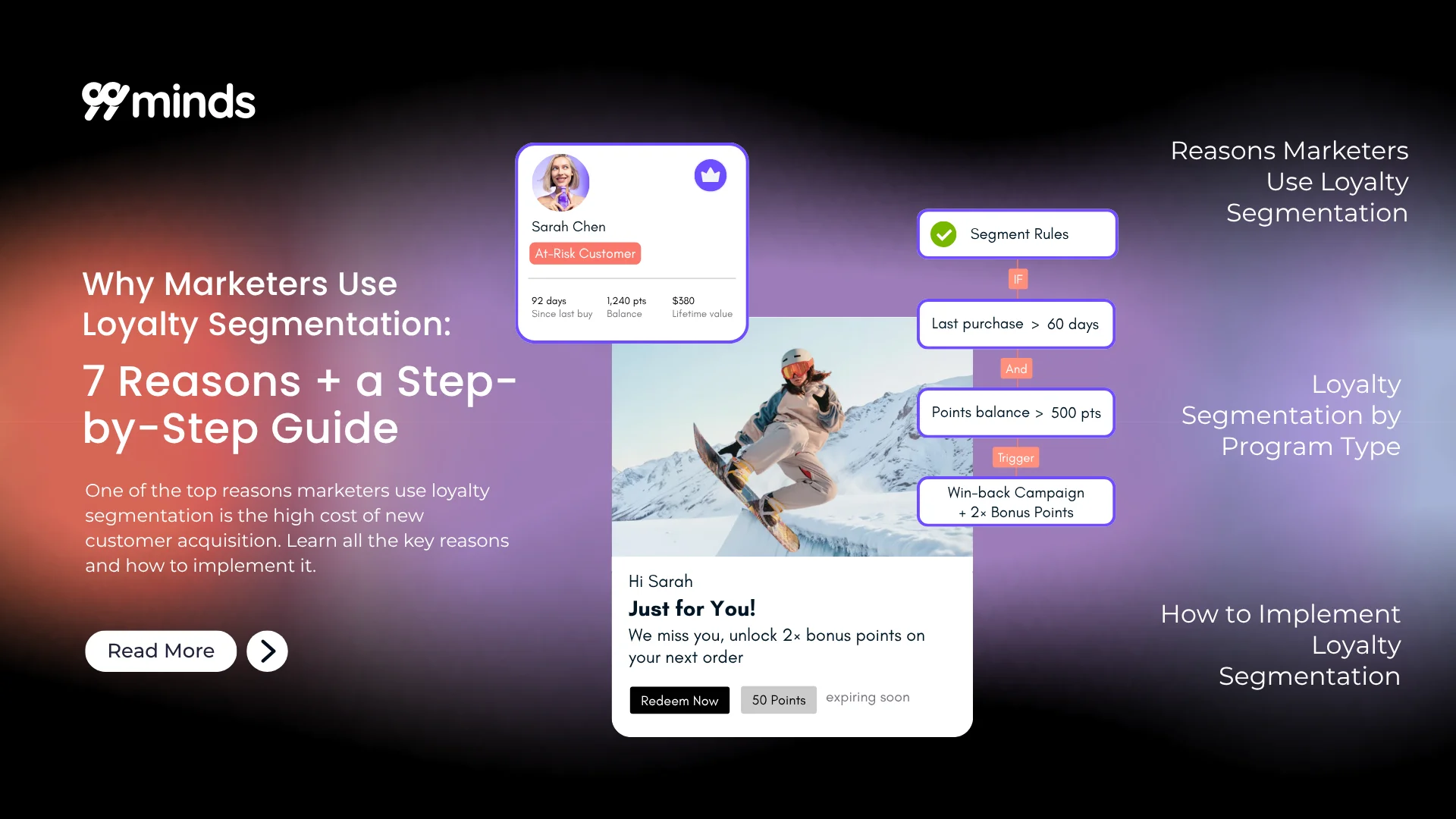
One of the primary reasons marketers use loyalty segmentation is the high cost of acquiring new customers. Research by Bain & Company found that acquiring a new customer costs five to seven times more than retaining an existing one. Loyalty segmentation lets you stop spreading your marketing budget thin across your entire customer base and instead direct it toward the people who are most likely to buy again, spend more, and stick around.
But that’s just the beginning. Below, we cover all the key reasons marketers swear by loyalty segmentation, how it applies differently depending on your loyalty program type, and a practical five-step guide to help you get started.
Loyalty segmentation is the practice of dividing your loyalty program members into distinct groups based on how they interact with your brand: how often they buy, how much they spend, how engaged they are, and how long they’ve been a customer.
It’s different from general customer segmentation, which typically starts with demographics (age, location, gender). Loyalty segmentation is behavior-first. It looks at what customers actually do with your loyalty program, including their purchase frequency, points balance, tier status, and referral activity, rather than who they are on paper.
The most common data inputs for loyalty segmentation include:
The goal is to create segments that are distinct enough to deserve a different marketing approach. A customer who’s bought from you 12 times this year doesn’t need the same message as someone who joined your loyalty program three months ago and hasn’t purchased since.
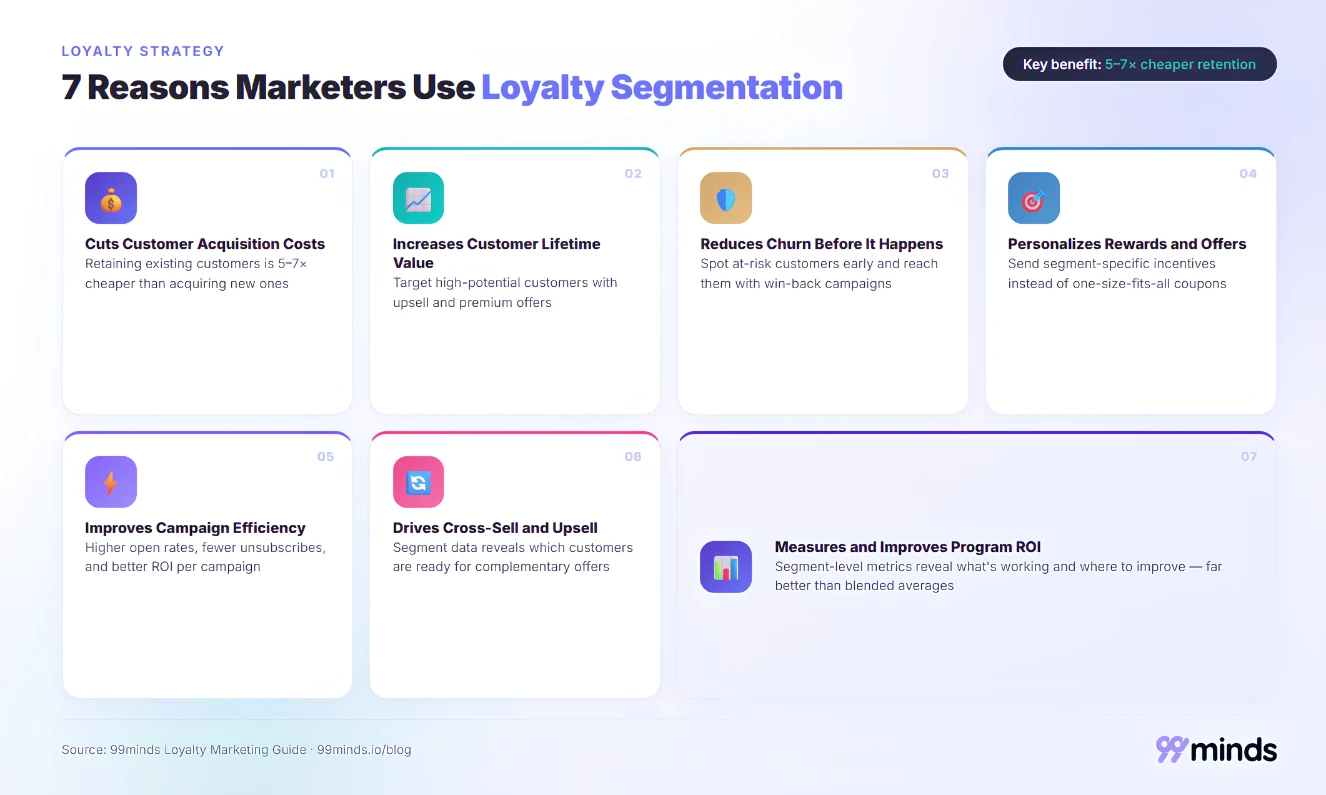
Let’s come back to the reason this keyword exists in the first place. Acquiring a new customer costs five to seven times more than keeping an existing one. When you add up paid ads, content, outreach, and the time it takes to build trust with a brand-new buyer, the math quickly favors retention over acquisition. Reducing customer acquisition costs starts with getting more value from customers you already have.
Loyalty segmentation directly addresses this by helping you maximize the value of customers you already have. Instead of spending equally across all existing customers, you can identify your high-value segments and put your budget where it will generate the best return. You stop guessing and start allocating with intention.
Not all loyal customers are equally valuable, and that’s actually a good thing for marketers. Loyalty segmentation helps you identify which customers have the highest lifetime value potential and which ones need a nudge to get there.
Once you know who your top spenders are, you can give them early access to new products, exclusive member perks, and higher-tier rewards. For customers in the mid-tier, you can run targeted upsell campaigns with customer lifetime value squarely in mind. Without segmentation, both groups receive the same generic message, and you leave money on the table.
The most valuable thing loyalty segmentation can tell you is who’s about to leave, before they actually do.
By tracking recency (when did this person last buy?), you can flag customers whose engagement is cooling and reach them with a win-back offer before they go quiet entirely. Proactive retention through a “we miss you” bonus points campaign is far cheaper than trying to win back someone who’s already switched to a competitor. A well-structured customer retention program treats this kind of early warning as routine, not reactive.
A one-size-fits-all reward structure sends the same 10% off coupon to your VIP customer who spends $500 a month and to the occasional buyer who hasn’t checked in since last quarter. That’s a waste for both of them: the VIP deserved something more exclusive, and the occasional buyer probably needed a different kind of nudge entirely.
Loyalty segmentation makes it possible to send segment-specific incentives: bonus points on their next three purchases for at-risk customers, early access to a new collection for champions, a free shipping threshold for mid-tier buyers trying to reach the next tier. Your loyalty program strategy only works as well as the personalization behind it.
Blasting your entire loyalty database with the same message doesn’t just produce mediocre results, it actively trains people to tune you out. Unsubscribes rise, open rates fall, and you’ve spent budget reaching people who weren’t ready to act.
When you segment first, every campaign you send is targeted at people for whom it’s actually relevant. Higher engagement rates, fewer unsubscribes, and better ROI on every email and push notification. The improvement in retention marketing efficiency alone often justifies the effort of setting up segmentation.
Your purchase history data, when organized by segment, reveals patterns you’d never spot by looking at averages. High-frequency buyers in one category are often the most receptive to complementary product recommendations. High-AOV customers who’ve only bought from one department are prime cross-sell targets.
Loyalty segmentation gives you the map. Instead of hoping customers discover new products on their own, you can surface the right complementary offer to the right segment at exactly the moment they’re most likely to act.
Without segments, you’re looking at blended averages that hide more than they reveal. Your overall retention rate might look healthy while a specific cohort of mid-tier customers is quietly churning. Your average order value might be climbing while your at-risk segment is shrinking in size.
Segment-level metrics, including retention rate, repeat purchase rate, average order value, and points redemption rate per group, give you the granular data you need to actually improve your program over time. Tracking the right loyalty program KPIs by segment is what separates programs that grow from programs that plateau.
The right segmentation model isn’t the same for every loyalty program; how you should segment your customers depends heavily on the type of program you’re running. Here’s something no one talks about enough.
The table below breaks down the best segmentation approach for each major program type, the key segments to create, and the primary goal each approach serves.
| Program type | Best segmentation model | Key segments to create | Primary goal |
|---|---|---|---|
| Points-based | RFM (Recency, Frequency, Monetary) | Champions, At-Risk, Lapsing, New | Increase redemption and repeat purchase |
| Tiered (VIP) | Tier progression + spend velocity | Rising stars, stable VIPs, stagnant members | Accelerate tier upgrades |
| Cashback | Spend-band segmentation | Big spenders, price-sensitive, occasional buyers | Increase AOV and frequency |
| Referral | Advocacy score + referral activity | Power advocates, one-time referrers, non-referrers | Convert one-time referrers to repeat advocates |
| Membership | Engagement depth + benefit usage | Power users, passive members, at-risk members | Reduce cancellation and deepen usage |
RFM scoring is the gold standard for points-based programs. It scores every customer across three dimensions: Recency (how recently did they earn points?), Frequency (how often do they transact?), and Monetary (how much do they spend?).
From those scores you can build your core segments: Champions (high across all three), At-Risk (historically strong but recently inactive), and Lapsing (haven’t engaged in 60+ days). Each segment gets a different campaign. Champions get early access and referral invites. At-Risk customers get a time-sensitive bonus point offer. Lapsing members get a “here’s what you’re missing” reactivation email.
If you run tiered loyalty programs, you can layer RFM on top of tier status for an even richer picture.
For tiered programs, tier progression velocity matters as much as current tier status. Identify your “rising stars,” the customers who are close to upgrading to the next tier, and send them a targeted nudge campaign. A well-timed “you’re only 200 points away from Gold” email can be the push they need.
On the flip side, stagnant members at risk of tier downgrade need re-engagement before they lose status and disengage entirely.
Cashback programs attract a wide range of spending behaviors. Segment by spend bands: heavy spenders who hit your cashback threshold regularly, moderate buyers who are one good campaign away from spending more, and occasional buyers who joined for a one-time purchase incentive.
Different cashback thresholds and bonus triggers for each band can significantly lift AOV across the board without diluting the reward economics.
Referral segmentation is advocacy segmentation. Identify your power advocates (three or more successful referrals), your one-time referrers, and your non-referrers. Power advocates deserve exclusive perks and co-marketing treatment. One-time referrers just need a compelling follow-up offer to refer again. Non-referrers may not know how the program works or may need a stronger incentive to try it.
Membership churn is driven almost entirely by passive members: people who signed up but never fully engaged with the benefits. Segmenting by benefit usage (who’s actually using their membership perks vs. who’s barely logged in) lets you trigger targeted onboarding campaigns for passive members before they cancel.
Before you pull any data, decide what problem you’re trying to solve. Are you trying to reduce churn? Increase average order value? Convert occasional buyers into repeat customers? Your objective determines which segments matter most and which data you actually need.
Trying to solve everything at once is how segmentation projects stall. Start with one goal, build the relevant segments, and expand from there.
The quality of your segments is only as good as the data feeding them. Pull together:
If your loyalty platform integrates with your e-commerce store (Shopify, BigCommerce, etc.), most of this data syncs automatically. The key is making sure it all lives in one place before you start building segments.
Start with three or four segments before adding complexity. A simple starting framework:
Use RFM scoring to assign each customer to one of these buckets. Once your base segments are working, add program-specific variables, like tier status, referral count, or cashback redemption rate, to refine further.
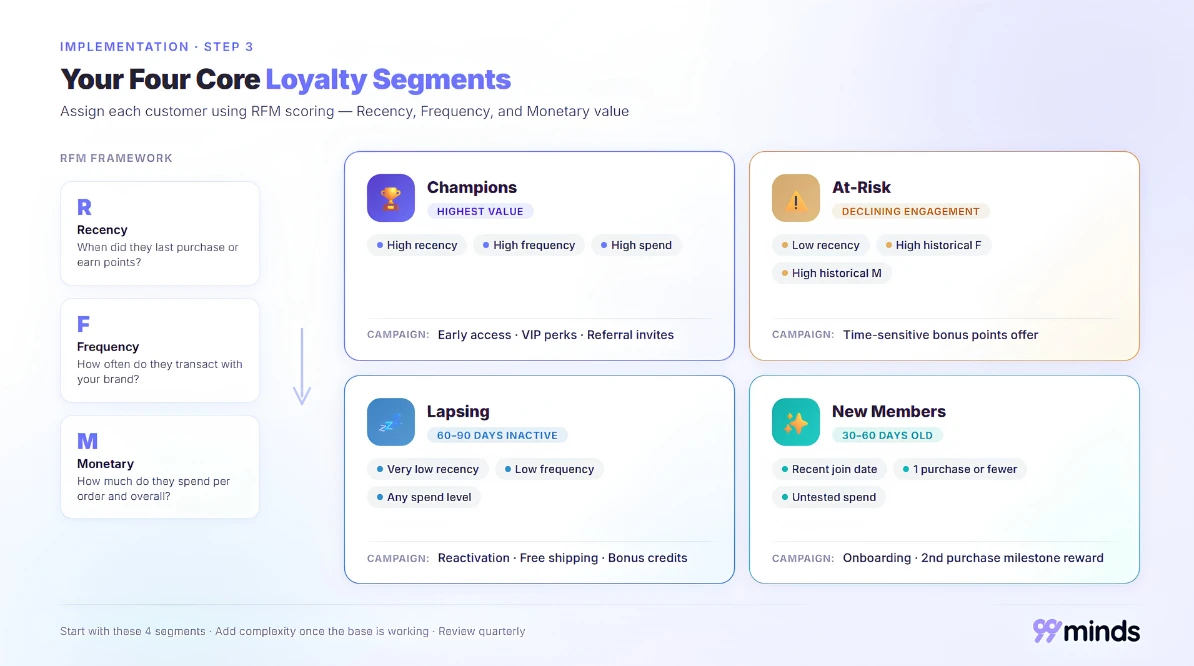
Map each segment to a different message, offer, and channel:
Personalization at the segment level is what separates a loyalty program that drives real behavior from one that just sits in the background.
Track metrics at the segment level, not just overall:
Review your segments quarterly. Customers move between segments as their behavior changes, and your campaigns should move with them. The goal isn’t to set up segmentation once; it’s to build a system that continuously improves.
Modern loyalty segmentation goes beyond RFM by layering in AI-powered pattern detection and zero-party data collected directly from customers. Most articles about loyalty segmentation stop at RFM, but the tools available to marketers today go significantly further.
AI-powered segmentation can identify micro-segments that manual analysis misses entirely: customers who only buy during flash sales, customers who have high referral potential but low personal spend, or customers who are statistically likely to churn within the next 30 days even though their recent purchase history looks fine. Predictive models can surface these patterns and trigger automated campaigns before the behavior becomes visible in your standard metrics.
Zero-party data is the other major shift. Rather than inferring preferences from behavior alone, you can ask customers directly. A single preference question at enrollment (“What matters most to you: discounts, early access, or free shipping?”) gives you self-reported data that’s both more accurate and more privacy-compliant than third-party alternatives. When you combine zero-party responses with behavioral data, you get the richest possible segmentation inputs.
You don’t need a massive tech stack to start. Even a basic quiz at sign-up, a preference center in your email footer, or a post-purchase survey can meaningfully improve how well your segments reflect what customers actually want. For a broader look at how AI is reshaping e-commerce personalization, see our guide on AI in e-commerce.
99minds helps you segment smarter by supporting every major loyalty program type and syncing the purchase and engagement data your segments run on directly from Shopify and BigCommerce. 99minds Loyalty Program is built for exactly the kind of segmentation this article describes.
On the data side, 99minds integrates natively with Shopify and BigCommerce, syncing purchase history, customer tags, and loyalty activity automatically. Automated workflows let you trigger segment-specific campaigns based on customer behavior: a win-back offer when a member goes 60 days without a purchase, a tier upgrade nudge when someone is 100 points from the next level, or a referral invite when a customer hits champion status.
The analytics dashboard gives you segment-level reporting so you can track retention rate, redemption rate, and repeat purchase rate per cohort, not just overall averages.
If you want to see what loyalty segmentation looks like in practice, check out some customer loyalty program examples for inspiration.
Loyalty segmentation isn’t a one-time setup. It’s an ongoing practice that gets more valuable the more you refine it.
Start with the four core segments (Champions, At-Risk, Lapsing, New), use RFM scoring as your foundation, and build from there as you learn what moves behavior in your specific program. Match your segmentation model to your program type using the decision matrix in this article, and keep an eye on AI and zero-party data as tools that can take your segments from good to genuinely predictive.
The brands that win on loyalty aren’t the ones with the biggest programs. They’re the ones that know their customers well enough to send the right message at the right time. Segmentation is how you get there.
Get started with 99minds and build a loyalty program that segments, personalizes, and automates, all from a single dashboard.