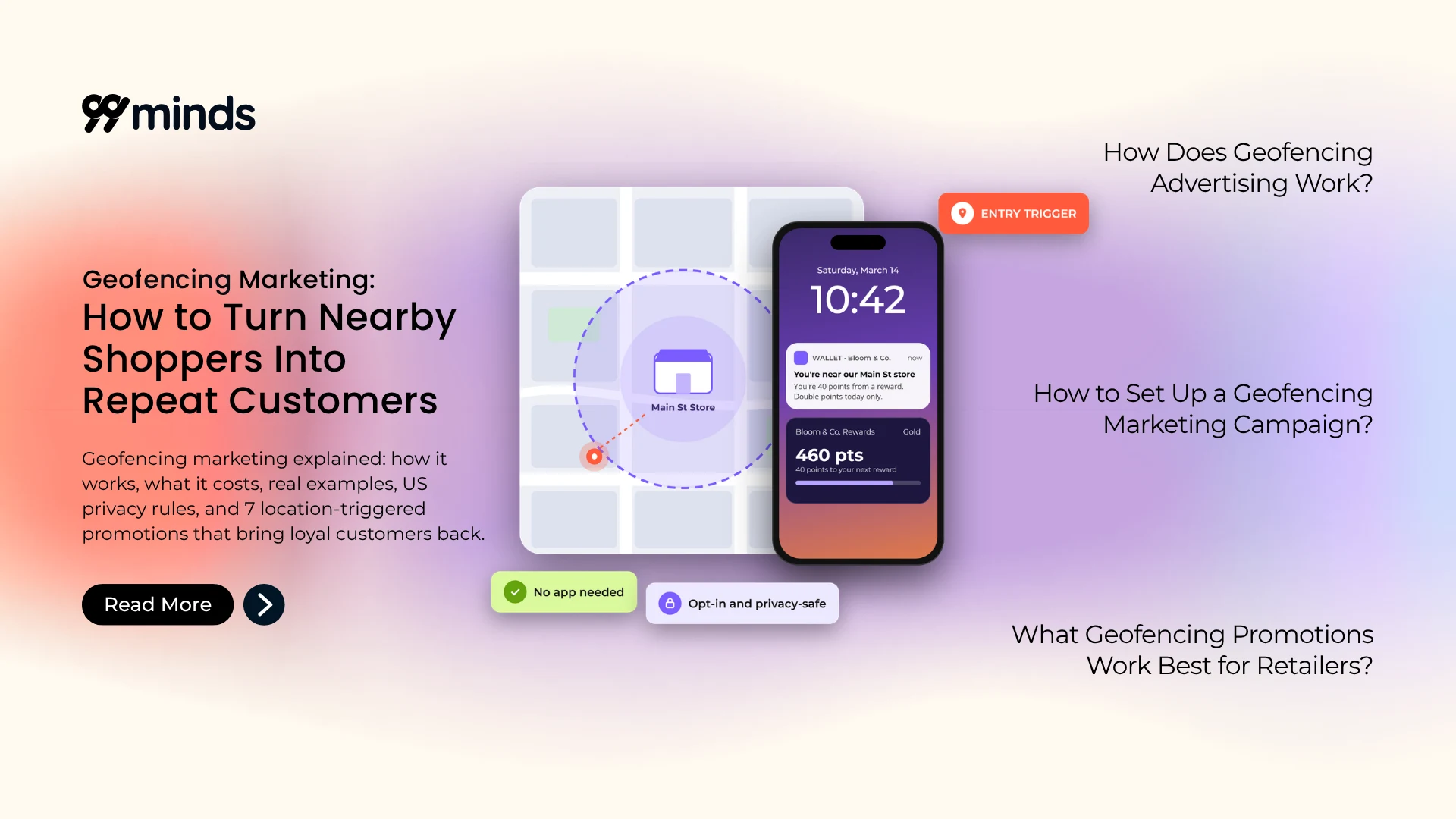
A loyalty member walks past your store with 40 points to go before their next reward. They don’t come in, because nothing reminded them.
Now replay that moment: their phone lights up with “You’re near our Main St store. Double points today only.” That’s the difference geofencing marketing makes.
Geofencing marketing sends a message when a customer’s phone enters, stays in, or leaves a virtual boundary around a real place. It’s growing fast. According to Fortune Business Insights, The global geofencing market was valued at $3.22 billion in 2025 and is projected to reach $11.85 billion by 2034.
60-Second Summary
- Geofencing marketing triggers an ad, push notification, SMS, or wallet pass alert when a phone crosses a virtual boundary around a location
- There are two models: third-party geofencing ads that reach new people, and first-party alerts sent to customers who opted in
- First-party geofencing is the cheaper, lower-risk choice for retention, because you own the data and the consent
- You don’t need an app: Apple Wallet and Google Wallet passes can show a lock-screen alert near a store
- The best geofencing promotions use loyalty data, like points balances, gift card balances, and store credit, not just a generic discount
- Several US states now treat precise geolocation as sensitive data that needs opt-in consent, and the FTC has acted against location data brokers
- Measure lift with a holdout group and track retention KPIs like repeat visits and redemptions, not just clicks
- 99minds connects location-triggered wallet passes to loyalty points, gift cards, and store credit in one platform
What Is Geofencing Marketing?
Geofencing marketing is a form of location-based marketing that draws a virtual boundary around a real-world place, like a store, a mall, or an event venue. When a customer’s phone enters, lingers in, or exits that boundary, it triggers a message such as an ad, push notification, SMS, or wallet pass alert.
That’s the geofencing marketing definition in one line. In plain terms, the meaning comes down to three parts: a boundary, a rule, and a message.
The boundary says where. The rule says when, for example “on entry, once a week.” The message says what the customer sees.
If you’re asking what is geofencing in marketing compared with other channels, think of it as the bridge between digital marketing and physical visits. Digital marketing geofencing lets online channels react to what a customer is doing in the real world, which is something email and search ads can’t do on their own.
Geofencing vs geotargeting vs beacons
These three terms get mixed up a lot. Here’s how they compare:
| Geofencing | Geotargeting | Beacons | |
|---|---|---|---|
| What triggers it | A device crossing a virtual boundary | A person's location or stated area when an ad is served | A phone coming within Bluetooth range of a small device |
| Typical area | A building to a few blocks | A ZIP code, city, or radius | A few feet to one room |
| Hardware needed | None | None | Beacons installed in the store |
| Best use | Reacting to arrivals, visits, and exits | Choosing who sees an ad by region | In-aisle or checkout messages |
The difference matters for budget. Geotargeting decides who is eligible to see an ad, geofencing reacts to a move in real time, and beacons need hardware in every store.
How Does Geofencing Advertising Work?
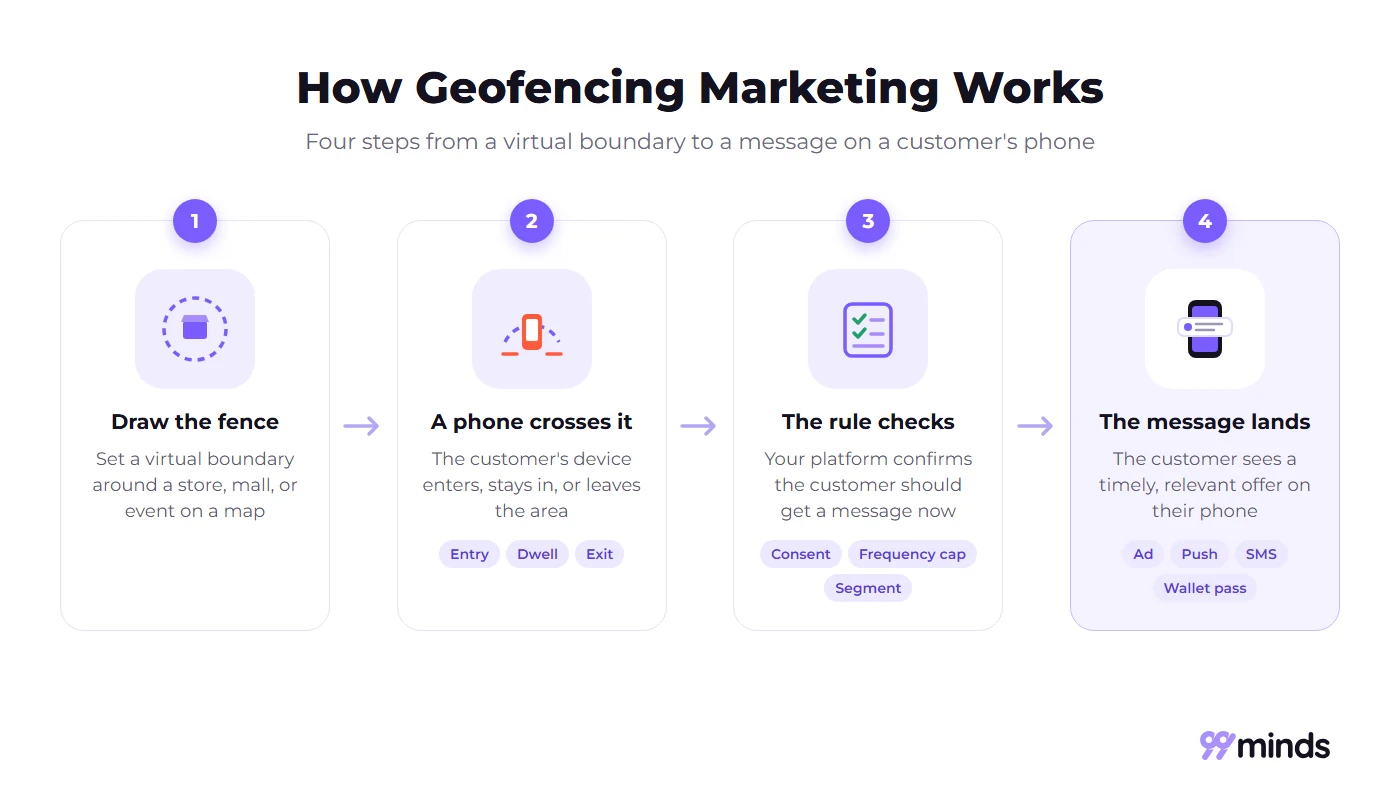
Using geofencing for marketing follows the same four-step flow, whatever the channel:
- You draw the fence around a location on a map
- A customer’s phone crosses the boundary
- The rule you set checks whether the customer should get a message (consent, frequency, segment)
- The message is delivered as an ad, push notification, SMS, or wallet pass alert
Location signals behind a geofence
Phones work out their location from several signals at once. GPS works best outdoors. Wi-Fi and cell towers fill in indoors and in dense city blocks, where GPS is weaker, and Bluetooth covers very short ranges, which is why beacons use it.
Because these signals vary, small fences are unreliable. Google’s Android documentation recommends that “the minimum radius of the geofence should be set between 100 - 150 meters” for best results, according to the Android geofencing guide.
Geofence shapes
- Radius: a circle around a point, the simplest option and the one most tools offer
- Drive-time or walk-time: an area based on how long it takes to reach the store, useful in suburbs where roads matter more than distance
- Building footprint: a polygon traced around a specific building or parking lot, useful in malls and dense areas
Geofence triggers: entry, dwell, and exit
There are three common triggers:
- Entry: a customer arrives near your store. Example: “Welcome back! Show this pass for double points today.”
- Dwell: a customer stays inside the fence for a set time. Example: a reminder that their gift card still has a balance
- Exit: a customer leaves. Example: “Thanks for stopping by, enjoy 2x points on your next online order.”
Don’t expect alerts to be instant. Phones limit how often apps check location to save battery.
On Android, the latency is “usually less than 2 minutes,” per the same Android guide. It averages two to three minutes when background location limits are in effect, and it can reach six minutes if the phone has been still for a while. According to Apple’s developer documentation, Core Location on iPhone stops any single app from monitoring more than 20 conditions at once.
Which Type of Geofencing Marketing Fits Your Brand?
Most guides blur two very different models together. Picking the right one changes your cost, your privacy risk, and who you can reach.
Third-party geofencing ads
Third-party geofencing serves programmatic display, social, or video ads to devices seen inside a fence. The location data usually comes from ad networks and data providers, not from your own customers.
It’s best for reaching new customers, promoting a store opening, or targeting shoppers near a competitor. The trade-offs are that you pay for every impression, you rely on someone else’s location data, and your privacy exposure is higher.
First-party geofencing
First-party geofencing sends push notifications, SMS, or wallet pass alerts to customers who opted in to hear from you. You set the fence, they gave consent, and you own the data.
It’s best for retention, repeat visits, and getting rewards or balances redeemed. The trade-off is reach: it only works for people already on your list. In exchange, each message costs little or nothing.
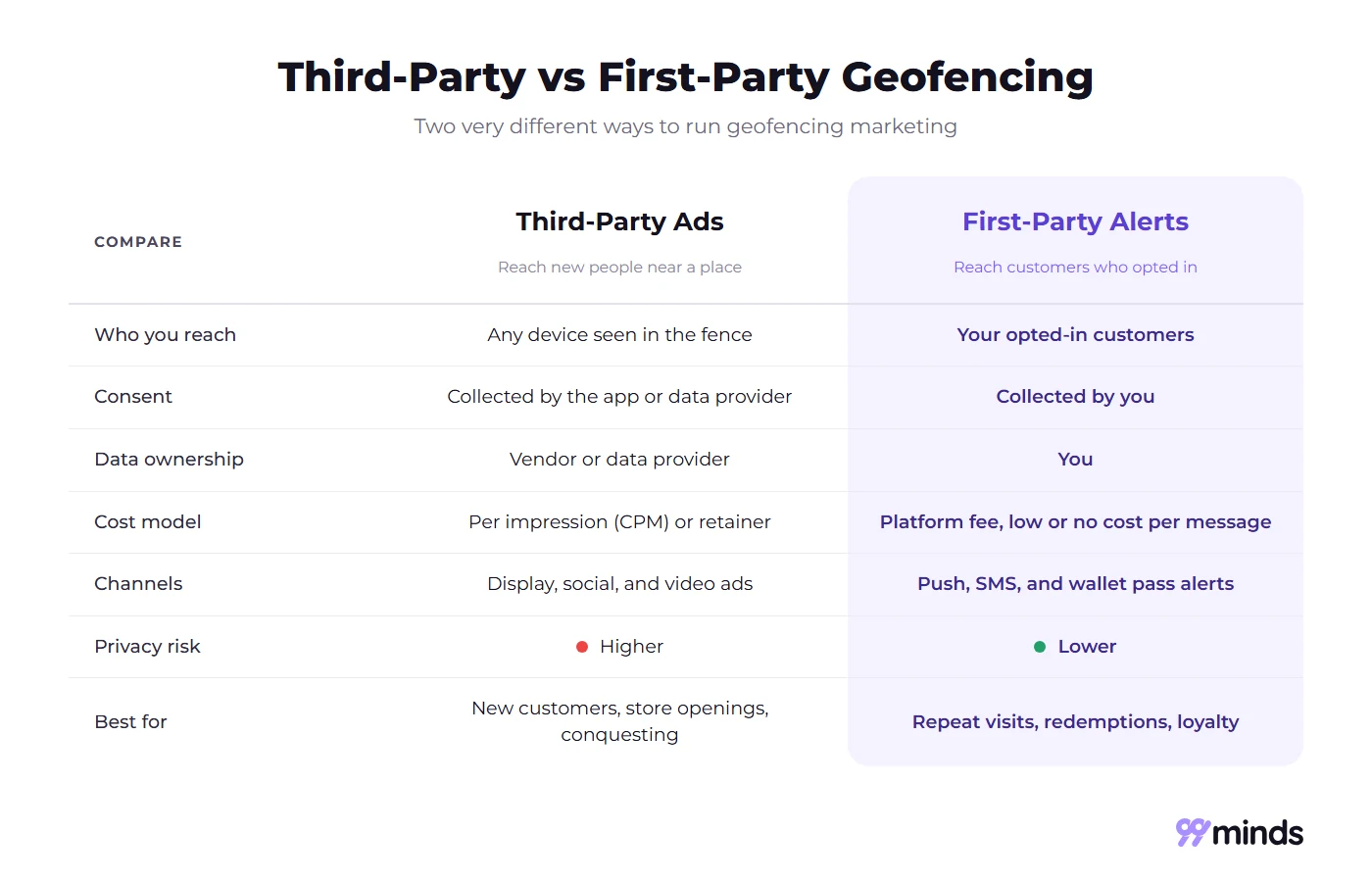
| Third-party geofencing | First-party geofencing | |
|---|---|---|
| Who you reach | Anyone with a device in the fence | Customers who opted in |
| Consent model | Collected by the app or data provider | Collected by you |
| Data ownership | Vendor or data provider | You |
| Cost model | Per impression (CPM) or a monthly retainer | Platform fee, with low or no per-message cost |
| Typical goal | Awareness, new customers, conquesting | Repeat visits, redemptions, loyalty |
| Privacy risk | Higher | Lower |
| Setup effort | Vendor setup and creative | Locations and messages in your platform |
Why Is Geofencing Marketing a Retention Tool, Not Just an Ad Tactic?
Marketing geofencing is usually sold as a way to win new shoppers. The bigger payoff often sits with the ones you already have. According to Harvard Business Review, acquiring a new customer is “anywhere from five to 25 times more expensive than retaining an existing one.” The same article notes that increasing retention by 5% can raise profits by 25% to 95%.
Existing customers also make geofencing feel helpful instead of creepy. They already opted in, so a nearby alert from a brand they buy from is expected.
You also know far more about them than location. You know their points balance, their gift card balance, any store credit they haven’t used, and when they last visited. “You’re 40 points from a free item” will always beat “10% off today.”
That’s why geofencing works best as one piece of a broader retention marketing plan, alongside email, SMS, and loyalty rewards.
Geofencing marketing without an app
Yes. Most retailers can’t justify building and maintaining an app just to send location alerts. Wallet passes solve that problem.
A loyalty card, gift card, or membership pass saved in Apple Wallet or Google Wallet can be tied to your store locations. According to Apple’s Wallet documentation, Apple’s pass format supports “up to 10” locations per pass that the system uses “to show a relevant pass,”. When the customer is nearby, the pass can surface on their lock screen without them installing anything.
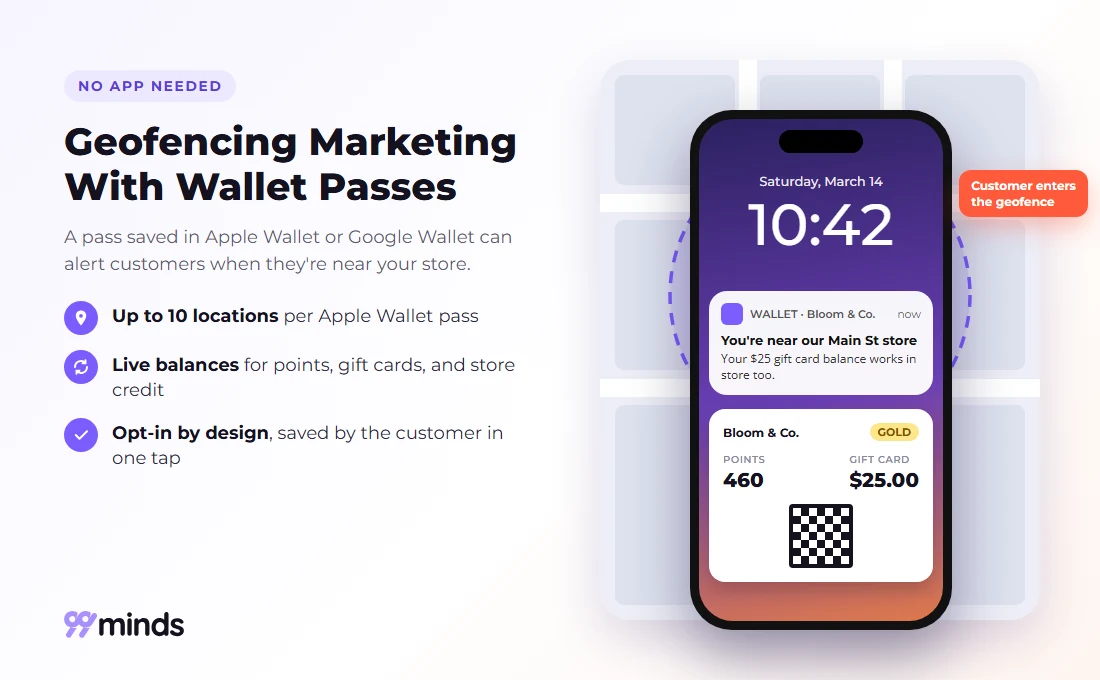
Wallet passes also update in real time, so the alert can show the customer’s current points or balance at the moment it matters. With digital wallet passes, you can run first-party geofencing from the same card customers already use at checkout. It’s one of the most practical ways to put mobile wallet marketing to work in physical stores.
How Do You Set Up a Geofencing Marketing Campaign?
If you’re wondering how to set up geofencing marketing without wasting budget, follow these seven steps. They apply whether you’re running ads to new shoppers or alerts to loyal ones.
Step 1: Pick one goal and one KPI
Decide what a win looks like before you draw a single fence. Good goals for geofencing marketing campaigns include more repeat visits, more reward redemptions, more foot traffic during slow hours, or faster pickup for online orders.
Pick one goal and one number per campaign. If you try to measure everything, you won’t learn anything.
Step 2: Choose your locations and fence size
Start with one or two stores, not your whole network. Then size each fence for its surroundings:
| Location type | Suggested fence size | Why |
|---|---|---|
| Mall unit | The mall building and its parking lot | Shoppers are already in buying mode, and the store itself is too small to fence reliably |
| High street store | About 150 meters | Matches the minimum Android recommends, and catches people walking past |
| Standalone or suburban store | A short drive-time area | Customers arrive by car, so the trigger needs to fire before they pass the turn |
| Event or pop-up | The venue footprint | The fence only needs to exist for the dates of the event |
| Competitor site | The competitor's building and lot | Only for third-party ads aimed at new customers |
Treat these sizes as starting points to test, not rules. Keep in mind that Android works best with a radius of at least 100 to 150 meters.
Step 3: Decide who you’re targeting
Third-party campaigns target anyone seen inside the fence. First-party campaigns target customers on your list, which means you can segment them.
Useful segments include loyalty tier, days since last visit, points balance, and whether they hold an unused gift card or store credit. A VIP who visits weekly needs a different message from a member who hasn’t been in for three months.
Step 4: Choose your delivery channel
This is the step that decides how to do geofencing marketing in practice:
- Programmatic ads: reach new audiences, but you pay per impression and can’t personalize much
- App push notifications: rich and personal, but only work if customers installed your app and allowed location access
- SMS: high visibility for geofencing mobile marketing, but needs separate SMS consent and can feel intrusive if overused
- Wallet pass alerts: no app needed, show live balances, and sit on the lock screen next to the customer’s payment cards
Step 5: Write the offer and the message
Keep messages short, specific, and tied to the customer’s own data. Here are five templates you can adapt:
- Arrival: “You’re near our Main St store. Double points on everything today.”
- Dwell: “Still browsing? Your $25 gift card balance works in store too.”
- Exit: “Thanks for visiting! Enjoy 2x points on your next online order.”
- Balance reminder: “Your $15 store credit expires Friday. Use it while you’re nearby.”
- Win-back: “We’ve missed you. Here’s a free coffee with any purchase this week.”
Step 6: Set frequency caps and quiet hours
Too many alerts turn a helpful nudge into a reason to opt out. A sensible starting point is one alert per customer, per location, per week, with no alerts before 9am or after 8pm local time. Adjust from there based on opt-out rates and redemptions.
Step 7: Launch with a holdout group
Keep 10% to 20% of eligible customers out of the campaign. They don’t get alerts, but you track their behavior the same way. Comparing the two groups shows the true lift from geofencing, rather than visits that would have happened anyway.
What Geofencing Promotions Work Best for Retailers?
The best geofencing marketing strategy matches each trigger to a specific goal. These seven geofencing promotions cover both retention and acquisition:
| Play | Trigger | Offer | Goal | Channel |
|---|---|---|---|---|
| 1. Points multiplier | Entry | Double or triple points today | More visits, bigger baskets | Wallet pass or app push |
| 2. Gift card balance reminder | Entry or dwell | "Your balance works in store" | Redemption and extra spend | Wallet pass |
| 3. Store credit expiry nudge | Entry | "Your credit expires soon" | Recover credit, drive a visit | Wallet pass or SMS |
| 4. Pickup check-in | Entry | "We see you, your order is coming out" | Faster pickup, add-on sales | App push or SMS |
| 5. Win-back | Entry after 60 to 90 days away | A small welcome-back reward | Reactivate lapsed members | Wallet pass or SMS |
| 6. Birthday reward | Entry during birthday month | Reward unlocked in store | Emotional loyalty, a visit | Wallet pass |
| 7. Competitor conquesting | Entry at a competitor site | An intro offer for new customers | New customers | Programmatic ads |
Here’s why each play works:
- A points multiplier gives members a reason to walk in right now, and it rewards spending rather than giving away margin. It works best when your loyalty program already has clear reward tiers
- Unspent gift card balances are money customers have already paid. A reminder near the store turns that balance into a visit, and many shoppers spend more than the card value. Your gift card program data tells you who holds a balance
- Unused store credit from returns is easy to forget. An expiry nudge recovers the sale and brings the customer back in person
- A pickup check-in removes waiting at the counter, which is one of the simplest wins in any omnichannel retail strategy
- Win-back alerts reach lapsed members at the one moment they’re physically close, which makes them far more timely than a generic email. They’re a practical way to tackle customer churn before it becomes permanent
- Birthday rewards feel personal, and tying them to a store visit turns a coupon into an occasion
- Competitor conquesting is the one play aimed at new customers. Use it sparingly, and only with third-party ads
What Are Some Real Geofencing Marketing Examples?
Here are three geofencing marketing examples worth studying, plus a hypothetical retail setup.
Burger King’s Whopper Detour
From December 4 to 12, 2018, Burger King unlocked a one-cent Whopper in its app for anyone within 600 feet of most McDonald’s locations, as Marketing Dive reported. The app then sent them to the nearest Burger King to pick it up. The stunt drove 1.5 million app downloads and generated 3.5 billion earned media impressions, according to Adweek, and it won the Direct Grand Prix at Cannes in 2019.
What you can copy: the offer was simple and the location trigger was the whole joke. A clear, single offer beats a clever but complicated one.
Nike SNKRS Stash
Nike’s SNKRS app let fans buy limited-edition sneakers only after they traveled to a set location in their city, like Washington Square Park in New York, as TechCrunch reported in 2017. Nike hasn’t published results, but the idea is useful.
What you can copy: use location to unlock something exclusive for loyal fans, not just to discount. A members-only reward that appears only in store gives people a reason to show up.
Sephora’s in-store messaging trial
Sephora tested beacons, a close cousin of geofencing, to send in-store messages in its San Francisco stores. During the trial, 82% of customers chose to receive the messages, BuzzFeed News reported.
What you can copy: when the messages are useful and come from a brand people already like, most customers will opt in. Ask clearly and give them a reason.
Hypothetical: a six-store apparel brand
This example is illustrative, not a real case study. Picture an apparel brand with six stores and a loyalty program saved to customers’ wallets.
It runs three plays from the table: a points multiplier on entry for members, a gift card balance reminder during dwell, and a win-back for members who haven’t visited in 90 days. It holds out 15% of members as a control group and compares repeat visits and redemptions between the two groups after eight weeks.
How Much Does Geofencing Marketing Cost?
Geofencing marketing cost depends far more on the model you choose than on the technology. Published price ranges mostly come from agencies and vendors selling the service, so treat any quote as a starting point for negotiation, not a benchmark.
| Model | How you pay | What drives the price |
|---|---|---|
| Programmatic geofencing ads | Per thousand impressions (CPM) | Number of fences, audience size, ad format, data fees |
| Agency-managed campaigns | Monthly retainer plus media spend | Number of locations, creative, reporting |
| Radius targeting in Google Ads and Meta | Your own daily or campaign budget | Bids, competition, radius size |
| First-party push, SMS, or wallet alerts | Platform subscription, plus per-message fees for SMS | List size, number of locations, features |
A note on self-serve ads: radius targeting isn’t the same as a true geofence. Google Ads, for example, requires “a radius of at least 1 km around any given location,” according to Google Ads Help, which is far wider than a single store.
So, how much does geofencing cost for a small chain? Here’s how to do the math with your own quotes.
Say a three-store brand runs ads in three fences and buys 100,000 impressions per fence each month. That’s 300,000 impressions. If a vendor quotes a $10 CPM (an assumption for the math, not a benchmark), the media cost is 300,000 ÷ 1,000 × $10 = $3,000 a month, before creative and fees.
A first-party program works differently. You pay for the platform, and the alerts themselves cost little or nothing, so cost doesn’t climb with every message. That’s a big reason first-party geofencing is the better fit for retention.
Don’t forget the hidden costs: creative for each offer, data or audience fees on programmatic buys, and attribution tools to prove store visits.
Is Geofencing Marketing Legal in the US?
Yes, geofencing marketing is legal in the US, but the rules have tightened. Consumers are wary too: 81% of Americans say they’re concerned about how companies use the data they collect, according to Pew Research Center.
FTC actions on location data
The Federal Trade Commission has taken action against several location data brokers:
- X-Mode Social and Outlogic (January 2024): barred from sharing or selling sensitive location data, per the FTC
- InMarket Media (January 2024): prohibited from selling or licensing any precise location data, per the FTC
- Gravy Analytics and Venntel (December 2024): charged with selling data about visits to health-related locations and places of worship, per the FTC
- Mobilewalla (December 2024): prohibited from selling sensitive location data, per the FTC
- Kochava (sued in 2022): a proposed settlement in May 2026 would ban it from selling sensitive location data, per the FTC
The pattern is clear. Regulators focus on location data collected without real consent and on visits to sensitive places.
State privacy laws that cover precise geolocation
A growing number of state privacy laws treat precise geolocation as sensitive data:
- Opt-in consent required: Virginia, Connecticut, Texas, and Oregon define precise geolocation as location within 1,750 feet, and Colorado added it in 2025 at 1,850 feet
- Right to limit: California treats precise geolocation (within 1,850 feet) as sensitive personal information that consumers can tell businesses to limit
- Stricter rules: Maryland bans the sale of sensitive data and allows processing only when strictly necessary, while Oregon has banned selling precise geolocation data since January 1, 2026
Washington goes further. Its My Health My Data Act makes it unlawful to put a geofence around an in-person healthcare provider to track consumers or send them health-related ads, per RCW 19.373.080. The law defines a geofence as a boundary of 2,000 feet or less from the location, under RCW 19.373.010.
Geofencing compliance checklist
- Get clear opt-in consent for location before you send any location-based message
- Explain in plain language why you use location and what customers get in return
- Set frequency caps so alerts stay helpful
- Never fence sensitive locations like clinics, places of worship, or shelters
- Keep location data only as long as you need it
- Make opting out as easy as opting in
- Check how any ad vendor or data provider collects consent
First-party, opt-in triggers are the lower-risk path because you control consent from start to finish. This section is general information, not legal advice, so check your plans with counsel.
How Do You Measure Geofencing Campaign Results?
Clicks and impressions only tell part of the story. Match your KPIs to the type of campaign you’re running:
| Acquisition KPIs | Retention KPIs |
|---|---|
| Impressions in the fence | Repeat visit rate |
| Click-through rate | Reward redemption rate |
| Store visit lift | Gift card redemption rate |
| Cost per store visit | Store credit recovered |
| New customer sign-ups | Average order value and customer lifetime value |
To read results, compare your exposed group with the holdout group from Step 7. Say 18% of exposed members visited in the month and 14% of the holdout group did. The difference of four percentage points is the lift you can credit to geofencing, not the full 18%.
Retention KPIs are easier to trust when in-store redemptions flow back into your loyalty data. When your POS syncs every points redemption, gift card swipe, and store credit use to the customer’s record, you can see which alerts actually turned into purchases. That closes the loop that most geofencing ads leave open, and it helps you grow your base of repeat customers over time.
How Does 99minds Support Geofencing Marketing?
99minds lets retailers run first-party geofencing marketing without building an app. Here’s how it fits together:
- Location-triggered wallet passes: loyalty cards, gift cards, and membership passes in Apple Wallet and Google Wallet can alert customers when they’re near your stores
- Live balances: passes show current points, gift card balances, and store credit, so every alert is personal
- One platform: loyalty, gift cards, store credit, and coupons run together, so the promotions in this guide use the same customer data
- POS sync: integrations with platforms like Shopify POS and others send in-store redemptions back to the customer’s record for accurate measurement
Conclusion
Geofencing marketing works best when it’s aimed at people who already know you. First-party geofencing is the smarter choice for retention, because you own the consent and the data. Start with one store and one promotion, keep a holdout group so you can prove real lift, and expand only what works. Along the way, stay opt-in, cap your alerts, and steer clear of sensitive locations.
The best geofence surrounds customers who already have your loyalty card, gift card, or store credit in their pocket. Wallet passes let you reach them at the right moment without asking them to download anything.
Want to see location-triggered wallet passes connected to your loyalty program, gift cards, and store credit? Book a demo with 99minds and we’ll walk you through a setup for your stores.
Frequently Asked Questions on Geofencing Marketing
How much does geofencing marketing cost?
It depends on the model. Third-party geofencing ads are usually priced per thousand impressions or through an agency retainer plus media spend, so the cost grows with your reach. First-party alerts sent through push, SMS, or wallet passes are usually covered by a platform subscription, with little or no cost per message, which makes them cheaper for retention.Is geofencing marketing legal?
Yes, geofencing marketing is legal in the US when you follow the rules. Several states, including Virginia, Connecticut, Texas, Oregon, and Colorado, require opt-in consent to process precise geolocation data. Washington bans geofences around healthcare providers for tracking or health-related ads, and the FTC has acted against brokers that sold sensitive location data.How do you do geofencing advertising?
Start by drawing a fence around a location, usually at least 100 to 150 meters across for reliable triggers. Next, pick your audience: anyone in the fence for third-party ads, or opted-in customers for first-party alerts. Then write a short, specific offer, set frequency caps, and keep a holdout group so you can measure real lift.What is an example of geofencing marketing?
Burger King's Whopper Detour is the best-known example. In 2018, the brand offered a one-cent Whopper in its app to anyone within 600 feet of most McDonald's locations, then sent them to a Burger King to collect it. The campaign drove 1.5 million app downloads, as Adweek reported.How accurate is geofencing marketing?
Accuracy depends on the signal the phone is using. GPS is strong outdoors, while Wi-Fi and cell towers help indoors but are less precise. That's why Android's developer guide recommends a minimum geofence radius of 100 to 150 meters for best results. Very small fences, like a single storefront, tend to miss or misfire.Does geofencing drain a customer's smartphone battery?
Not much, in most cases. Phone operating systems manage geofencing in the background and check location in batches to save power. That's also why alerts can arrive a few minutes late. Android, for example, says background geofence events usually arrive within two to three minutes when background location limits apply.What's the difference between active and passive geofencing?
Active geofencing relies on an app that's tracking the phone's location, either while open or with background location permission, so it can react quickly but uses more power. Passive geofencing lets the operating system watch for boundary crossings in the background, often with Wi-Fi and cell signals. It's slower and less precise but uses less battery.Can users block geofencing ads?
Yes. Customers can turn off location access for an app, limit apps to location only while in use, block ad tracking on iPhone, or switch off notifications. That's why consent matters so much. Alerts from brands customers chose, like a loyalty pass in their wallet, are far less likely to be blocked than ads from unknown advertisers.Boost Customer Engagement with 99minds. The Ultimate Gift Card & Loyalty Solution!
Sign up for free