We're building the future of agentic promotions. Sign up for early access!
Sign up
We're building the future of agentic promotions. Sign up for early access!
Sign up 
Here’s a scenario that plays out thousands of times a day: a customer discovers your product on Instagram, saves it to their wish list on your app, and drives to your store to see it in person. They ask the associate about their loyalty points balance. Blank stare. No history. No context. Just friction at the exact moment they were ready to buy.
That disconnect is what omnichannel retail exists to fix. And according to a Harvard Business Review study of 46,000 shoppers, omnichannel customers spend 10% more per online order and make 23% more repeat shopping trips within six months than single-channel shoppers. The gap between brands that connect their channels and brands that don’t isn’t just an experience problem; it’s a revenue problem.
In this guide, you’ll learn what omnichannel retail is, how leading brands pull it off, and how to build your own strategy using a realistic 30/60/90-day roadmap.
Omnichannel retail is a customer-first strategy where every sales and service channel, including your online store, mobile app, physical location, social media, and marketplaces, is integrated so that the shopping experience is consistent and continuous regardless of which channel a customer uses.
The critical word is integration. In a true omnichannel setup, a customer’s cart, purchase history, loyalty points, and preferences travel with them across every touchpoint. The channel changes; the customer experience doesn’t.
This is what separates omnichannel retailing from traditional retail approaches. The focus isn’t on managing channels in isolation. It’s on managing the customer relationship across all of them simultaneously.
Here’s what omnichannel retail looks like when it’s working the way it should:
A customer sees your new sneaker colorway on TikTok Shop. They tap through to your website, browse a few options, and add a pair to their cart. That evening, they open your app and the cart is still there. They check their loyalty points, realize they have enough for a discount, and complete the purchase, selecting BOPIS (buy online, pick up in-store) for same-day pickup.
When they arrive at your store, the associate greets them by name, hands over the order, and mentions they’ve just crossed into the next loyalty tier. The customer touched five different channels and felt like they dealt with one brand the entire time.
That experience doesn’t happen by accident. It requires your ecommerce platform, POS system, inventory management, and loyalty infrastructure to be reading from the same source of truth in real time.
These terms get used interchangeably, but they describe very different realities.
Multichannel retail: Your brand is present on multiple channels: a website, an Instagram Shop, a physical store. But each operates independently. Inventory systems don’t talk to each other. A discount code generated online doesn’t work in-store. A customer who complained via email is unrecognized when they walk through the door. The channels coexist; they just don’t communicate.
Omnichannel retail: The channels are connected. A return initiated online is visible to the store associate. Loyalty points earned in-store appear in the customer’s app. An out-of-stock notification triggers a “find it in-store nearby” prompt automatically. The customer experience is continuous because the data is continuous.
The simplest way to think about it: multichannel is about reach. Omnichannel is about coherence.
Unified commerce takes omnichannel one step further. Instead of integrating multiple separate systems via APIs, it collapses everything (ecommerce, POS, inventory, and customer data) into a single backend platform, an architecture closely related to headless commerce.
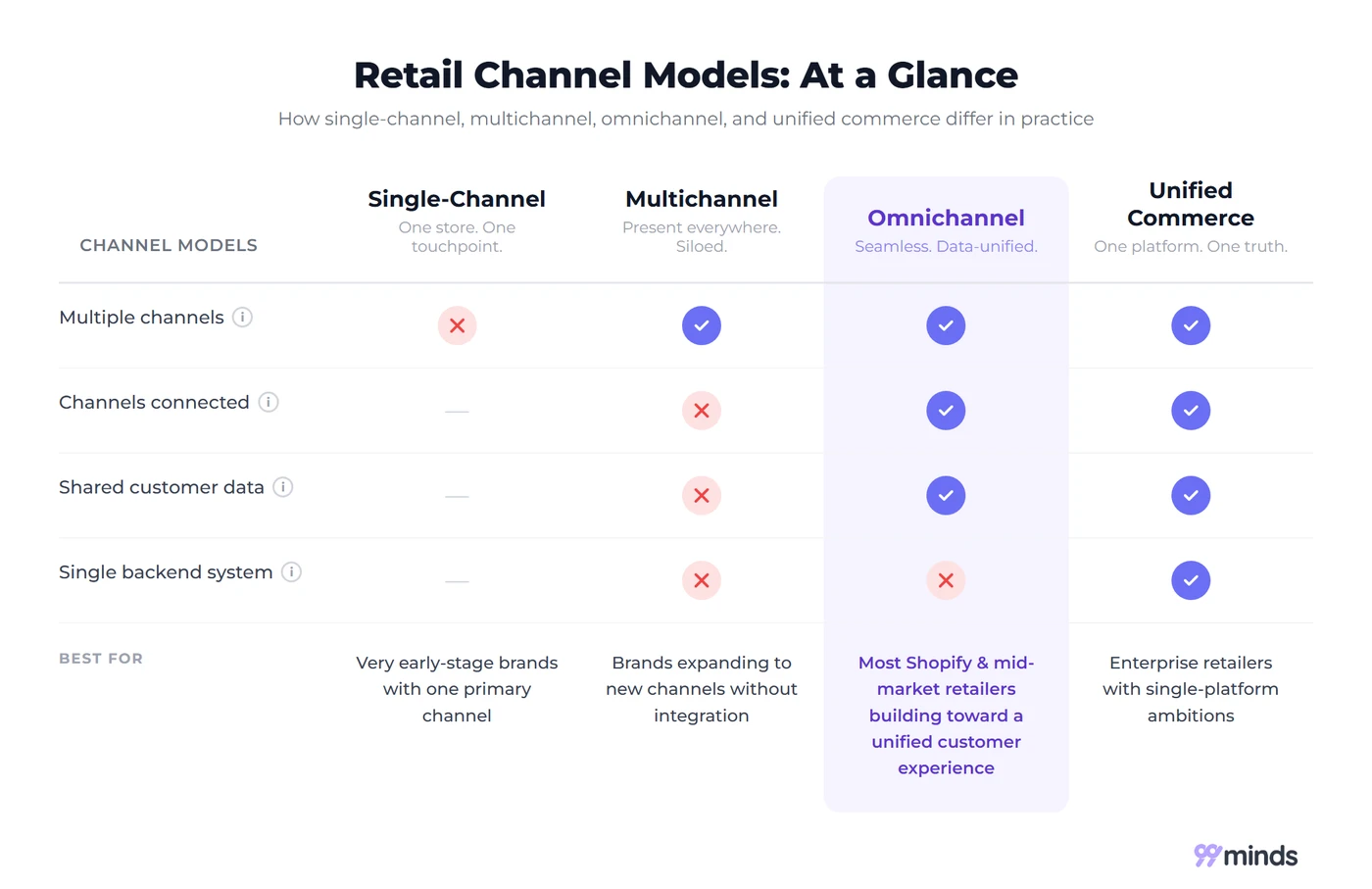
For most Shopify merchants and mid-market retailers, omnichannel is the right destination today. Unified commerce is the long-term horizon. The important thing is to be moving in that direction, not standing still.
The business case is straightforward. Here’s what the data actually says:
Higher revenue per customer: Omnichannel shoppers spend 10% more per online order than single-channel shoppers and make 23% more repeat shopping trips within six months (Harvard Business Review). When customers can engage with your brand seamlessly across channels, they give more of their wallet to you.
Better retention: A widely-cited Aberdeen Group study found that businesses with strong omnichannel engagement retain 89% of their customers on average, compared to just 33% for businesses with weak omnichannel engagement. Building solid customer retention strategies starts with eliminating the friction that sends customers elsewhere.
Deeper customer data: When channels are unified, so is your data. You get a complete picture of how customers behave across touchpoints, which makes segmentation, personalization, and remarketing dramatically more effective than any single-channel view ever could.
Inventory efficiency: Real-time inventory visibility across channels reduces out-of-stock incidents, prevents overselling, and makes fulfillment options like BOPIS possible. Your physical store stops being just a retail space; it becomes a fulfillment hub.
Competitive differentiation: 73% of consumers use multiple channels during a single shopping journey (Harvard Business Review). Retailers who connect those channels win. Those who don’t lose the sale, often to a competitor who made the same journey feel effortless.
Seeing how leading brands execute this is the fastest way to understand what you’re actually building toward.
Starbucks: Starbucks Rewards is the textbook omnichannel loyalty example. Stars earned with a card tap in-store sync to the app in seconds. A mobile order placed at 8:47 a.m. is ready when you walk through the door at 8:51. Promotions are tailored based on your actual purchase history across every channel, not just your last visit. The app, the in-store experience, and the brand feel like one thing because they’re built on a unified loyalty identity layer.
Nike: Nike members get a single identity across Nike.com, the Nike app, and Nike retail stores. Members can reserve products via the app before visiting a store, scan in for exclusive access to drops, and earn rewards at every touchpoint. Associates can pull up a member’s full profile and purchase history on the floor. Nike’s omnichannel strategy is built around the member ID as the connective thread between every channel.
Target: Target Circle loyalty points work identically whether a customer shops at Target.com, on the Target app, or in-store. The Drive Up service, where you order on the app and a team member brings it to your car in under two minutes, now accounts for a significant portion of Target’s fulfillment volume. BOPIS and in-store returns for online orders have become standard expectations that Target has met with real infrastructure investment.
Sephora: Sephora’s Beauty Insider program integrates in-store and online purchase history so completely that store associates can view a customer’s online wish list on a tablet and pick up the conversation exactly where it left off online. Rewards are redeemable across all channels, and tier status follows customers everywhere.
Warby Parker: Warby Parker started as a pure ecommerce brand and expanded into physical retail. Their Home Try-On program, an online-first experience, drove customers into stores. Today, their stores are fully integrated with their digital presence: the same inventory, the same customer profiles, the same brand experience. It’s a clear example of how DTC brands can build an omnichannel presence without starting from a legacy retail setup.
Most omnichannel guides give you a list of five steps with no timeline and no definition of what “done” looks like. This roadmap is different. It’s designed for ecommerce and Shopify brands that want a realistic, sequenced path.
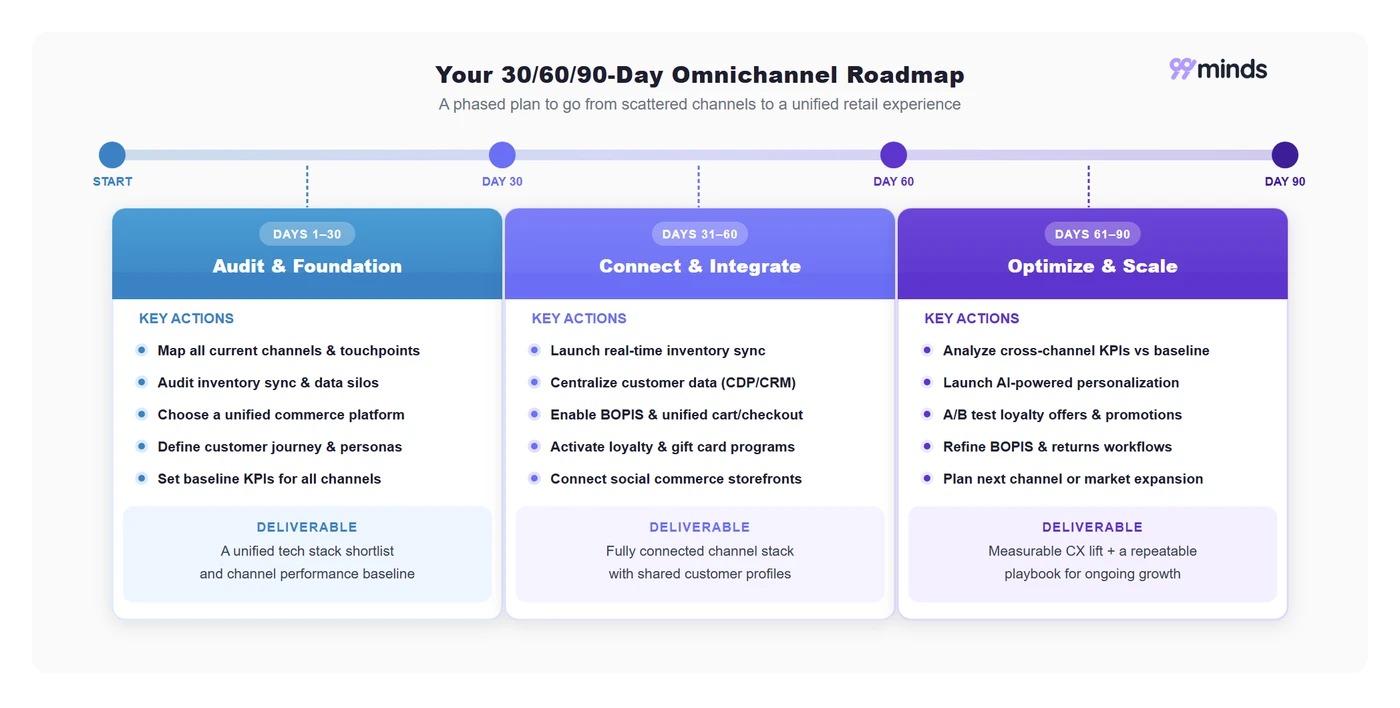
Start by getting clear on the current state before changing anything.
Map your channels: List every place a customer can interact with your brand: website, mobile app, social media, marketplaces, physical store, email, and SMS. For each channel, note who owns it, what data it collects, and whether that data is shared with any other channel.
Identify the breaks: Walk through your own customer journey from discovery to repeat purchase. Where does data stop flowing? Where does a loyalty reward fail to carry over? Where would a returning customer feel like a stranger? These breaks are your integration priorities.
Unify your customer data: The foundation of every omnichannel strategy is a single customer record. For Shopify merchants, this typically starts with a loyalty or CRM platform that can aggregate cross-channel behavior into one profile.
Deliverable: A channel audit document with a prioritized list of integration gaps ranked by customer impact.
Now you start closing the gaps.
Integrate inventory: Real-time inventory visibility across all channels is non-negotiable. For Shopify merchants, Shopify’s multi-location inventory is the starting point. Make sure your online store and POS read from the same stock levels.
Launch cross-channel loyalty: Deploy a loyalty program that works online and in-store from day one. Ensure your gift cards and store credit are channel-agnostic. This single step eliminates one of the most common omnichannel friction points immediately.
Enable BOPIS: If you have a physical location, enabling buy online, pick up in-store is the highest-ROI single capability you can add. It drives foot traffic, increases basket size through in-store upsells, and gives customers the convenience of digital ordering with the immediacy of in-store fulfillment.
Deliverable: At least two channels fully integrated, for example, your Shopify online store and POS sharing a unified loyalty and inventory system.
Once the foundation is solid, layer on top of it.
Personalize across channels: Use your unified customer data to personalize email campaigns, SMS messages, and in-store associate interactions based on cross-channel purchase history. A customer who bought online twice and visited in-store once deserves a different message than a customer who’s only ever bought in-store.
Add social commerce: Connect your Shopify store to Instagram Shopping and TikTok Shop. Your product catalog, inventory, and order data should flow back to the same backend that powers your website and POS, not live in a separate silo.
Measure and iterate: Pull your KPIs (more on those below) and set a weekly review cadence. An omnichannel experience is never fully “done”; it improves with every data point you gather.
Deliverable: A cross-channel attribution dashboard and your loyalty program actively capturing transactions across all channels.
The omnichannel landscape is shifting fast. Here’s what’s defining the space right now.
AI has moved from buzzword to practical omnichannel tool. In 2026, leading retailers are using AI to personalize product recommendations, email timing, and in-store associate suggestions in real time, all pulling from the same unified customer data.
The differentiator is that AI working with cross-channel data is dramatically more powerful than AI working with single-channel data. A model that knows a customer’s in-store frequency, online browse behavior, and loyalty redemption history can surface the right product in the right channel at the right moment. 71% of consumers expect personalized experiences (McKinsey’s Next in Personalization report), and frustration when personalization is absent directly drives churn.
TikTok Shop has grown into a genuine retail channel, not just an advertising placement. U.S. social commerce sales are projected to exceed $100 billion by 2026 (eMarketer). For omnichannel merchants, the shift is treating TikTok Shop, Instagram Shopping, and Pinterest Shopping as channels within your omnichannel stack, not as separate marketing activities that exist outside it.
That means TikTok Shop orders should flow into the same order management system as your Shopify orders. Inventory should decrement from the same pool. And if a TikTok Shop customer becomes a repeat buyer on your website, their purchase history should be unified in your loyalty program.
WhatsApp, SMS, and AI chat have evolved from support channels into purchase-complete channels. A customer can now discover a product, ask questions, complete a purchase, and track delivery without leaving a messaging app.
For omnichannel retailers, this means messaging needs to connect to the same inventory, loyalty, and order management infrastructure as every other channel. A customer who buys via WhatsApp should earn loyalty points. A discount code issued via SMS should be redeemable in-store.
Buy online, pick up in-store (BOPIS) has become a baseline expectation for customers with access to a physical location. The fulfillment conversation has expanded to include BORIS (buy online, return in-store): accepting online returns in-store and issuing instant store credit or exchanges.
BORIS is a high-value omnichannel touchpoint. A customer who comes in for a return and leaves with store credit applied to a new in-store purchase is an omnichannel success story. According to Salesforce’s Connected Shoppers Report, 64% of retailers now offer in-store returns for online purchases, a capability that’s quickly becoming table stakes rather than a differentiator.
Omnichannel is worth building, but it’s not without real difficulty. Here are the obstacles most retailers run into:
Data silos and legacy systems: Most retailers didn’t build their ecommerce, POS, and fulfillment systems to communicate with each other. Integrating them requires middleware, custom APIs, or a platform migration. This is the biggest technical barrier for most mid-market brands.
Inventory accuracy: Real-time inventory across channels requires constant synchronization. When counts are off, you get overselling online, unfulfilled BOPIS orders, and customers who drove to your store for a product that wasn’t actually there.
Cross-channel attribution: When a customer touches five channels before converting, which channel gets credit for the sale? Last-click attribution massively undercredits in-store touchpoints and social discovery. Building an accurate cross-channel attribution model is genuinely hard.
Organizational alignment: Omnichannel often fails not because of bad software but because in-store and ecommerce teams have separate P&Ls and no real incentive to cooperate. If BOPIS orders don’t show up in the store manager’s sales numbers, they won’t prioritize processing them. This is a structural and cultural challenge, not a technology one.
Cost and complexity: Connecting multiple systems, training staff across channels, and maintaining consistent brand UX everywhere requires real investment. For smaller brands, the answer is to start narrow: prioritize loyalty program unification and inventory sync first, and expand from there.
These are the six metrics that tell you whether your omnichannel strategy is actually working:
| KPI | What it measures | Target benchmark |
|---|---|---|
| Cross-channel customer LTV | Revenue per customer across all channels combined | Typically 2-3x higher than single-channel LTV |
| BOPIS attachment rate | % of online orders fulfilled via in-store pickup | Industry average: 30-40% of eligible orders |
| Cross-channel retention rate | % of customers active across 2+ channels after 90 days | Target: 60%+ |
| Loyalty program engagement rate | % of transactions tied to a loyalty ID | Target: 50%+ (varies by vertical) |
| Inventory accuracy rate | % of inventory counts accurate across channels | Target: 98%+ |
| Cross-channel attribution | Revenue attributed to multichannel journeys | Track as % of total revenue; should grow quarter over quarter |
The most practical way to pull these numbers is from a unified loyalty or analytics dashboard that aggregates cross-channel transaction data. Platforms like 99minds, an omnichannel loyalty and gift card platform for Shopify and BigCommerce brands, surface loyalty engagement, cross-channel redemptions, and tier progression data in one place, making it easier to see how your omnichannel investments are changing customer behavior.
Here’s the insight that most omnichannel guides miss: technology alone doesn’t make a customer feel recognized across channels. The loyalty program does. For a complete breakdown of how to build one, see our dedicated guide to omnichannel loyalty programs.
Think about what a loyalty program actually is: a persistent customer identity layer. A customer’s profile, points balance, tier status, redemption history, and preferences all live in the loyalty platform. When that platform is connected to every channel, that identity travels with the customer wherever they shop.
That’s the infrastructure that turns omnichannel from a technical exercise into a human experience.
When your loyalty program is truly omnichannel, here’s what becomes possible:
The loyalty ID is the thread that stitches every interaction into one continuous customer relationship. Without it, omnichannel is a bunch of connected systems. With it, it becomes a recognizable, personal experience. If you want to go deeper on how retail loyalty programs work and how to structure one, we’ve covered that separately.
Gift cards and store credit are two of the most underrated omnichannel tools available, and they’re also where a lot of retailers quietly break their own omnichannel promise.
Here’s the problem: many ecommerce platforms issue digital gift cards that can only be redeemed online. The in-store POS runs a separate gift card system. The result: a customer who receives a gift card as a birthday reward tries to use it in-store and gets told it’s “online only.” Trust breaks. The experience breaks.
The same applies to store credit. If a customer makes an online return and receives store credit, that balance should be immediately spendable in-store. If it isn’t, you’ve created friction at the exact moment the customer was ready to come back and spend.
Fixing this is one of the highest-leverage, lowest-complexity wins in any omnichannel strategy. 99minds Gift Card lets Shopify merchants issue and redeem gift cards for ecommerce and Shopify gift cards across online and offline channels interchangeably, with balances that sync in real time.
99minds Store Credit works the same way: credit issued for an online return is redeemable in your physical store the same day, no manual sync required.
99minds is an omnichannel loyalty, gift card, and customer lifetime value platform built natively for Shopify and BigCommerce. Here’s what that means in practice:
If you’re building an omnichannel strategy on Shopify and want loyalty to be the connective tissue from day one, that’s exactly what 99minds is designed to do.
Omnichannel retail is about one thing: making your customer feel like they’re dealing with one brand, regardless of which channel they’re using at any given moment.
Three things worth keeping from this guide:
First, adding more channels is not the same as going omnichannel. The work is in connecting them, sharing data between them, and ensuring the customer experience is continuous across all of them.
Second, your loyalty program is the most practical mechanism for making customers feel recognized across channels. A unified loyalty identity layer is what turns connected systems into a connected experience. It’s also the piece that most omnichannel guides, and most of your competitors, completely ignore.
Third, you don’t need to do all of this at once. The 30/60/90-day roadmap above gives you a sequenced path that works for brands of any size.
If you’re building on Shopify and want loyalty, gift cards, and store credit to function as one unified cross-channel system from day one, 99minds Loyalty Program is built for exactly that. You can set up your first omnichannel reward in under a day.