We're building the future of agentic promotions. Sign up for early access!
Sign up
We're building the future of agentic promotions. Sign up for early access!
Sign up 
If you type “promo code” into Google right now, you’ll get pages full of Roblox codes, Honey extensions, and Groupon listings. All of it built for shoppers. Almost nothing built for you, the merchant creating the codes.
This guide flips that. Whether you’re setting up your first promotion or trying to fix a campaign that’s leaking margin, here’s everything you need to know: what promo codes are, the five main types, how to run them strategically, and how to stop them from being abused.
A promo code, also called a promotional code, discount code, or coupon code, is an alphanumeric string that customers enter at checkout to unlock a discount or offer. The terms are used interchangeably across platforms; functionally, they’re identical.
Here’s how the mechanics work: when a customer enters a code, the system validates a set of conditions before applying the benefit. Those conditions can include a minimum order value, an expiry date, eligible products, a usage limit per customer, or regional restrictions. If all conditions are met, the discount applies to the subtotal.
One important distinction worth making early: promo codes are different from automatic discounts. Automatic discounts apply without any customer action, while promo codes require the customer to actively enter a code. That difference matters for tracking. Because each code can be tied to a specific campaign, audience, or channel, you can measure exactly which promotion drove which sale. Automatic discounts can’t give you that level of attribution.
For a deeper look at how promotional codes fit into a broader marketing strategy, check out our dedicated guide.
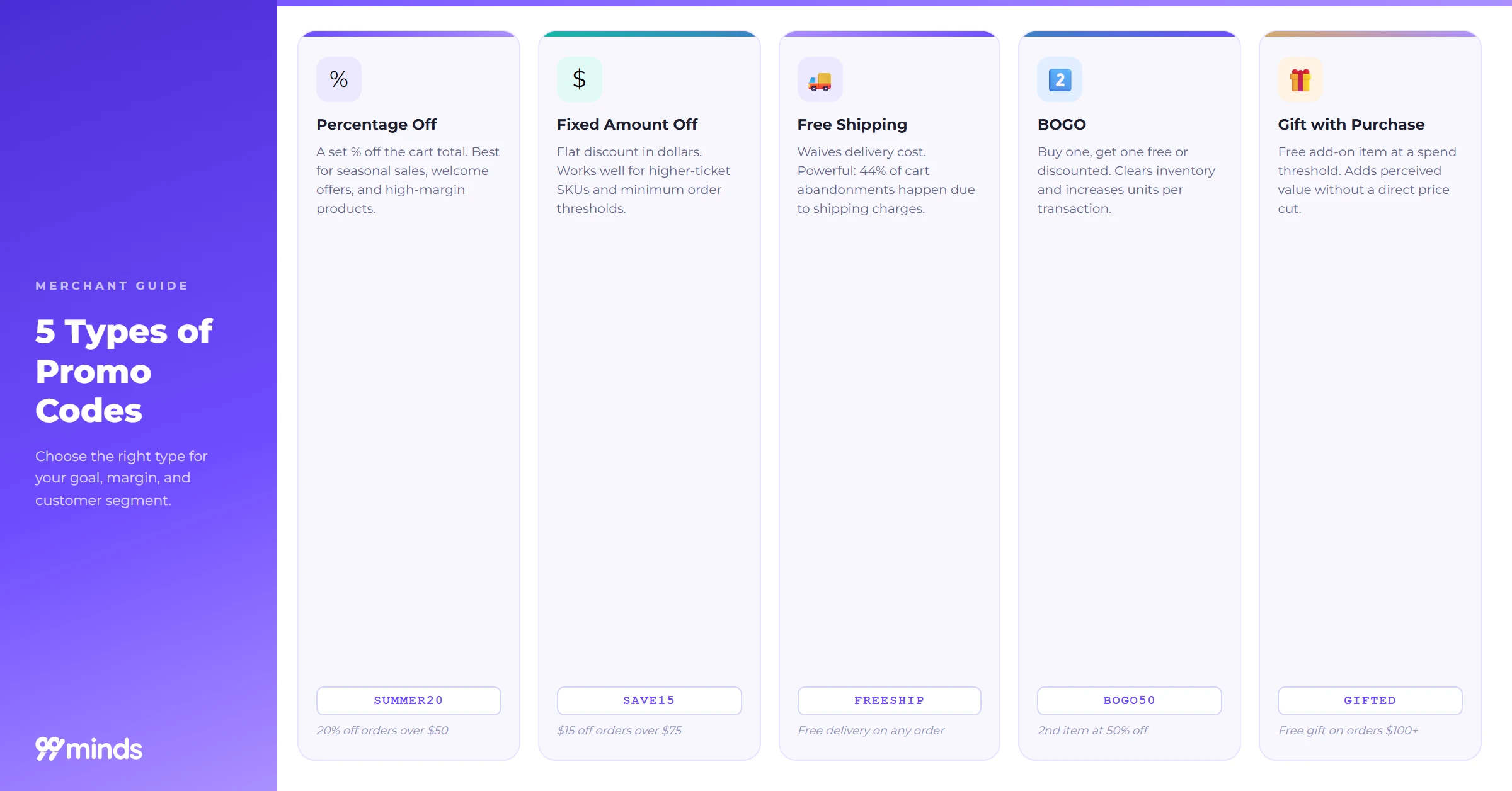
There are two useful ways to categorize promo codes: by what kind of discount they offer, and by who can access them.
1. Percentage off
The most common type. Customers get a set percentage off their total, like 10% or 20% off. Percentage discounts work well for seasonal campaigns, new customer welcome offers, and driving conversions on full-priced inventory. Example: SUMMER20 for 20% off orders over $50.
2. Fixed-amount off
A flat dollar (or currency) amount off the total, like $10 or $15 off. These work better for higher-priced products or when you want to set a clear minimum order threshold. Example: SAVE15 for $15 off orders over $75.
3. Free shipping Waives the delivery cost entirely or up to a cap. Free shipping codes are especially powerful because shipping costs are one of the top reasons shoppers abandon their cart: 48% of cart abandonments happen because extra costs like shipping, taxes, and fees appear too high at checkout. Tying free shipping to a minimum order value can also increase average order value at the same time.
4. Buy One Get One (BOGO) The customer gets a free or discounted item when they buy one at full price. BOGO deals are useful for clearing slow-moving inventory and increasing units per transaction.
5. Gift with purchase Customers receive a free add-on item when they hit a spending threshold. Think of it as a loyalty reward built into a promo: it adds perceived value without a straightforward price cut.
For more inspiration on structuring these, see our list of discount code ideas that have worked well for e-commerce stores.
Beyond discount type, there’s a second taxonomy that’s underused but highly effective.
Public codes Anyone can see and use these. They’re typically promoted via website banners, social media, and paid ads. Use them for site-wide sales and new customer acquisition, but know that public codes are the most vulnerable to ending up on coupon aggregator sites.
Private codes Distributed to a specific segment, like email subscribers, loyalty members, or VIP customers. More targeted than public codes and far less likely to get scraped and shared.
Restricted (single-use) codes Unique codes generated per customer that can only be redeemed once, tied to one email address. These are your most powerful tool for apology codes, birthday rewards, referral bonuses, and high-value customer retention.
Before getting into best practices, it’s worth grounding the conversation in what the data actually shows:
If you’re dealing with high cart abandonment right now, our cart abandonment guide covers recovery tactics in detail, including how timed promo codes can bring shoppers back.
Having the right type of code is step one. Running it strategically is step two. Here’s what separates a promo code campaign that grows your business from one that just erodes your margins.
Before creating any code, define what you want it to accomplish. Are you clearing slow-moving inventory? Recovering abandoned carts? Rewarding loyal customers? Reactivating lapsed ones? Each goal calls for a different code type, audience, and distribution channel. A code without a goal is just margin loss.
The discount needs to be large enough to motivate action, but not so large it destroys your margin. A useful framework: percentage discounts work better for high-margin products; fixed-amount discounts work better for lower-margin or higher-ticket SKUs. Tiered incentives, like $10 off orders over $50 and $20 off orders over $100, can also nudge customers toward larger baskets.
Without a deadline, customers file the code away and never use it. Expiration dates create urgency. For one-time campaigns, seven to 14 days is a good window. For welcome sequences, 30 days gives enough time to convert without losing urgency. “Expires August 31” will always convert better than “limited time offer.”
Cap each code at one redemption per email address or customer account. This prevents abuse, controls your total discount liability, and keeps the offer reaching the intended audience rather than getting shared on coupon forums.
A 15% off code sent to everyone performs worse than a targeted code sent to the right person. Use behavioral data: send free shipping codes to customers who abandoned due to shipping costs, birthday codes to loyalty members, and win-back codes to customers who haven’t purchased in 90 days. Our guide on customer retention covers audience segmentation in more depth.
Don’t bury a promo code in one email. The same offer should appear across email, SMS, retargeting ads, and, for public codes, your website header and social media. For attribution, create channel-specific code variants: SAVE15FB, SAVE15EMAIL, SAVE15SMS. Now you know exactly which channel drove which conversion.
A/B test discount amounts, code names, expiry windows, and distribution channels. Track redemption rate, average order value lift, and repeat purchase rate post-redemption. Any coupon marketing effort that doesn’t tie back to measurable outcomes is just spending without accountability.
Promo code abuse is one of the most overlooked risks in e-commerce promotions. Unchecked, it erodes margins fast, especially when codes leak to aggregator sites or browser extensions.
Here are six tactics that protect your promotions:
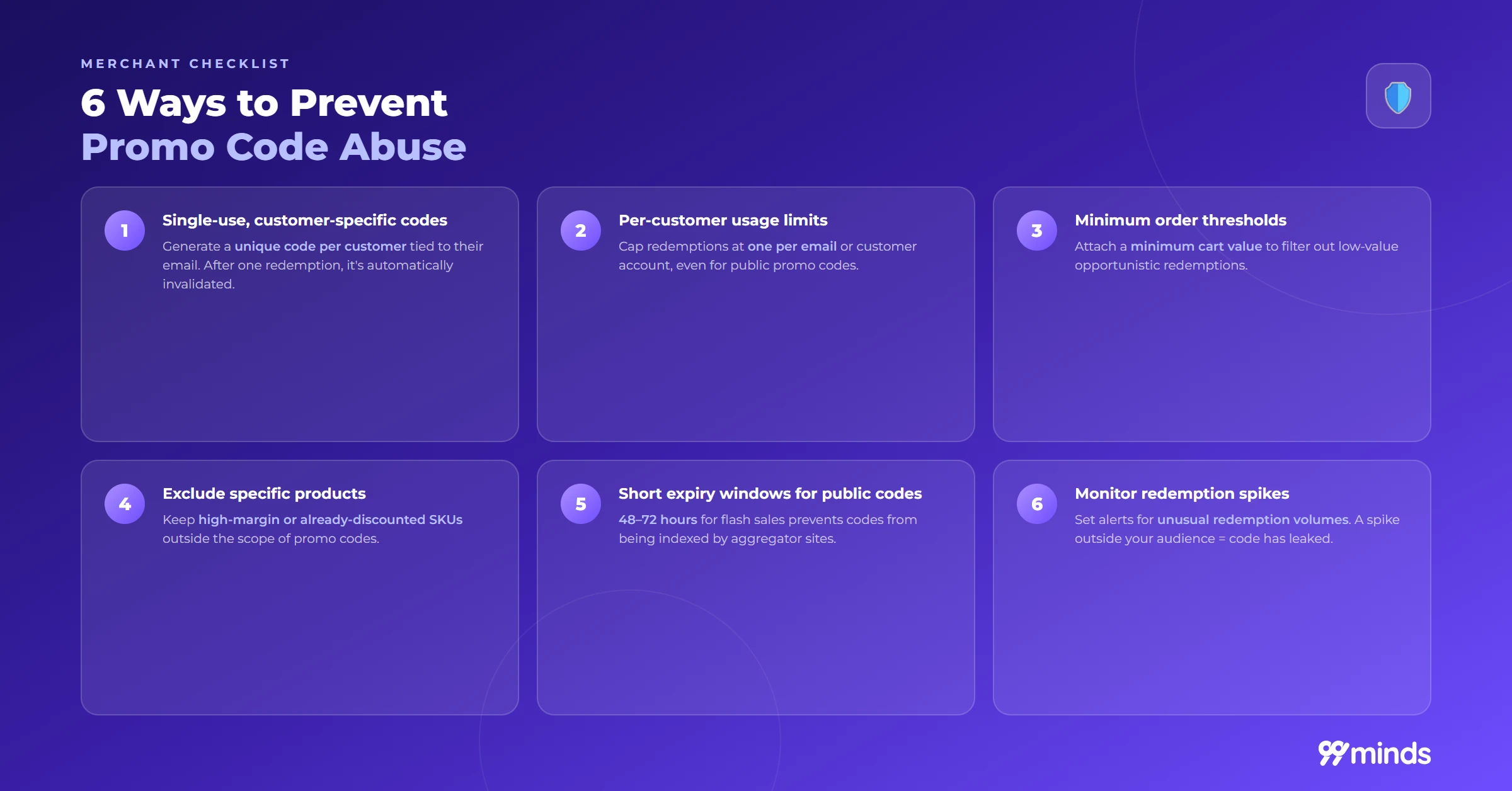
1. Use single-use, customer-specific codes Generate a unique code per customer tied to a specific email. After one redemption, the code is automatically invalidated, making sharing pointless.
2. Set per-customer usage limits Even for public codes, cap redemptions at one per email or customer account. Most e-commerce platforms support this natively.
3. Require minimum order values A threshold requirement filters out opportunistic redemptions on low-value orders and protects your margin without changing the customer experience for genuine buyers.
4. Exclude specific products or categories Keep already-discounted SKUs or high-margin products outside the scope of promo codes. Most platforms let you exclude specific collections or product tags.
5. Set short expiration windows for public codes For flash sales, 48 to 72 hours significantly reduces the chance of a code being indexed by aggregator sites. The shorter the window, the less time there is for leakage.
6. Monitor redemption spikes Set alerts for unusual redemption volumes. A sudden jump in redemptions outside your expected audience is almost always a sign the code has leaked somewhere.
Most merchants treat promo codes as isolated, one-off discounts. The smarter approach is integrating them with a loyalty program so every redemption either earns or spends loyalty points, creating a feedback loop that drives repeat purchases instead of just a single transaction.
99minds Coupons is built for exactly this. Here’s how the integration works in practice:
Point-earning codes: Customers earn loyalty points when they redeem a promo code, reinforcing the repeat purchase habit rather than training shoppers to only buy when there’s a discount.
Point-redemption codes: Loyalty members redeem accumulated points for a unique discount code at checkout, bridging the rewards program directly into the purchase flow.
Referral codes as promo codes: The 99minds Referral Program issues unique promo codes to referrers: the referred customer gets a discount, while the referrer earns points or store credit. Both sides benefit.
Tier milestone codes: When a customer reaches a new loyalty tier, 99minds can automatically issue a promo code as a welcome reward. That’s a retention moment that feels earned, not arbitrary.
With 99minds automated workflows, all of these triggers can be configured once and run on autopilot: no manual code generation, no spreadsheet tracking, and no margin leakage from codes that should have expired.
Promo codes are one of the most versatile tools in e-commerce marketing, but only when they’re tied to a goal, protected from abuse, and built into a system that drives retention rather than one-off discounts.
To recap: choose your code type based on what you’re trying to accomplish, use expiration dates and usage limits to protect your margin, use single-use codes as your first line of defense against abuse, and, when connected to a loyalty program, your promo codes become a long-term retention engine rather than a recurring discount habit.
If you’re ready to build a smarter promotions engine, 99minds Loyalty Program lets you create and manage promo codes, connect them to your rewards and referral programs, and track every redemption from one dashboard. Get started for free.