We're building the future of agentic promotions. Sign up for early access!
Sign up
We're building the future of agentic promotions. Sign up for early access!
Sign up 
A promotional code is an alphanumeric string (like SAVE20 or FREESHIP150) that unlocks a discount, free shipping, or free product at checkout. According to Statista, over 145 million Americans used digital coupons in 2023. That number continues to rise every year.
Most merchants use promotional codes reactively, discounting when sales slow, not by design. That approach trains customers to wait for deals, erodes margins, and produces no data on what worked.
This guide covers what a promotional code is, the seven types that drive conversions, why they work psychologically, and how to build a strategy that generates revenue instead of giving it away.
A promotional code is a string of letters, numbers, or both that customers enter at checkout. It unlocks a specific reward: most often a discount, free shipping, or a free item. Unlike a generic sale, a promotional code is targeted: the merchant controls exactly who receives it and how many times it can be used.
Coupon marketing and promotional codes are closely related, but not identical. A coupon code is technically a type of promotional code. The term “coupon” implies a printed or digital voucher, while “promotional code” is the broader term, covering referral codes, partner codes, and one-time personalized codes too.
Promotional codes differ from automatic discounts in one key way: they require the customer to actively enter the code. That friction is intentional. It signals intent, filters for deal-seekers, and makes the discount feel earned rather than universal.
Common promotional code formats:
| Format | Example | Typical use |
|---|---|---|
| Generic/brand | SUMMER20 | Seasonal campaigns sent to all subscribers |
| Personalized | SARAH20 | One-to-one loyalty or win-back offers |
| Partner-prefixed | NIKE-SAVE15 | Co-marketing campaigns with brand partners |
| Referral | REFJOHN25 | Rewards for the customer who referred a friend |
| One-time | X7K2M9QZ | Single-use security codes for high-value offers |
Promotional codes work by triggering a validation check at checkout: when a customer enters a code, the platform checks it against a set of predefined rules before applying the discount.
The rules that control whether a code is valid include:
If all conditions are met, the discount is applied. If any condition fails, the customer sees an error. This rule system is what turns a promotional code from a simple discount into a precise marketing instrument.
Understanding this mechanism is important because the rules are where most merchants either protect their margin or accidentally blow through it. A code sent via email with no usage limit and no expiry will circulate across coupon sites indefinitely, costing you far more than planned. A code with a 72-hour window, capped at one use per customer, and requiring a $50 minimum order is a completely different proposition.
For a deeper look at building profitable campaigns around these mechanics, see the beginner’s guide to e-commerce promotions and best practices for profitable promotions. Promotional codes work by triggering a validation check at checkout: when a customer enters a code, the platform checks it against a set of predefined rules before applying the discount.
Promotional codes drive conversions for three overlapping reasons: perceived value, urgency, and reciprocity.
Perceived value: A customer who finds a 20% off code before checkout feels like they won something. The act of discovering and applying it creates a positive experience that generic sales don’t replicate. This is why personalized codes (sent to a customer by name) outperform generic blast codes for repeat purchases.
Urgency: A code with an expiry date activates loss aversion. The potential of losing the discount motivates action more than the prospect of gaining savings. A 10% code that expires in 24 hours recovers far more abandoned carts than a standing 10% discount with no deadline.
Reciprocity: A personalized reward code sent after a purchase, review, or referral creates a social obligation to return. This is the engine behind customer loyalty and retention programs; codes tied to behaviors reinforce the cycle of purchase, reward, and repeat purchase.
McKinsey’s research on promotional pricing shows that promotions without clear ROI targets degrade brand positioning over time.
Customers who receive unrestricted discount codes regularly begin to anchor their expected price at the discounted level. Structure matters as much as the discount itself.
There are seven main types, and each serves a different goal in your customer loyalty and acquisition strategy.
The most common type is a set percentage off the cart total, a specific product, or a collection. SUMMER20 gives 20% off everything. JEANS15 gives 15% off jeans only. Percentage codes scale with the cart value, which means they’re naturally more rewarding for larger orders and require a minimum order threshold to stay profitable on small carts.
Best for: Seasonal sales, email list welcome offers, cart abandonment recovery
A flat dollar amount off the cart. SAVE10 gives $10 off regardless of cart size. Fixed codes feel more concrete than percentages, which is why they’re especially effective for smaller average order values where a percentage feels negligible. Always pair a fixed dollar code with a minimum subtotal slightly above your average order value to protect margin (e.g., $10 off orders over $50).
Best for: First-order incentives, win-back campaigns, co-marketing with partners
Removing shipping cost eliminates one of the top checkout abandonment reasons. Free shipping codes (FREESHIP, SHIPFREE150) work particularly well as a standalone offer when you don’t want to discount the product price; they add perceived value without reducing your revenue per unit. Setting a minimum order threshold (e.g., free shipping on orders over $75) typically increases average order value while the customer feels they’re saving money.
Best for: Cart abandonment recovery, first-time buyer conversion, high-margin product promotions
Buy one, get one free or buy one, get one at a discount. BOGO offers feel like maximum value to customers even though the effective discount is 50% of one unit’s price. They’re particularly effective for inventory clearance, driving trial of a new product alongside an existing favorite, or increasing units per transaction. For a detailed breakdown of when BOGO makes more sense than a volume discount, see BOGO vs. volume discounts.
Best for: Inventory movement, new product launches, seasonal bundles and BFCM campaigns
A code that adds a specific free item to the cart, rather than discounting the order total. Free product codes (FREEITEM, FREEGIFT) drive higher perceived value than an equivalent dollar discount because the customer receives something tangible. They work especially well paired with a minimum order requirement and are a low-cost way to introduce customers to a new SKU. You can also issue digital gift cards as the “free product,” giving the recipient spending flexibility instead of locking them into a specific item.
Best for: New product trials, personalized loyalty rewards, high-value customer milestones
Personalized codes generated for each customer to share with friends. When a referred friend uses the code, both the referrer and the new customer typically receive a reward. Referral codes are unique because they do double duty: they acquire a new customer at a lower cost than paid advertising and reward an existing customer for advocacy. See how Shopify referral apps handle this flow automatically.
Best for: Customer acquisition, brand loyalty reinforcement, word-of-mouth campaigns
Codes with a custom prefix or suffix that identify the source: NIKE-SAVE15 for a Nike co-marketing campaign, or INFLUENCER-10 for an influencer partnership. The prefix/suffix lets you track performance per partner without needing separate campaign setups. This is one of the most underused promotional code types for mid-market merchants, and it’s particularly valuable for tracking which channel or partner is actually driving conversions.
Best for: Influencer campaigns, brand partnerships, affiliate programs, multi-channel attribution
A good strategy starts with a goal, not a discount amount. Follow these six steps before issuing any code.
Step 1: Define the objective. Are you trying to convert first-time visitors, recover abandoned carts, reward loyal customers, or drive a specific product’s sales? Each goal maps to a different code type and distribution channel.
Step 2: Pick the right type. Match the code type to the objective: percentage and fixed dollar codes for acquisition, free shipping for cart recovery, referral codes for advocacy, partner codes for tracking multi-channel campaigns.
Step 3: Set usage rules. Every code needs four things: a maximum total redemption limit, a maximum per-customer limit (usually one), a minimum order threshold, and an expiry date. These four rules separate a targeted promotion from a runaway discount. The 11 best practices for profitable promotions covers this in depth.
Step 4: Design the distribution channel. How will customers receive the code? Email, SMS, a pop-up for new visitors, a post-purchase thank-you page, or a referral share link? The channel should match the audience: a win-back code goes to lapsed customers via email, not to a public social post where anyone can use it.
Step 5: Set up tracking. Use prefixes and suffixes to segment performance by campaign, channel, or partner. Track three metrics: redemption rate, average order value from code users vs. non-users, and repeat purchase rate after the first redemption. This tells you whether the promotion is building value or just discounting one-time transactions. Customer loyalty analytics is where this becomes a growth lever.
Step 6: Plan the lifecycle. Decide in advance what happens when the code expires or the limit is reached. Do customers get a follow-up offer? Does the campaign roll into a different type of promotion? Leaving this open-ended leads to inconsistent customer experiences and missed re-engagement opportunities. The 5 key components of a personalized loyalty experience covers how to make this post-promotion touchpoint work harder for retention.
For Black Friday promotions and peak season campaigns, this lifecycle planning is especially important; promotional codes should connect to a wider seasonal strategy, not just fire and forget. The BFCM loyalty marketing guide covers how to layer codes into a full holiday campaign.
99minds gives you full control over promotional codes through its Coupons module, built around reusable Coupon Rules that you configure once and apply across unlimited individual codes.
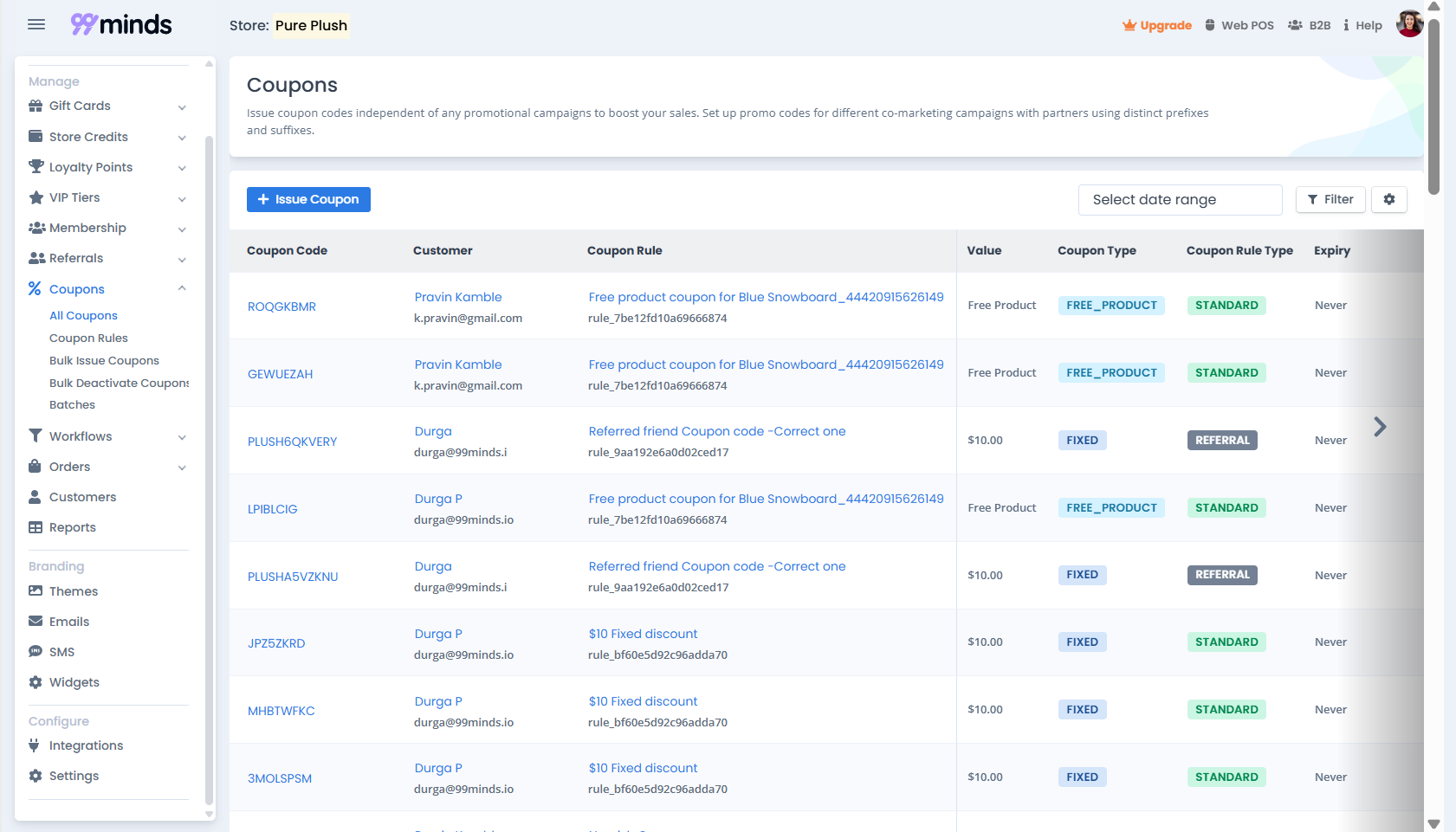
From the dashboard, you can see every issued coupon alongside the Coupon Rule it belongs to, the assigned customer, the discount value and type, and its current status. The platform supports three coupon types natively: Fixed (dollar amount), Percentage, and Free Product, covering the full range of promotional code types covered above.
Coupon Rules are the core feature. Instead of configuring each code from scratch, you create a rule template with all the parameters set once: maximum total usage, maximum usage per customer, minimum subtotal, minimum quantity, expiry period, code length, character set, and custom prefix/suffix. Every code issued under that rule inherits those settings automatically.
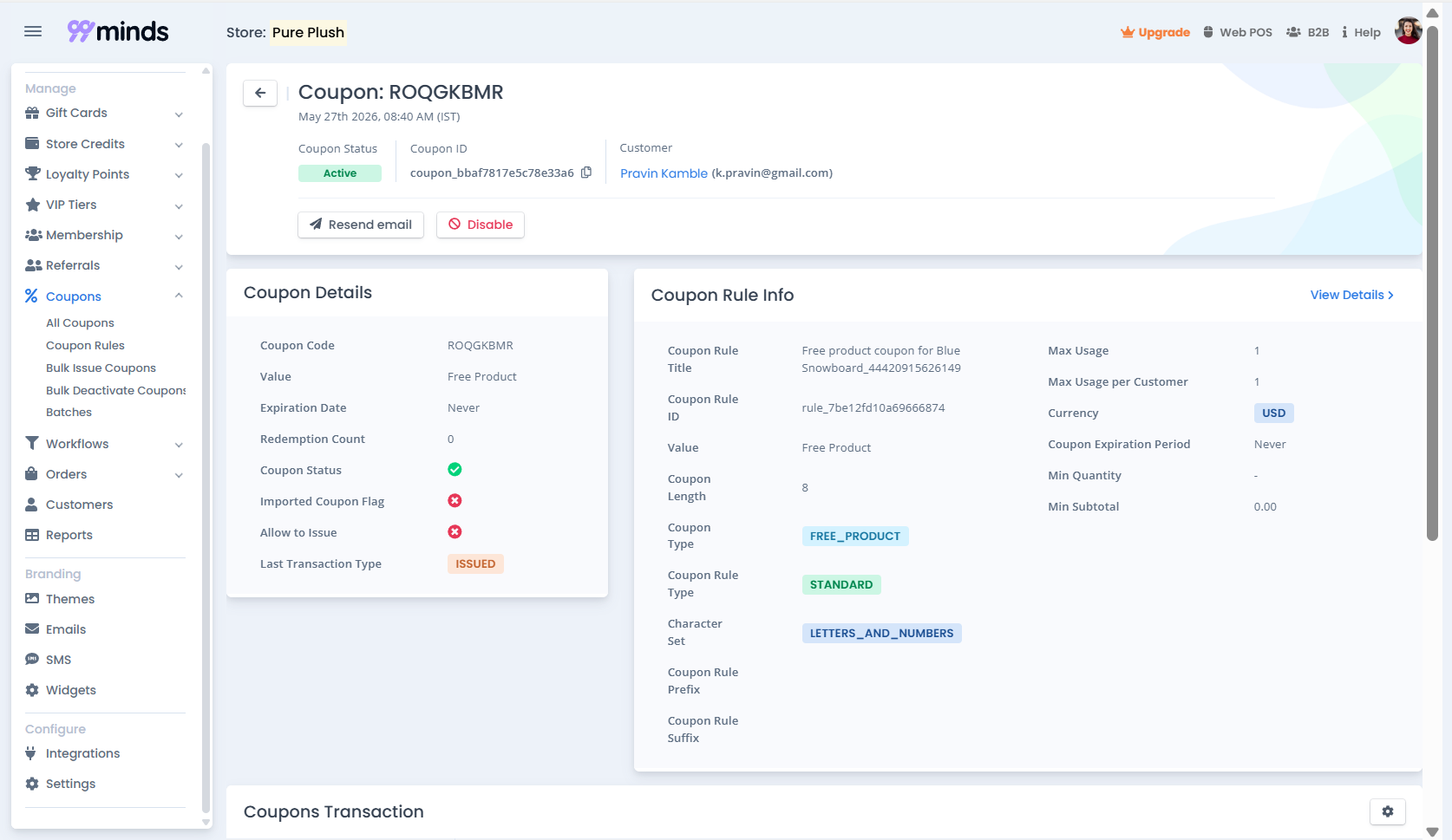
The prefix/suffix support is particularly useful for coupon marketing across multiple channels. A rule named “Partner Summer Campaign” with prefix PARTNER- generates codes like PARTNER-X7K2M, PARTNER-R9PQ4; every redemption is traceable back to that campaign without any additional setup. The same applies to influencer codes, co-marketing partnerships, and channel-specific campaigns.
Bulk issue lets you generate and assign hundreds of codes at once, either manually or via CSV upload. Each code in the batch inherits the parent rule’s settings, so issuing 500 personalized codes to a customer segment is a single operation rather than 500 individual setups.
Referral coupon integration connects directly to the Referrals module. When a customer’s referral is successful, 99minds automatically issues a coupon to the referred friend using the Referral coupon rule type; the prefix can include your store name for brand consistency (e.g., YOURSTORE-WELCOME10).
Workflow automation is where promotional codes become hands-off. You can set workflows to auto-issue coupons on any of the following triggers:
This means your promotional code strategy runs automatically. The right code reaches the right customer at the right moment, without manual intervention. Combined with the loyalty program and Shopify loyalty apps ecosystem, 99minds turns promotional codes from a one-off discount tool into a continuous retention engine.
Promotional codes are one of the most effective conversion tools in ecommerce, but only when they’re structured correctly. A code with no rules is a cost center. A code with clear usage limits, a minimum threshold, an expiry window, and the right distribution channel is a revenue driver.
The seven types covered here (percentage, fixed dollar, free shipping, BOGO, free product, referral, and partner codes) each serve a different moment in the customer lifecycle. Getting the type right matters as much as the discount depth.
If you’re ready to move from ad-hoc discounting to a systematic promotional code strategy with Coupon Rules, bulk issue, workflow automation, and full redemption tracking, 99minds Coupon Management Software handles all of it in one platform. It integrates with Shopify, WooCommerce, BigCommerce, and 100+ other platforms, and you can start for free. You can also combine coupons with 99minds Loyalty Points, digital gift cards, and store credit in the same platform.
For a broader look at combining promotional codes with a long-term retention strategy, see the guide on building a loyalty program for small businesses and the full breakdown of loyalty program benefits.