We're building the future of agentic promotions. Sign up for early access!
Sign up
We're building the future of agentic promotions. Sign up for early access!
Sign up 
Every restaurant wants regulars: customers who come back without a coupon, recommend you to friends, and order a little more every time they visit. A well-designed restaurant loyalty program is one of the most reliable ways to make that happen.
Here’s the catch: most loyalty programs are built on gut feeling, not math. Restaurants launch a points system or a punch card and assume retention will follow. Sometimes it does. Often, it quietly drains margin instead.
This guide covers everything you need to design a restaurant loyalty program that actually works: the right type for your restaurant model, how to avoid the most expensive design mistakes, how to measure ROI properly, and how to stay ahead of the biggest trends reshaping loyalty in 2026.
A restaurant loyalty program is a structured system that rewards customers for repeat visits or purchases, usually with points, credits, or perks they can redeem on future orders. The goal is straightforward: make it more worthwhile to return to your restaurant than to try somewhere new.
These programs have evolved considerably. Paper punch cards gave way to digital apps, and digital apps are now giving way to integrated platforms that track customer behavior across in-store, online, and delivery channels simultaneously. Today’s restaurant loyalty programs do far more than hand out free coffees. They collect first-party data, segment customer behavior, and power personalized marketing campaigns at scale.
At their core, though, restaurant loyalty programs are still a value exchange. You reward customers for their loyalty; they reward you with repeat business, higher spend, and word-of-mouth referrals. That fundamental dynamic hasn’t changed. What’s changed is how much precision you can bring to designing and managing that exchange.
Acquiring a new customer costs anywhere from five to 25 times more than retaining an existing one, and increasing retention by just 5% can grow profits by 25% to 95%, according to Harvard Business Review research based on Bain & Company data. With rising food costs, labor costs, and delivery platform commission fees compressing margins across the industry, retention isn’t just a nice-to-have strategy, it’s a financial necessity.
Here’s what the data consistently shows about loyalty programs for restaurants:
Beyond the numbers, there’s a competitive pressure angle worth naming. Just a few years ago, restaurant loyalty programs were the domain of large QSR chains with app development budgets. That’s no longer true. Loyalty software has become accessible to independent and small-chain operators, which means your competition may already be running one. A customer who earns points at the taco spot down the street has a concrete reason to go back there instead of trying your restaurant.
The good news: you don’t need Starbucks’s tech budget to build a program that works. You need the right structure, the right metrics, and a platform that doesn’t require a developer to manage.
Not all restaurant loyalty programs are built the same, and the type you choose should match your restaurant’s model, customer behavior, and operational capacity. Here’s a breakdown of the six main types.
Customers earn points for every dollar spent and redeem them for rewards once they reach a threshold. This is the most common format in the industry. It works well for high-frequency, lower-ticket restaurants because customers reach rewards quickly enough to feel motivated and build a habit around returning.
Best for: QSRs, fast casual restaurants, coffee concepts
The classic format: earn a stamp per visit or purchase, get a free item after a set number of stamps. Digital punch cards work exactly the same way, just without the physical card. Low-tech, low-friction, and surprisingly effective for habitual customers who already know they like you.
Best for: Independent restaurants, neighborhood cafes, bakeries
Customers move through membership levels (Bronze, Silver, Gold) based on cumulative spend or visit frequency, with escalating perks at each tier. Tiered loyalty programs create aspiration: customers spend more to reach the next level and stay loyal to protect their status. The emotional hook is strong.
Best for: Casual dining, mid-size chains, restaurants with a diverse customer base
Customers pay a recurring fee in exchange for ongoing perks: unlimited drinks, priority reservations, monthly credits. Panera’s Unlimited Sip Club is the most prominent example. Subscriptions lock in visit frequency because customers naturally want to get their money’s worth from the fee they’ve already paid.
Best for: Cafes, bakeries, fast casual chains with habitual daily or weekly visitors
A percentage of each purchase is returned as credit applicable to a future visit. This format is clean, transparent, and universally understood: spend $50, get $2.50 back. Store credit is especially powerful because it pulls customers back to your restaurant specifically, rather than offering a generic discount they might mentally apply anywhere.
Best for: Any restaurant type; particularly appealing to value-conscious customers
Two or more of the above formats combined. For example, a points-based earning system with a tiered structure layered on top. Complexity is higher, but so is the ceiling on customer engagement.
Best for: Mid-size to larger chains with the tech stack to support it
Here’s a quick comparison to help you decide:
| Program Type | Best For | Complexity | Customer Appeal |
|---|---|---|---|
| Points-based | QSR, fast casual | Medium | High |
| Punch card | Independent, cafes | Low | Medium |
| Tiered | Mid-size chains | Medium-High | High |
| Subscription | Cafes, habitual concepts | Medium | High |
| Cashback / store credit | Any | Low | Very High |
| Hybrid | Larger chains | High | Very High |
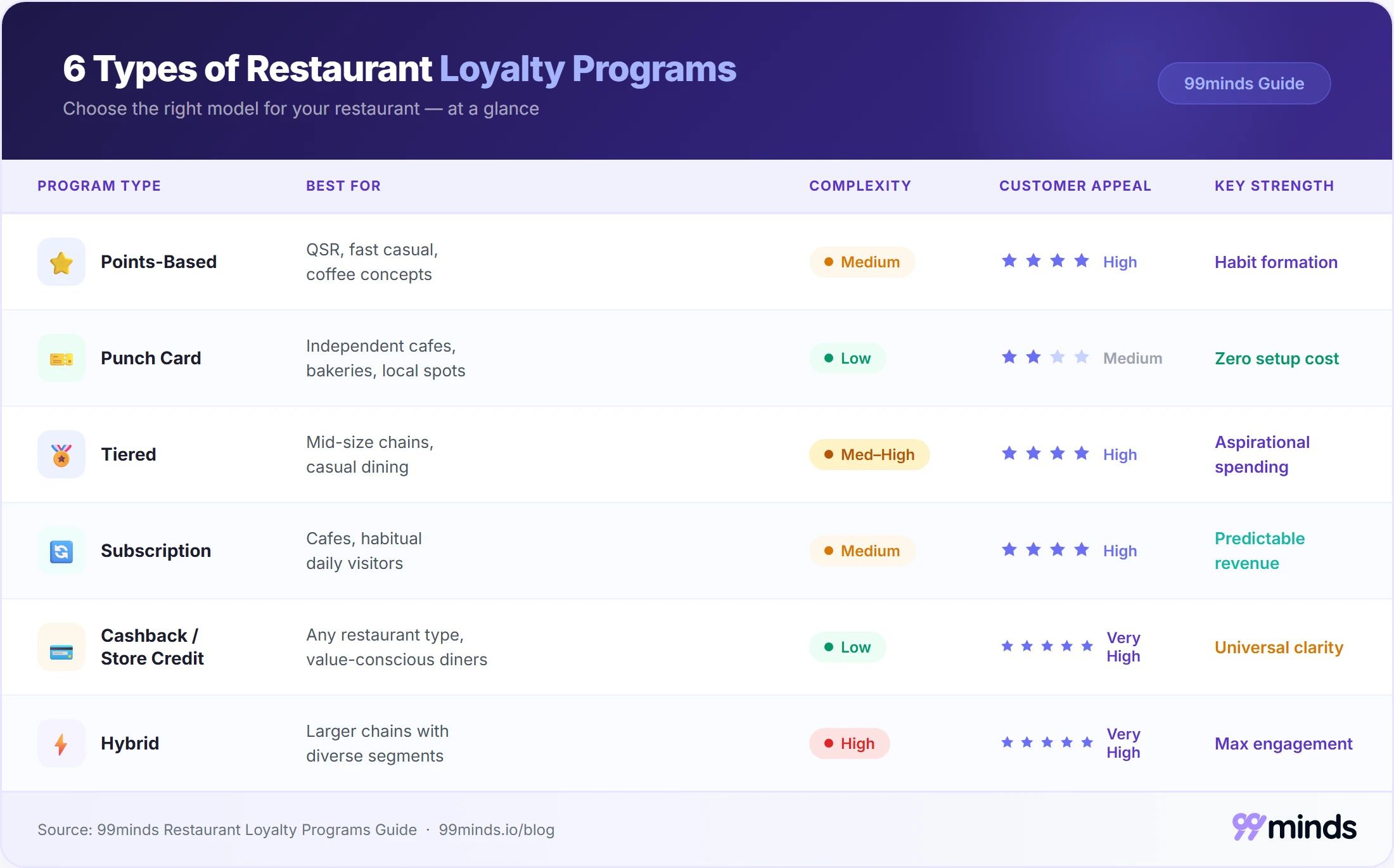
A practical rule of thumb: the higher your average transaction value and the lower your visit frequency, the more you need a program with aspirational tiers or experiential perks (like priority reservations or chef’s table access for a fine dining restaurant). The lower the ticket and the higher the frequency (think a $5 coffee), the more you need something instant and frictionless, like a punch card or a simple points system.
Here’s something most restaurant loyalty program articles skip: a restaurant loyalty program can hurt your margin if it isn’t designed correctly. Restaurants launch with good intentions and generous rewards, then quietly absorb the cost without ever connecting it back to actual revenue growth.
The profit trap shows up in a few predictable ways.
Reward ratios that are too generous: If you offer a $10 reward for every $50 in spend, that’s a 20% effective discount applied on top of all your other costs. Most restaurant margins can’t absorb that sustainably. A healthier target: keep your reward cost at one to three percent of loyalty-attributed revenue, and back-calculate your point ratios from there, not the other way around.
No expiry on points: Unredeemed points are a liability on your books. Without an expiry policy, that liability grows indefinitely. Build in a rolling expiry (for example, points expire after 12 months of inactivity) to encourage redemption velocity without alarming customers. Communicate the policy clearly upfront; most customers accept it when it’s transparent.
One-size-fits-all rewards: A $2 discount motivates a QSR customer who spends $8 per visit. It doesn’t move a casual diner spending $45. Segment your rewards by customer tier or spending behavior to make the program feel meaningful at every level, not just for your lowest-spending visitors.
Ignoring breakage: Breakage is the revenue from loyalty points or rewards that are issued but never redeemed. Breakage rates vary widely depending on how easy rewards are to redeem and how engaged your member base is. A well-designed program accounts for this in its financial model: before you launch, know what your expected breakage rate is and how it affects your cost per redemption. Breakage isn’t a bug; it’s a built-in subsidy for your program costs when managed correctly.
Treating all customers the same: In most restaurants, the top 20% of customers drive 60-70% of revenue. If your restaurant loyalty program treats your most loyal regulars the same as someone on their second visit, you’re leaving a major retention lever unused. Segmentation and tiered rewards exist for exactly this reason. For more on tracking performance, see our guide to loyalty program KPIs.
Before you launch, lock in these three parameters:
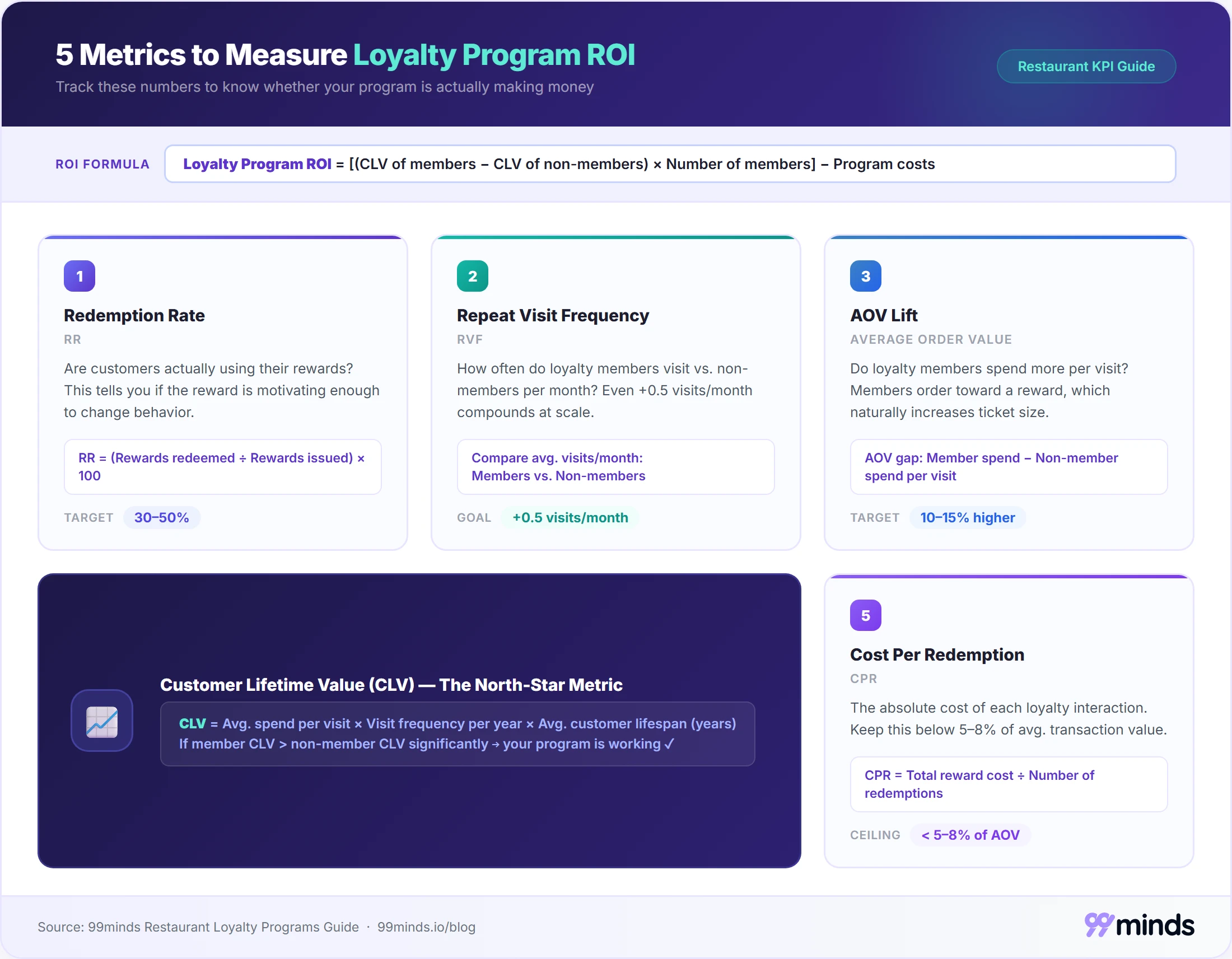
Most restaurant operators know loyalty “works.” Few can quantify how much — and fewer still connect it to their broader finances. Pairing loyalty data with restaurant financial management software gives operators a clearer picture of how loyalty impacts revenue and profitability.
1. Redemption rate
Formula: (Rewards redeemed / Rewards issued) x 100
This tells you whether customers find the rewards motivating. A healthy redemption rate sits between 30-50%. Below 15% means the reward isn’t compelling or visible enough. Above 60% may signal your ratios are too generous.
2. Repeat visit frequency
Compare average visits per month for loyalty members versus non-members. Even a half-visit increase per month per member compounds significantly at scale. If your program isn’t moving this number, review your point earn velocity: customers need to see progress fast enough to feel motivated to return.
3. Average order value (AOV) lift
Loyalty members typically spend more per visit than non-members, partly because they’re more engaged and partly because they’re ordering toward a reward. Track the AOV gap between the two groups. A 10-15% lift is a realistic target for a well-structured program.
4. Customer lifetime value
Formula: Average spend per visit x Visit frequency per year x Average customer lifespan in years
Customer lifetime value is the north-star metric for any restaurant loyalty program. If your members have a meaningfully higher CLV than non-members, the program is working. If the gap is small, the program needs attention: either the design isn’t motivating enough, or the enrollment funnel isn’t reaching the right customers.
5. Cost per redemption
Formula: Total cost of rewards delivered / Number of redemptions
This tells you what each loyalty interaction costs in absolute terms. Keep it below five to eight percent of your average transaction value.
If that number is positive, you have a profitable program. If it’s negative, something in the design needs adjusting: reward ratios, redemption rates, or the enrollment funnel.
Here’s a revenue strategy that virtually no one in this space writes about: combining your gift card program and your loyalty program into a single, connected system.
Most restaurants treat these as separate channels. They shouldn’t be.
Gift card recipients become loyalty members: When a customer redeems a gift card at your restaurant, enroll them in the restaurant loyalty program automatically. You’ve just acquired a new loyalty member at near-zero cost: the gifter already paid for the acquisition. This is one of the most cost-effective enrollment funnels available to any restaurant.
Loyalty points can fund gift card rewards: Instead of awarding free appetizers or percentage-off coupons, give your top-tier loyalty members restaurant gift card credit as their reward. It feels more premium than a discount, is more flexible for the customer, and is no more expensive for you to issue.
Gift card float offsets loyalty costs: When customers purchase gift cards, you receive the revenue upfront. The portion that’s never redeemed (breakage) goes directly to your bottom line. This float can effectively fund your loyalty reward costs, making the program financially self-supporting in ways a standalone restaurant loyalty program can’t match.
Data bridge between gifter and recipient: When someone buys a gift card for a friend, you’ve just been introduced to a new potential customer. When that friend redeems the card and joins your restaurant loyalty program, you’ve turned a one-time transaction into an ongoing relationship.
99minds Loyalty Program and 99minds Gift Card run on the same platform, so restaurants can automate this connection without custom development, including automatic loyalty enrollment at gift card redemption and real-time balance sync across channels.
The modern restaurant customer interacts with you across multiple channels. They dine in on weekdays, order delivery on Friday nights, and grab lunch through your online ordering portal. If your restaurant loyalty program only tracks one of those channels, you’re missing most of the picture and most of the data.
A customer who earns points when dining in but gets nothing for their online delivery order will notice the inconsistency. Worse, you lose the behavioral data from those other channels, making personalized re-engagement harder.
Three channels need to be connected for a restaurant loyalty program to work at full power:
For a deeper dive into connecting these channels, see our full guide on omnichannel loyalty programs.
One practical tool worth knowing: Apple Wallet and Google Wallet loyalty passes, available through 99minds Wallet Pass, let customers carry their loyalty card in their native phone wallet without downloading a separate app. This removes one of the biggest friction points in loyalty enrollment and works seamlessly across both in-store and online interactions.
The restaurant loyalty programs that win in 2026 aren’t the ones with the most points. They’re the ones that feel the most personal. Here are the three trends reshaping restaurant loyalty right now.
Instead of sending every customer the same “earn double points this weekend” offer, AI-powered loyalty platforms analyze individual purchase behavior and serve relevant offers automatically. A customer who always orders your seasonal specials gets a notification when a new one drops. A customer who skipped their usual weekly visit gets a “we miss you” offer calibrated to their typical order. Early adopters report 20-30% higher redemption rates on personalized offers compared to generic campaigns.
App fatigue is real. Most customers don’t want to download another app just to earn points at a restaurant. Restaurant loyalty programs that live inside Apple Wallet and Google Wallet solve this entirely: the card sits in the native wallet app, sends push notifications for offers, and updates automatically. No separate app download is required, which means no enrollment friction.
Third-party cookie deprecation is changing how restaurants reach customers digitally. Restaurant loyalty programs are one of the cleanest sources of first-party and zero-party data available: purchase history, visit frequency, order preferences, and communication opt-ins, all collected with explicit customer consent. Restaurants building their loyalty member databases now are building a marketing asset that won’t be disrupted by platform policy changes.
Looking at what works for established brands is useful, as long as you extract the principle rather than just copying the format.
Starbucks Rewards: A stars-based program with a mobile-first experience and AI-personalized offers. The lesson: gamification drives daily engagement. Small visible progress (stars adding up toward the next reward) creates a habit loop that keeps customers returning even when they don’t “need” to.
Chick-fil-A One: A tiered program where higher-tier members earn points faster and access exclusive experiences. The lesson: aspirational tiers motivate customers to spend more, not just visit more. Status is a powerful retention mechanic that costs very little to create.
Chipotle Rewards: Simple points accumulation with periodic bonus point challenges (for example, earn 2x points on your next three visits). The lesson: limited-time challenges create urgency and spike visit frequency at low incremental cost.
Panera Bread (MyPanera + Unlimited Sip Club): A subscription layer built on top of a traditional restaurant loyalty program. Subscribers pay a monthly fee for unlimited beverages, which locks in daily visit behavior. The lesson: subscription fees turn occasional customers into daily habits and create predictable, recurring revenue.
Subway MVP Rewards: A multi-tier structure with clear progress indicators at every level. The lesson: showing customers exactly how far they are from their next reward drives the next purchase as powerfully as the reward itself.
For a wider collection of approaches across industries, see our roundup of loyalty program examples to see what translates well into a restaurant context.
99minds gives you points, tiers, gift cards, and omnichannel sync in one platform. No developer required.
99minds is a loyalty and rewards platform built for restaurants and retailers that want enterprise-level features without the enterprise price tag or setup complexity.
Here’s what operators use it for:
99minds integrates with Shopify, BigCommerce, and restaurant-specific POS systems including Square and Paytronix, making it easy to layer loyalty onto your existing tech stack without ripping out what you already use. For more on how loyalty fits into a broader customer retention strategy, see our resource library.
Restaurant loyalty programs work. The evidence is clear, the mechanics are well understood, and the tools are more accessible than they’ve ever been. What separates the programs that quietly drain margin from the ones that compound revenue over time is intentional design from the start.
To recap the four things that matter most:
99minds makes all of this straightforward on one platform: restaurant loyalty programs, gift cards, omnichannel sync, Apple/Google Wallet passes, and automated campaigns that run without constant manual oversight. Get started with 99minds and build a restaurant loyalty program your regulars will actually use.