We're building the future of agentic promotions. Sign up for early access!
Sign up
We're building the future of agentic promotions. Sign up for early access!
Sign up 
In 2025 and 2026, shoppers aren’t just browsing, they’re hunting. According to Numerator, 42% of consumers say they’ll actively look for sales and coupons to offset rising prices. eMarketer reports that 62% of US consumers actively search for and use promo codes, discounts, or coupons when making online purchases. For brands, that’s a real opportunity.
But here’s the catch: a poorly designed promotion trains customers to only buy when there’s a deal. Done right, a sales promotion earns the next purchase, not just the current one.
In this guide, we’ll cover what sales promotions are, the 15 most effective types, proven strategies to run them, and how AI and loyalty programs are reshaping the way modern brands promote.
| Section | What You'll Learn |
|---|---|
| What is a sales promotion? | A limited-time offer designed to drive immediate purchases, attract new customers, or reward loyalty |
| Benefits | Seven core benefits, from boosting sales volume to filling slow-period revenue gaps |
| Types | 15 types including loyalty programs, flash sales, cashback, BOGO, and referral programs |
| Loyalty connection | How promotions feed into a loyalty ecosystem so customers return after the deal ends |
| AI and personalization | How behavior-triggered, individual-level offers protect margins while improving conversions |
| Strategies | SMART goals, audience segmentation, channel selection, urgency, and customer data |
| How to measure | Sales lift, redemption rate, repeat purchase rate, and Return on Promotion Investment (ROPI) |
| Real examples | Starbucks Rewards, Sephora Beauty Insider, Amazon Prime Day, McDonald's Monopoly, Coca-Cola "Share a Coke" |
A sales promotion is a limited-time offer or deal designed to prompt immediate buying behavior, increase brand awareness, or encourage trial usage of products. Sales promotions help companies reach short-term sales goals using tactics like discounts, flash sales, or loyalty programs. They provide incentives that influence the decision-making of existing customers and draw in new buyers by creating an appealing, time-sensitive offer.
Unlike advertising, which builds awareness gradually over time, sales promotions are action-oriented. They’re designed to drive an outcome right now, whether that’s a first purchase, a repeat order, or a referral. The three core objectives of any sales promotion are:
Sales promotions can be game-changers for businesses, influencing everything from customer acquisition to brand loyalty. Here’s a closer look at the core benefits:
Sales promotions amplify brand visibility by capturing attention through discounts, events, and interactive campaigns. A flash sale or a “limited-time offer” on social media attracts potential customers and increases exposure, driving traffic to your online or physical store. Seasonal campaigns like Black Friday and holiday discounts can further maximize this impact.
Discounts, bundles, and Buy One Get One Free (BOGO) deals are powerful tools for increasing sales volume quickly. They encourage customers to purchase immediately, often leading to a surge in sales within a short timeframe.
Sales promotions aimed at repeat customers, such as loyalty programs or VIP-only discounts, foster brand loyalty. By rewarding repeat purchases, brands make customers feel valued, increasing the likelihood of future sales. Loyalty programs that offer points or tiered rewards are particularly effective in building long-term customer relationships.
Promotions like free trials, sampling, or first-time discounts make it easier for potential customers to try a product with minimal commitment. This is especially valuable for new product launches, where businesses aim to generate buzz and gather early feedback.
Clearance promotions and limited-time discounts move slow-moving or seasonal stock efficiently, freeing up warehouse space and cash flow for new products. For eCommerce brands, this is one of the most practical applications of a well-timed sale.
Every promotion is a live experiment. By tracking which offers get the highest redemption rates, which customer segments respond, and which products benefit most, you collect data that informs smarter future campaigns. These insights can shape product development, pricing strategy, and audience segmentation.
Strategic promotions can revitalize sales during traditionally slow periods, like Q1 post-holiday or summer slumps, ensuring more consistent revenue flow throughout the year. A well-timed offer keeps your brand top-of-mind even when customers aren’t in active buying mode.
While sales promotions can bring significant benefits, there are also potential drawbacks to consider carefully.
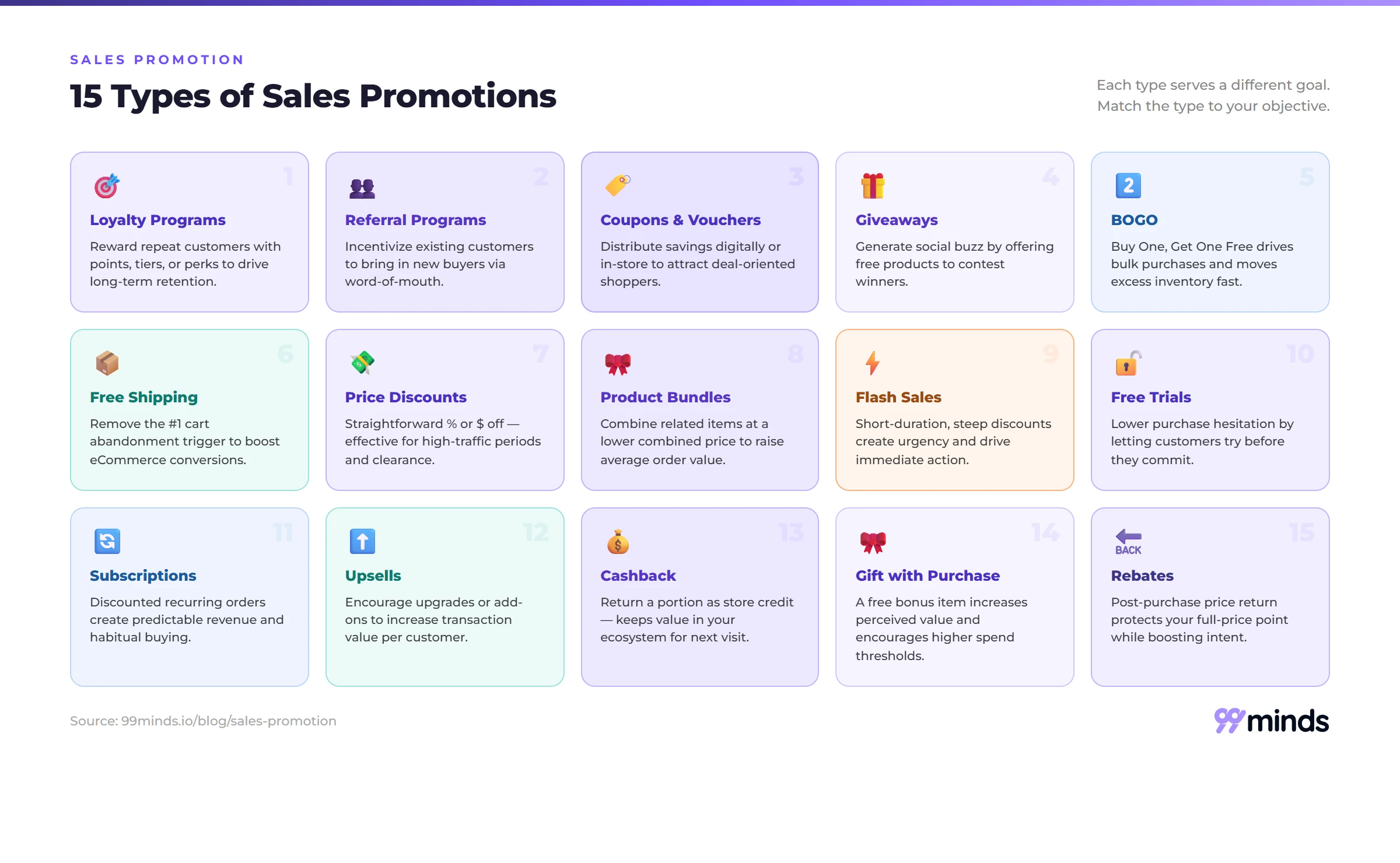
Loyalty programs reward repeat customers with incentives like points or rewards redeemable for discounts and free items, encouraging ongoing engagement. This approach keeps customers returning by offering exclusive benefits that deepen brand loyalty. Starbucks Rewards, for example, not only enhances customer retention but also builds brand identity by creating a community of regular customers who enjoy unique perks.
Referral programs leverage existing customers to bring in new ones by offering rewards, such as discounts or credits, to both the referrer and the new customer. This word-of-mouth strategy enhances credibility since recommendations come from trusted sources. Dropbox’s referral program is a perfect example: they offered extra storage space for referrals, which helped scale their user base without relying on heavy advertising.
Coupons and vouchers are versatile tools that give customers a specific savings amount or percentage off a purchase. These can be distributed through email, social media, or in-store, and work effectively for attracting deal-oriented shoppers. Digital coupons also enable businesses to track usage and measure promotion success more accurately. Coupons and vouchers are versatile tools that give customers a specific savings amount or percentage off a purchase. These can be distributed through email, social media, or in-store, and work effectively for attracting deal-oriented shoppers. Digital coupons also enable businesses to track usage and measure promotion success more accurately.
Giveaways generate buzz, especially on social media, by offering free products to winners who engage with the brand. Participants typically enter by liking, sharing, or tagging friends, creating widespread engagement. Giveaways increase brand reach and awareness at minimal cost, especially when paired with a partner brand or influencer.
BOGO (Buy One, Get One Free) promotions encourage bulk purchases by offering a free or discounted product with each one purchased. This technique is particularly useful for clearing excess inventory and increasing transaction size, appealing to budget-conscious shoppers who value extra value for their money.
Free shipping promotions remove one of the biggest barriers for online shoppers. Many brands apply it to orders above a certain threshold, encouraging customers to add more items to qualify. By offering free shipping, brands can increase conversion rates and average order values in eCommerce, where shipping costs often discourage customers from completing purchases.
Direct price discounts are straightforward but effective, offering customers a percentage or set amount off select items. This approach works especially well during high-traffic periods like holiday sales. Brands often use discounts for specific products to move stock or for entire categories, making them versatile across different sales goals.
Product bundles combine multiple related items at a lower price than if bought separately. This encourages customers to purchase complementary products, increasing the average order value. A skincare brand might bundle a cleanser, toner, and moisturizer together, appealing to customers who want a complete routine in one purchase.
Flash sales are short-term promotions that create urgency by offering steep discounts for a limited time. This type of sale is effective for clearing inventory or creating excitement around a brand, as the time-limited nature encourages customers to make quick purchase decisions.
Free trials offer customers the opportunity to try a product or service before making a commitment. This approach is popular with SaaS and subscription-based businesses, as it lowers customer hesitation and increases conversion rates by showcasing the product’s value firsthand.
Subscription discounts incentivize customers to commit to recurring purchases by offering a reduced rate for ongoing orders. This model is common in consumable goods like pet food or supplements, and creates a predictable revenue stream while encouraging long-term brand loyalty.
Upselling is the practice of encouraging customers to upgrade to a higher-priced product or add complementary items to their purchase. This tactic maximizes transaction value, benefiting both the customer, who gets a premium experience, and the brand, which sees increased revenue per transaction.
Cashback promotions reward customers with store credit or a portion of their purchase price back, giving them a compelling reason to return. Unlike a one-time discount, cashback creates a built-in incentive for the next purchase. This is especially effective when cashback is issued as store credit rather than cash, keeping the value within your ecosystem.
Offering a free gift with a purchase (GWP) enhances value perception and makes customers feel rewarded. The gift can be a sample of a new product, an exclusive item, or a bestseller, encouraging larger transactions or minimum order amounts. For new product launches, this technique is especially effective as customers get to experience additional products risk-free.
A rebate returns part of the purchase price to the customer after the transaction, rather than reducing the price at checkout. Unlike an instant discount, the customer pays full price upfront and claims the rebate later. An analysis of 133 digital rebate campaigns found an average redemption rate of 52%, meaning brands only pay out on about half of qualifying purchases while still protecting their perceived full-price point.
Here’s the problem with most standalone promotions: when the sale ends, the customer leaves. There’s no thread connecting that discounted purchase to the next one. The brand spent margin to acquire a transaction, not a relationship.
That’s the gap loyalty programs fill. When a loyalty platform sits underneath your promotions, every sale becomes the beginning of a loyalty relationship rather than the end of a transaction.
A flash sale drives a spike in orders. But without any mechanism to bring those customers back, you’ve essentially rented their attention with a discount. The customer who bought once at 30% off has no particular reason to return at full price. This is how brands accidentally train their audiences to be deal-hunters rather than loyal buyers.
The key shift is simple: make every promotional purchase earn something. When a customer buys during a flash sale and earns double loyalty points, they’re now invested in your brand beyond the discount. They have a balance to spend. They have a reason to come back.
Here are four specific mechanics that connect promotions to loyalty outcomes:
When promotions and loyalty work together, you’re not just measuring sales lift during the campaign. You’re measuring whether promo buyers came back at full price, whether they referred friends, and how their lifetime value compares to non-promo customers. That’s the metric that actually determines whether a promotion was worth running.
The 99minds Loyalty Program is built to connect every promotion to a loyalty outcome, whether that’s points, cashback, gift card credit, or tiered rewards, so promotional purchases build toward a customer’s next visit rather than ending at the checkout. The 99minds Loyalty Program is built to connect every promotion to a loyalty outcome, whether that’s points, cashback, gift card credit, or tiered rewards, so promotional purchases build toward a customer’s next visit rather than ending at the checkout.
Traditional promotions offer the same deal to every customer. Send a 20% off email to your entire list and you’ll give discounts to customers who would have bought anyway, while still missing the ones who needed a stronger nudge. That’s an expensive way to promote.
AI is changing this. Modern brands are moving from blanket promotions to individual-level offers delivered at exactly the right moment.
According to Attentive’s 2025 global study, 96% of consumers say they’re likely to purchase when brands send personalized messages. The insight here isn’t just that personalization increases conversions. It’s that you only discount when the customer actually needs the nudge. Customers who were going to buy anyway get a full-price experience. Your margins stay healthier, and your promotional spend goes further.
For eCommerce brands, automated workflows tied to customer behavior are the most practical path to AI-powered promotions. Event-triggered promotions (abandoned cart, post-purchase upsell, birthday rewards) can be set up to fire automatically, so the right offer reaches the right customer without manual effort every time.
To get the most out of sales promotions, it’s essential to plan strategically. Here are the key ways to make your promotions more effective:
A successful promotion begins with specific goals. Whether the purpose is to boost immediate revenue, introduce a new product, or expand customer reach, defining these objectives guides every element of the campaign. Use the SMART framework: make your goal Specific, Measurable, Achievable, Relevant, and Time-bound.
For example, “Increase new customer conversion rate by 15% over a two-week flash sale period” is a SMART goal. “Run a sale” is not. The difference is that a SMART goal tells you exactly when the promotion succeeded and when it didn’t.
Audience segmentation tailors promotions to specific demographics, increasing relevance and appeal. By segmenting based on age, location, purchase history, or interests, you can customize offers to better resonate with each group. Student discounts attract younger audiences, while loyalty discounts appeal more to existing buyers. Personalized promotions show customers that the brand understands their preferences, leading to higher conversion rates.
Promoting across multiple channels broadens your campaign’s reach, but the key is focusing on the channels your target audience actually uses. Here’s how to think about each one:
Urgency is a powerful motivator in sales promotion. When customers believe that time is running out, whether through limited-time offers or countdown timers, they’re more likely to act immediately. Flash sales, “while supplies last” deals, and limited-edition products all harness the fear of missing out (FOMO) to encourage quick decisions.
Data is invaluable in shaping promotions and improving future campaigns. By analyzing past promotions, sales data, and customer behavior, you gain insight into which strategies resonate with your audience. Tracking customer responses to different discount types can reveal whether percentage-based or flat-rate discounts drive more conversions. Customer data also informs segmentation, helping you develop more personalized promotions over time.
Running a promotion without tracking its performance is like driving without a destination. Here are the five key metrics to measure after every campaign:
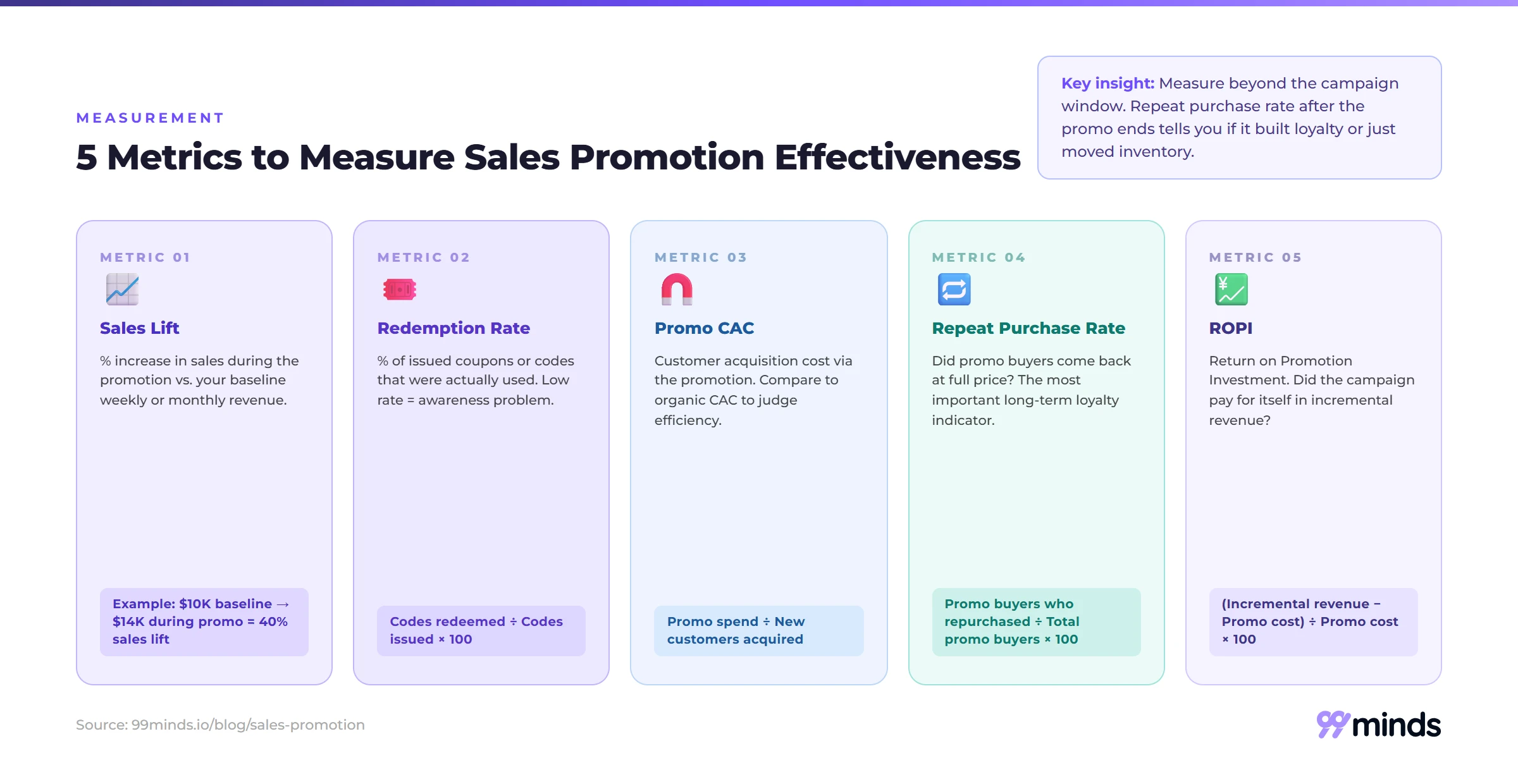
Here are some creative ideas to make your sales promotions stand out:
Seasonal promotions are tailored to specific times of the year, such as holiday shopping, back-to-school, or summer clearance sales, to match customer spending trends. Structuring a promotion like “12 Days of Deals” with a different offer each day creates anticipation and daily engagement that keeps customers coming back throughout the campaign period.
A gamified approach, “spin-the-wheel” discounts add an element of excitement and engagement. Customers virtually spin to receive a random discount, such as 5% off, free shipping, or a grand prize. Not only does this increase interaction, but it also creates anticipation and a feeling of exclusivity. Businesses often tie these to email sign-ups, expanding their subscriber list while giving visitors an extra incentive to purchase.
Partnering with complementary brands can significantly extend a promotion’s reach and build cross-brand exposure. A coffee company collaborating with a chocolate brand to create a “coffee and cocoa” bundle, for example, is marketed to both audiences simultaneously. These partnerships work especially well because they let you tap into a pre-qualified audience without competing against each other.
Personalized promotions leverage customer data to create discounts or product recommendations that are individually tailored. By using purchase history and browsing behavior, brands can offer discounts on items a customer viewed multiple times but didn’t buy. Sending a 10% discount on that specific product encourages completion of the purchase and makes customers feel seen, not marketed to.
A “second-chance” discount targets customers who abandoned their cart without completing a purchase. Send an automated email 24 hours later with a time-limited discount code for the exact products they left behind. This is one of the highest-converting promotional tactics in eCommerce because it targets people who were already ready to buy.
Tiered discounts based on purchase value encourage customers to spend more to unlock better savings. For example: 10% off orders over $50, 15% off over $100, and 20% off over $150. This increases average order value without requiring a blanket discount, and gives customers a clear incentive to add one more item to their cart.
Examining real-world examples of effective sales promotions gives deeper insight into strategies that yield impressive results.
Coca-Cola launched the “Share a Coke” campaign, replacing its classic logo on bottles with popular first names and phrases. This strategy tapped into personalization, creating an emotional connection with consumers by encouraging them to find and purchase bottles featuring their own names or the names of friends and family. The campaign spanned TV, digital ads, and social media challenges, with millions of user-generated photos shared online. It’s been re-run in markets around the world through 2024, demonstrating just how durable a well-personalized promotion can be.
McDonald’s Monopoly is a long-running sales initiative that gamifies the customer experience. Customers receive game pieces with every purchase, representing properties on a classic Monopoly board. Collecting a complete set allows customers to win prizes ranging from free food items and gift cards to cars and vacations. The campaign is supported by in-store advertisements, printed game boards, and interactive mobile apps for tracking progress. This promotion effectively increases sales as customers return frequently to collect game pieces, fostering loyalty and significantly boosting revenue during promotional periods.
Amazon Prime Day is an annual, exclusive sales event that Amazon created to boost its Prime membership program. During this event, Amazon offers deep discounts across thousands of products for a limited time, accessible only to Prime members. The event is heavily marketed through email, online ads, and social media weeks in advance to build anticipation. Prime Day has contributed to billions in sales revenue and a surge in new Prime subscriptions, reinforcing the benefits of Prime membership while driving substantial traffic to Amazon’s platform.
Starbucks Rewards incentivizes repeat visits by offering Stars (points) for each purchase. Members can redeem their Stars for free drinks, food, or exclusive merchandise. The program operates through a mobile app, making it easy for customers to track their points, receive personalized offers, and pre-order to skip lines. Regular updates with bonus-point challenges and double-Star days keep customers actively engaged.
What makes Starbucks Rewards a master class in promotion is that it’s not a one-time event. It’s an ongoing promotional structure that rewards every purchase and gives customers a perpetual reason to return. That’s the difference between a discount and a loyalty-native promotion.
Sephora’s Beauty Insider program is a tiered loyalty program that rewards customers based on their annual spending. The three levels, Insider, VIB (Very Important Beauty Insider), and Rouge, offer increasing perks such as birthday gifts, exclusive product previews, and access to special events. Sephora’s program also integrates a points system that allows customers to redeem points for products or experiences.
The Beauty Insider program creates a community of loyal Sephora shoppers who feel valued and appreciated. It drives significant revenue through repeat purchases, as customers are motivated to spend more to unlock higher-tier benefits. It’s a textbook example of how a tiered loyalty program turns promotions into a long-term retention engine.
Sales promotions are one of the most versatile tools in a marketer’s arsenal, but their real power shows when they’re connected to a larger strategy. The best promotions in 2026 aren’t just short-term discounts, they’re moments that earn loyalty, generate data, and compound over time.
A few key takeaways to carry forward:
99minds provides a comprehensive suite of tools designed to help you design, test, and analyze a wide range of sales promotions. Whether you aim to launch targeted discounts, create personalized rewards, automate cashback, or engage customers through gamified experiences, 99minds equips you with everything you need to turn promotions into lasting customer relationships.