We're building the future of agentic promotions. Sign up for early access!
Sign up
We're building the future of agentic promotions. Sign up for early access!
Sign up 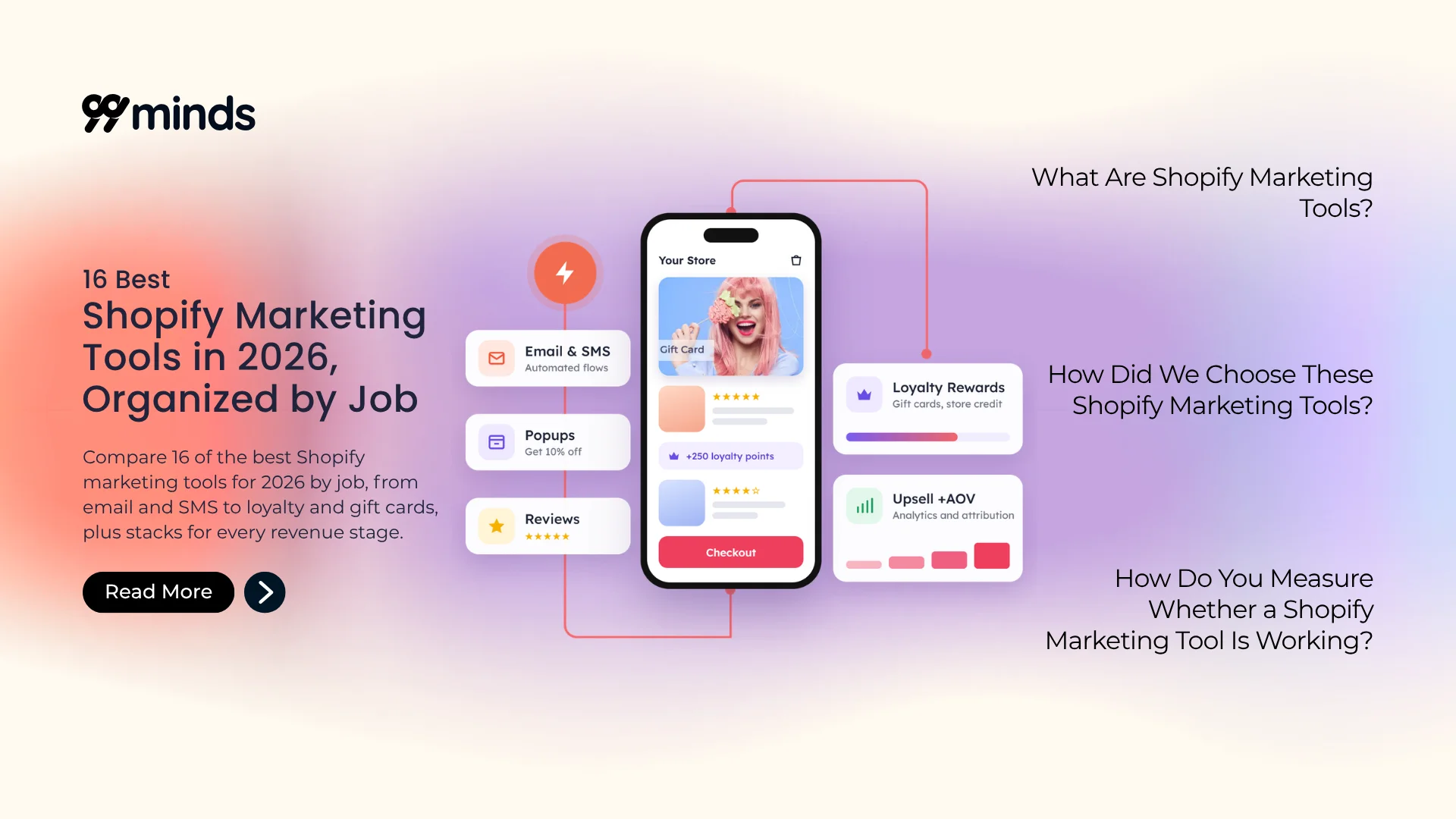
Running a Shopify store usually starts with a simple marketing setup: collect emails, send campaigns, run discounts, and measure sales. As the store grows, that setup can turn into a stack of apps that all do slightly different versions of the same job.
That creates two problems. You pay for overlapping features, and customer data gets spread across multiple systems.
The better approach is to choose Shopify marketing tools around specific jobs. Use Shopify’s built-in tools where they are enough, then add specialized software when a specific limitation starts costing you revenue.
Shopify marketing tools are built-in Shopify features and third-party apps that help merchants attract shoppers, convert them into customers, increase order value, and encourage repeat purchases.
They include email and SMS platforms, popup tools, review apps, upsell software, affiliate platforms, loyalty programs, gift cards, store credit, customer support systems, and analytics platforms.
There are three broad types. Shopify’s native tools cover common marketing jobs without requiring another app. Shopify App Store apps extend a specific function, such as email automation or product reviews. All-in-one platforms combine several retention or marketing functions under one system.
The right Shopify marketing software depends on the job you need to solve, your customer volume, and how much of your marketing data you want to keep in one place.
Before installing another Shopify marketing tool, check what Shopify already provides. Several native features can handle basic marketing without adding another subscription or storefront script.
| Built-in tool | What it covers | Signal you have outgrown it |
|---|---|---|
| Shopify Messaging (formerly Shopify Email) | Email and SMS campaigns and basic automations, with 10,000 free emails a month | You need advanced segmentation, deeper analytics, or complex email and SMS journeys |
| Shopify Forms | Popups, inline forms, email capture, B2B inquiries | You need advanced targeting, exit-intent campaigns, quizzes, or sophisticated lead capture |
| Shopify Flow | Workflow automation | You need more advanced customer engagement or marketing orchestration |
| Shopify Inbox | Live chat | Support volume requires a full helpdesk and automated ticket workflows |
| Shopify Audiences | Ad audience creation for eligible Shopify Plus stores in the US and Canada | You need broader attribution and cross-channel measurement |
| Shopify Collabs | Creator and affiliate partnerships | You need more complex commission structures and affiliate management |
| Shopify Magic / Sidekick | AI-assisted content and store tasks | Your team needs specialized AI workflows or deeper marketing automation |
| Shopify Discounts and Gift Cards | Basic promotional codes and native gift cards | You need loyalty-linked rewards, advanced gift card campaigns, store credit, or omnichannel balances |
Shopify’s own marketing automation tools can be combined with customer segments, Forms, Shopify Messaging, and Shopify Flow to build marketing workflows directly from the Shopify admin.
The practical rule is simple: start with Shopify’s native tools, then add an app when a specific limitation has a measurable business cost.
The goal is not to rank 16 apps based on which vendor has the loudest marketing.
Each Shopify marketing tool was evaluated around five practical criteria:
The list also separates specialized tools from retention platforms. A popup tool should not be judged by the same criteria as an attribution platform.
99minds is our product and is listed in the retention category because that is where its broader functionality fits: loyalty, gift cards, store credit, referrals, cashback, memberships, and wallet passes. The other tools are evaluated around the same practical criteria rather than simply being included because they are popular.
The best Shopify marketing tool depends on the problem you are trying to solve. A store struggling to collect email subscribers needs a different tool from a $10 million brand trying to understand advertising profitability.
Here is the shortlist before we look at each tool in detail. Pricing was checked against each vendor’s website and Shopify App Store listing in October 2026, so confirm current plans before you buy.
| # | Tool | Job | Best for | Starting price | Free plan |
|---|---|---|---|---|---|
| 1 | 99minds | Loyalty, gift cards and retention | Growing Shopify and omnichannel brands | $49/mo paid plans | Free plan |
| 2 | Privy | Popups and lead capture | Small and growing stores | $30/mo | No |
| 3 | OptiMonk | Personalization and popups | Conversion-focused stores | $0 | Yes |
| 4 | Klaviyo | Email and SMS | Growing Shopify brands | Free tier | Yes |
| 5 | Omnisend | Email, SMS and push | SMB ecommerce brands | $16/mo | Yes |
| 6 | Postscript | SMS marketing | SMS-first Shopify brands | $0 + $49/mo minimum spend | No |
| 7 | Attentive | Enterprise messaging | High-volume and Plus brands | Custom | Trial |
| 8 | Rebuy | Upsells and personalization | AOV-focused stores | From about $25/mo | 14-day trial |
| 9 | ReConvert | Post-purchase upsells | Stores optimizing checkout value | Free, then from $9.99/mo | Yes |
| 10 | Judge.me | Product reviews and UGC | Budget-conscious stores | $0 | Yes |
| 11 | Loox | Visual reviews | Fashion, beauty and lifestyle brands | $0 | Yes |
| 12 | Shopify Collabs | Affiliate and creator marketing | Stores starting creator programs | Free | Yes |
| 13 | UpPromote | Affiliate management | Growing affiliate programs | $0 | Yes |
| 14 | TinySEO (formerly TinyIMG) | SEO and image optimization | Stores improving technical SEO | From $14/mo | Pay as you go |
| 15 | Gorgias | Customer support | Growing ecommerce teams | $10/mo | Trial |
| 16 | Triple Whale | Attribution and analytics | Brands spending heavily on ads | $0 | Yes |
Pricing changes frequently, especially for apps that charge according to contacts, orders, messages, or traffic. Check the current plan on each vendor’s site before purchasing.
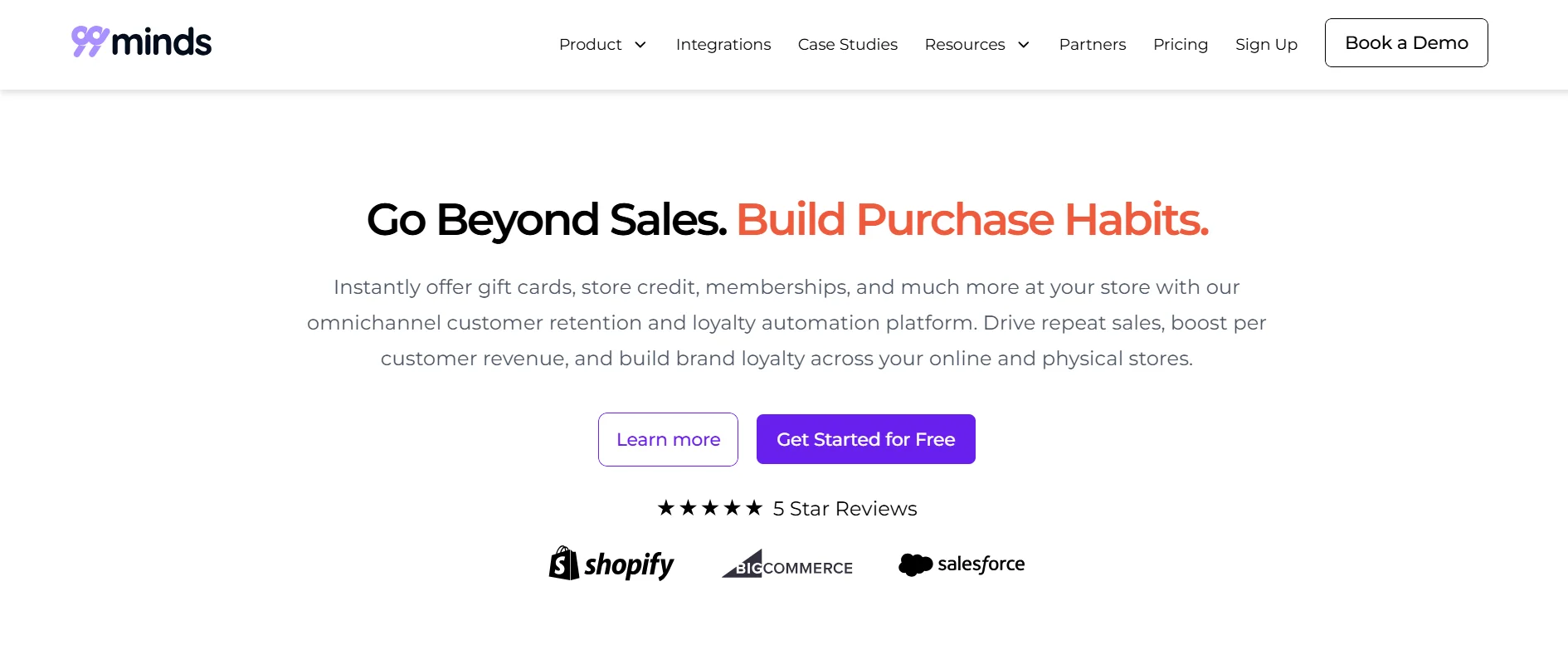
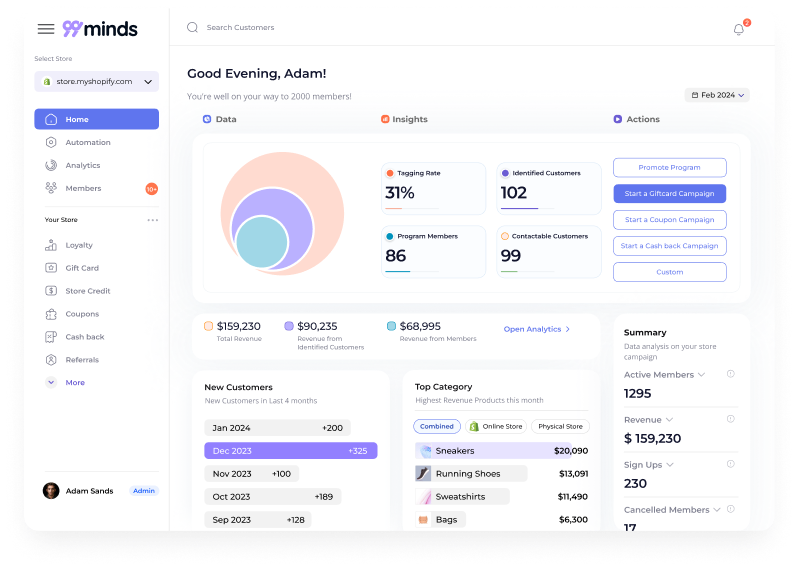
99minds is an omnichannel gift card and loyalty platform that combines loyalty programs, gift cards, store credit, referrals, cashback, memberships, and wallet passes.
The main advantage is consolidation. A Shopify merchant that wants loyalty points, referral rewards, store credit, and gift cards does not necessarily need a separate app for every function. 99minds brings those retention mechanics into one platform and can connect them with Shopify, Shopify POS, CRM, and marketing systems.
99minds turns one-time buyers into repeat customers. Points, store credit, gift card balances, and referral rewards give shoppers a reason to come back, and syncing those balances with email and SMS tools lets marketers build campaigns around them.
Footwear retailer Tassels Shoes used 99minds to run store credit, loyalty points, and gift cards across its Shopify store and Heartland POS. Customers could take refunds as store credit, earn points for purchases and referrals, and receive “spend $300, get $30” store credit offers, with unused balances triggering reminders through Klaviyo. Tassels saw a 20% increase in repeat purchases and 20% higher LTV, and AOV rose 10% in the first six months. Read the full Tassels Shoes case study.
Key Features
Limitations
99minds is more than a simple points app, so a merchant that only needs a basic loyalty program may not need its full feature set. Its value becomes clearer when a brand wants several retention mechanics connected instead of managing them as separate applications.
Pricing
Privy is an onsite marketing and email platform built for small and growing ecommerce stores. It combines popups, email, and SMS in one tool, so a merchant can capture visitors and follow up with them without connecting several apps.
Privy lets Shopify stores create popups, multi-step popups, spin-to-win displays, and embedded forms, then target them by page, behavior, or exit intent. New subscribers can flow straight into welcome emails, cart-saver campaigns, and SMS messages managed from the same dashboard.
Privy turns anonymous traffic into an owned email and SMS list. That list reduces dependence on paid ads, and the built-in welcome and cart recovery flows help convert first-time visitors into first-time buyers.
Key Features
Limitations
Privy’s pricing increases with the number of mailable contacts, so the cost needs to be considered as the email database grows. Stores already using a separate email platform may also find some functionality overlapping.
Pricing
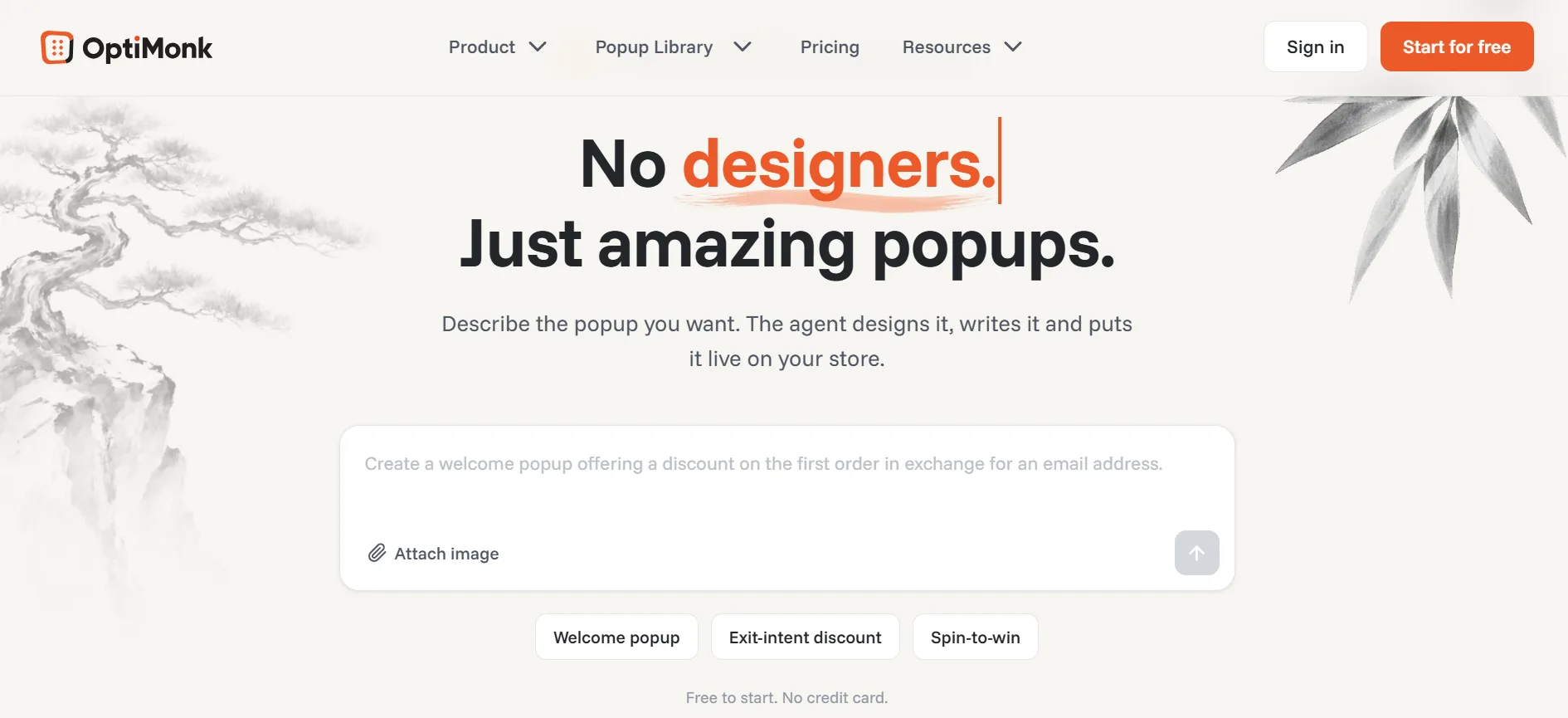
OptiMonk is an onsite personalization and conversion optimization platform. It goes beyond a basic popup builder by showing different messages to different visitors based on who they are and how they behave on the store.
OptiMonk lets merchants build popups, banners, announcements, quizzes, and gamified campaigns such as lucky wheels, then target them by traffic source, visit history, cart value, or exit intent. Its A/B testing and AI features help teams test offers and copy without developer help.
For Shopify stores, OptiMonk improves conversion from existing traffic. Personalized offers for new visitors, returning shoppers, and cart abandoners can grow the email list and recover sales that a single generic popup would miss.
Key Features
Limitations
OptiMonk is strongest when onsite personalization is a meaningful part of the conversion strategy. A store that only needs a basic email signup popup may not need its more advanced capabilities.
Pricing
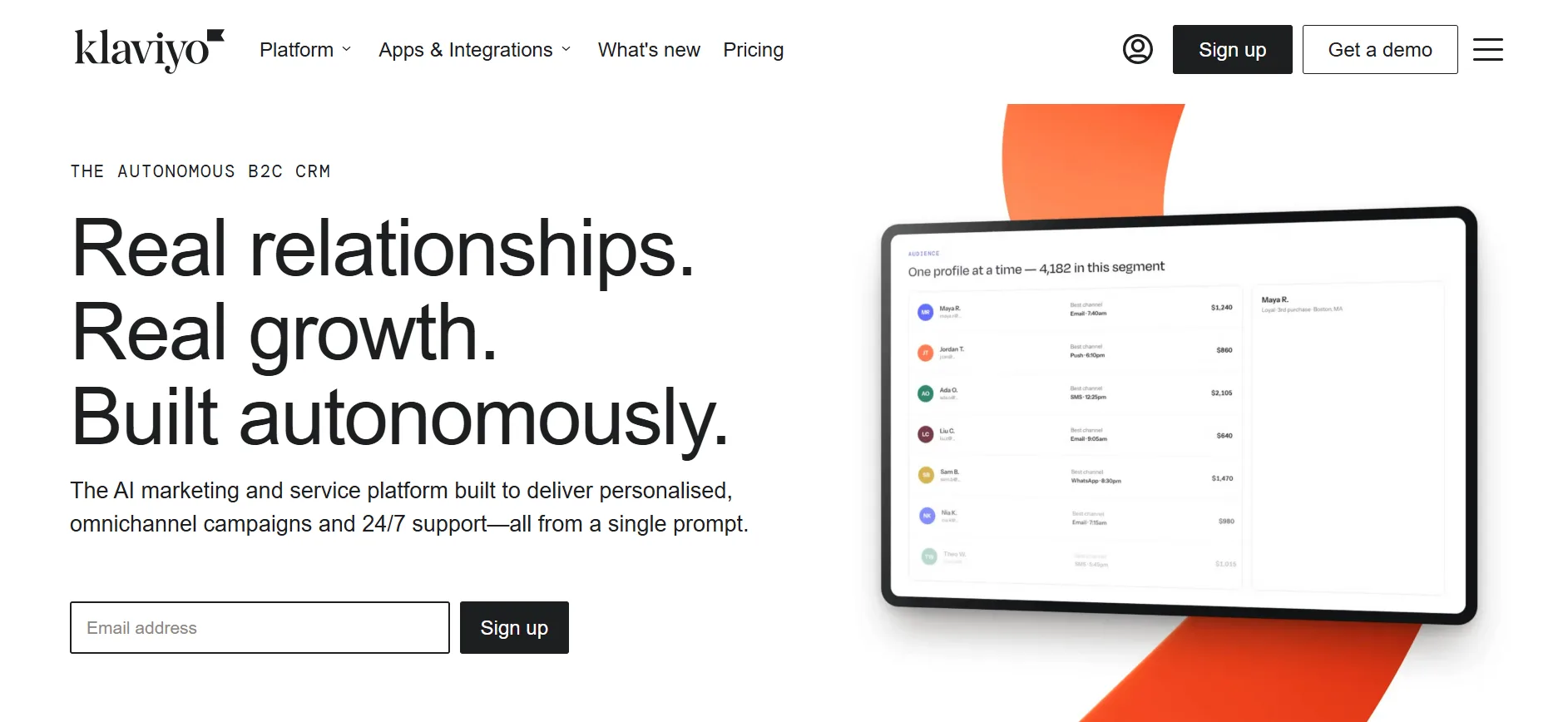
Klaviyo is a customer data and marketing automation platform built for ecommerce. It is one of the more comprehensive Shopify marketing automation platforms for brands that have outgrown basic email campaigns.
Klaviyo syncs Shopify customer, order, and browsing data, then uses it to power segments, email and SMS campaigns, and automated flows such as welcome series, abandoned cart, post-purchase, and win-back. Campaigns can be triggered by purchases, product interests, customer attributes, and engagement.
Klaviyo turns store data into personalized messages that drive repeat revenue. Segmentation and predictive features help brands send the right offer to the right customer instead of sending the same email to the whole list.
Key Features
Limitations
Klaviyo becomes more expensive as your active profile count and messaging requirements grow. Its depth can also be unnecessary for a small store that only needs occasional newsletters.
Pricing

Omnisend is an ecommerce marketing automation platform that combines email, SMS, and web push notifications in one tool. It is a practical choice for Shopify stores that want multi-channel automation without managing a separate system for each channel.
Omnisend includes prebuilt ecommerce workflows such as welcome, abandoned cart, browse abandonment, and post-purchase, along with signup forms, segmentation, and a drag-and-drop email builder. Different channels can be combined inside the same workflow.
Omnisend makes it easier to launch revenue-driving automations quickly. Small teams can reach shoppers by email, text, and push from one platform, which keeps costs and setup time low as the store grows.
Key Features
Limitations
Brands with highly complex enterprise segmentation or broader CRM requirements may eventually need a more advanced customer data and marketing platform.
Pricing
Postscript is an SMS-first marketing platform for Shopify brands. It treats text messaging as a primary revenue channel rather than an add-on to email, and it has recently added email and RCS messaging.
Postscript helps merchants grow an SMS subscriber list, send campaigns, and automate flows such as welcome offers, abandoned cart reminders, and product launch alerts. It uses Shopify order and browsing data for segmentation and includes tools for consent management and compliance.
Postscript opens a direct, high-visibility channel to customers’ phones. Well-timed texts can recover carts, drive launch-day sales, and bring back repeat buyers, especially for brands with frequent drops or promotions.
Key Features
Limitations
SMS marketing requires careful consent management and can become expensive at high message volumes. Merchants should also monitor message frequency because over-messaging can increase unsubscribes.
Pricing
Attentive is an enterprise messaging platform for larger ecommerce brands. It covers SMS, MMS, RCS, email, and push notifications from a single system.
Attentive helps brands grow subscriber lists, build personalized automated journeys, and use AI to optimize message content and send times. It also offers dedicated strategy and support for high-volume programs.
For Shopify Plus and high-volume stores, Attentive supports large-scale, personalized messaging across channels. Brands that run frequent product launches and promotions can manage subscriber growth and campaign performance in one place.
Key Features
Limitations
Attentive is generally better suited to brands with meaningful messaging volume and a larger customer base. Smaller stores may not get enough value from an enterprise-oriented platform.
Pricing
Rebuy is a personalization and upsell platform for Shopify stores. It focuses on increasing average order value by showing shoppers the right products at the right moment.
Rebuy powers AI product recommendations, smart carts, in-cart upsells, cross-sells, checkout offers, and post-purchase offers. Merchants can control merchandising rules and A/B test offers across the shopping journey.
Rebuy helps shopify stores to earn more revenue from existing traffic. Relevant add-ons and bundles raise order value without extra ad spend, which improves the return on every visitor the store already pays to acquire.
Key Features
Limitations
Rebuy is most useful when a store already has enough order volume to optimize AOV systematically. Very small stores may not have enough traffic to justify a dedicated personalization layer.
Pricing
ReConvert is a post-purchase upsell and thank-you page app for Shopify, now developed by Upsell.com. It is best known for what happens after a customer completes an order, a moment many stores leave unused, and its plans now also cover product page and cart upsells, plus checkout upsells for Shopify Plus stores.
ReConvert lets merchants customize the thank-you page, add one-click post-purchase offers, show product recommendations, and run post-purchase surveys. It also tracks how those offers convert.
ReConvert turns the thank-you page into another sales opportunity. Post-purchase upsells add revenue without interrupting checkout, and survey responses give marketers data for future segmentation and campaigns.
Key Features
Limitations
Post-purchase optimization works best when the store already has a healthy order volume. It should also complement, rather than duplicate, any upsell system already running inside the cart or checkout.
Pricing
Judge.me is a product review app for Shopify stores. It helps merchants collect and display product reviews, photo reviews, video reviews, and other customer-generated content.
Judge.me sends automated review request emails after delivery, displays star ratings and review widgets on product pages, and supports Google rich snippets. Its free plan includes unlimited reviews, while Google Shopping integration is on the paid plan.
Judge.me builds social proof without a large software budget. Reviews give new shoppers the confidence to buy, and star ratings in search results and Google Shopping can improve click-through rates.
Key Features
Limitations
Judge.me is focused primarily on reviews and social proof. It now offers a basic email product and referral coupons on its paid plan, but brands looking for a full loyalty program or advanced lifecycle marketing will still need additional tools.
Pricing

Loox is a visual review app for Shopify stores. Its focus on photo and video reviews makes it particularly relevant to fashion, beauty, lifestyle, food, and other categories where seeing the product in use influences the buying decision.
Loox automatically requests reviews after delivery, encourages customers to upload photos and videos, and displays them in galleries and widgets on product pages. Video reviews, Google Shopping syndication, referrals, and advanced AI review tools are available on the Convert plan and above.
Loox turns customer photos into marketing content. Visual reviews give new shoppers more context before they buy and can be reused across product pages and social campaigns.
Key Features
Limitations
Loox is more expensive than basic review apps as a store grows. Convert plan pricing increases with order volume, and the free plan does not include video reviews or Google, Meta, and TikTok syndication.
Pricing
Shopify Collabs is Shopify’s built-in app for creator and affiliate marketing. It lets eligible Shopify merchants recruit creators through an application page, invite existing partners, and manage affiliate relationships from the Shopify admin.
Collabs handles creator recruitment, invitations, commission rules, affiliate links and discount codes, and sales tracking, with commission payouts handled through Shopify.
Collabs makes it easy to start a performance-based acquisition channel. Brands pay creators a commission only when their content drives a sale, without building an affiliate system from scratch.
Key Features
Limitations
Collabs currently isn’t accepting new creator signups, so merchants can only recruit creators who already have Collabs accounts, and it requires Shopify Network Intelligence to be turned on. It is also designed around Shopify’s ecosystem, so merchants that need highly advanced affiliate structures or complex multi-platform program management may eventually need a dedicated affiliate platform.
Pricing
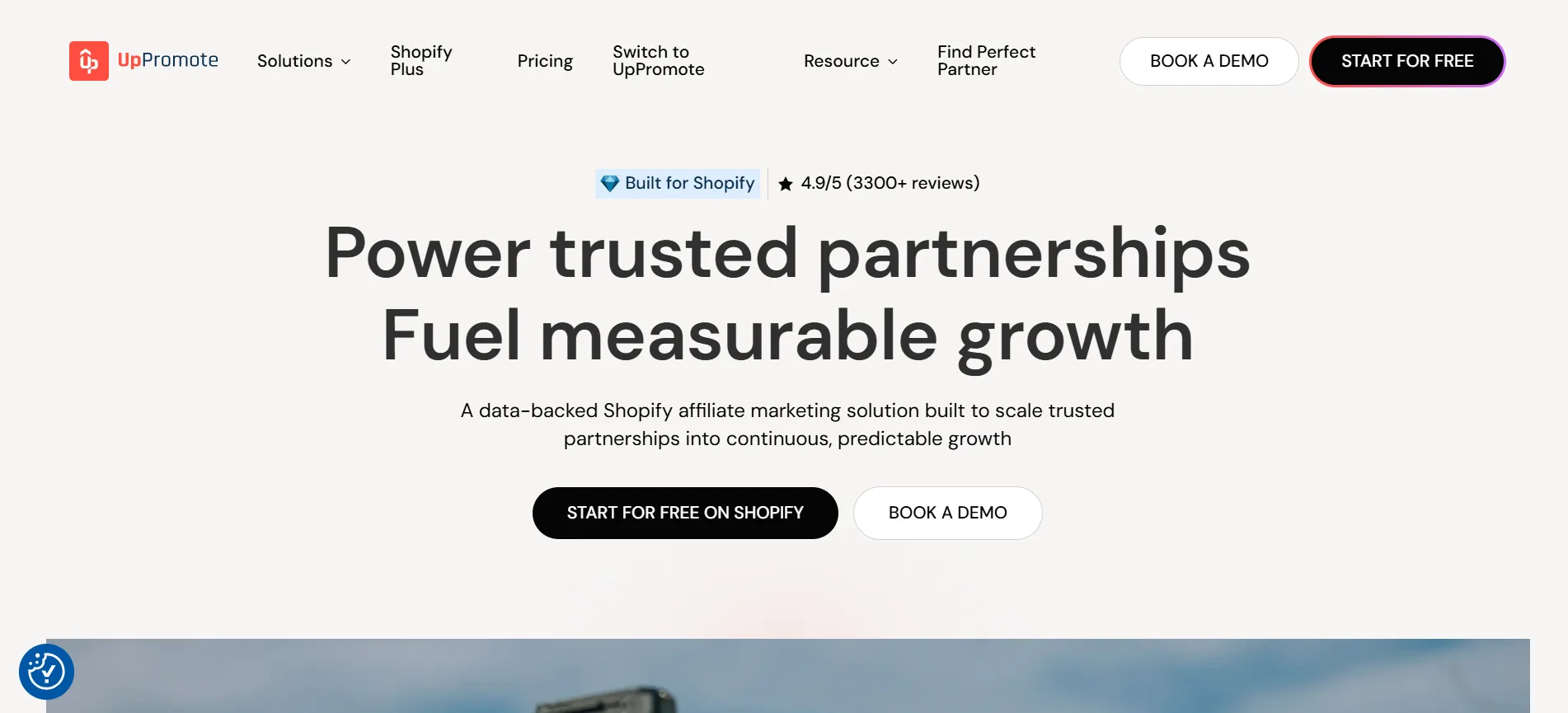
UpPromote is an affiliate and referral management platform for Shopify stores. It gives merchants more control over commissions, affiliates, and partner performance than a basic creator tool.
UpPromote supports affiliate recruitment, custom commission rules by program or product, coupon and link tracking, multi-level commissions, fraud detection, and payouts, including payouts as store credit.
UpPromote helps scale affiliate and influencer marketing into a structured acquisition channel. Detailed tracking shows which partners actually drive revenue, so brands can reward their best affiliates and focus budget where it works.
Key Features
Limitations
UpPromote’s pricing includes performance fees on paid plans, so the total cost can increase as affiliate-generated revenue grows. Merchants should evaluate both the subscription and performance fee together.
Pricing
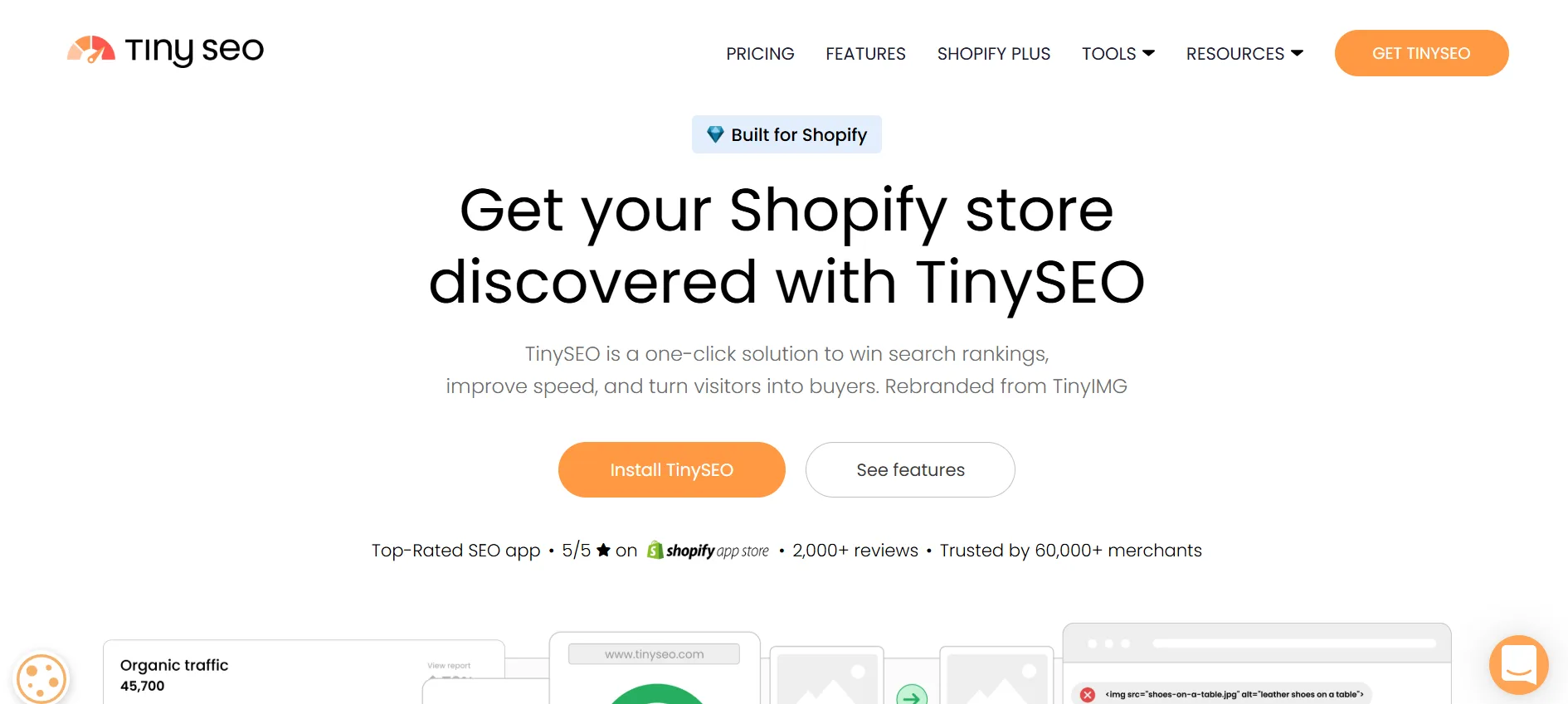
TinySEO, previously called TinyIMG, is an SEO and image optimization app for Shopify stores. It focuses on the technical issues that slow pages down or keep them from ranking, such as oversized images, missing alt text, metadata, and structured data.
TinySEO compresses images, adds and optimizes alt text, manages SEO metadata, adds structured data, and runs SEO audits. Most of these tasks can be automated across the full product catalog instead of edited page by page.
TinySEO supports organic search as a marketing channel. Faster pages and cleaner metadata help product and collection pages rank and convert, especially for stores with large catalogs.
Key Features
Limitations
An SEO app cannot replace a broader SEO strategy. Technical optimization will not fix weak product pages, poor internal linking, thin content, or an unclear search strategy.
Pricing
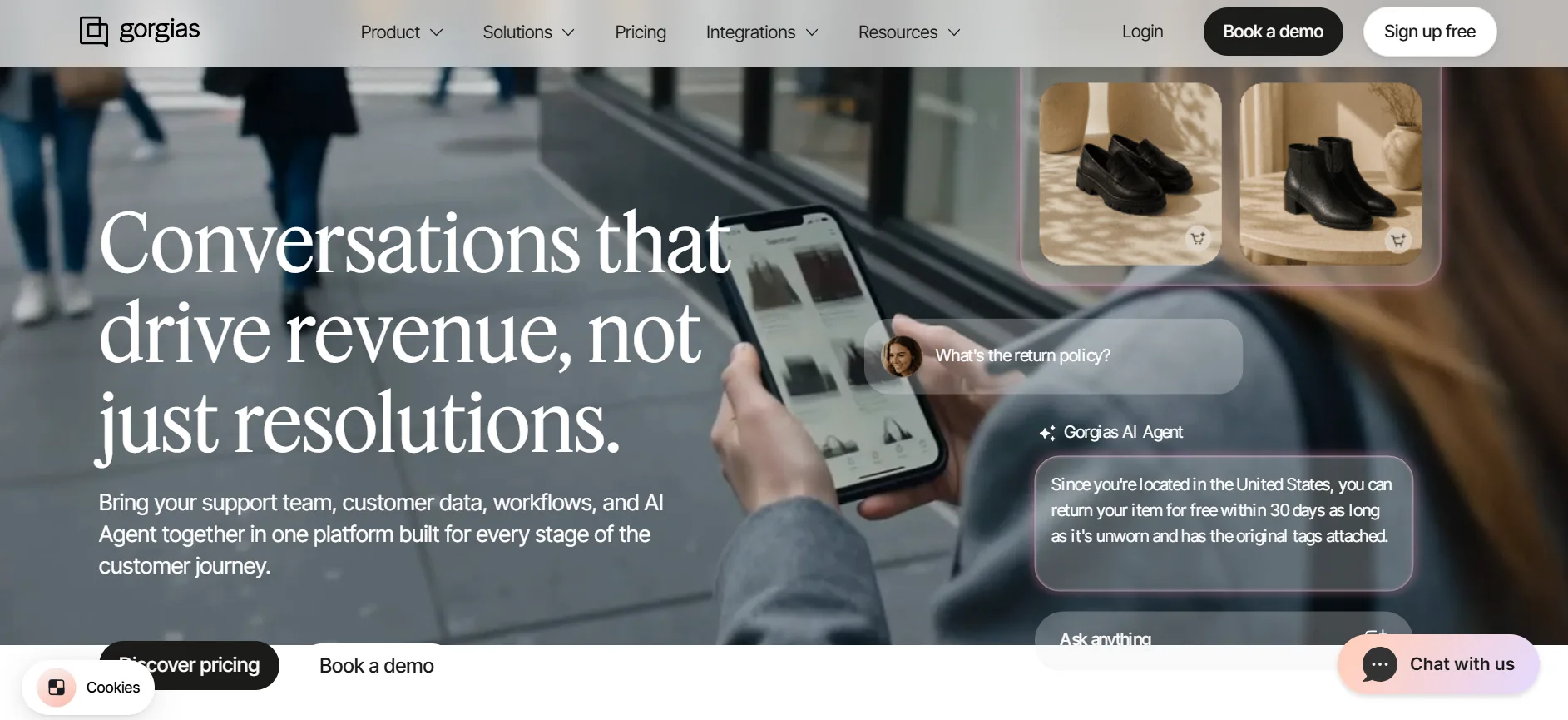
Gorgias is a helpdesk built specifically for ecommerce brands. Its Shopify integration brings customer and order information into support conversations, so agents can answer questions without switching between systems.
Gorgias manages email, live chat, and social channel conversations in one inbox, with automation rules and an AI Agent that can resolve common questions such as order status and returns. Agents can also take Shopify order actions directly from the helpdesk.
Gorgias protects revenue at key moments. Fast answers before purchase can save a sale, and good support after purchase keeps customers from abandoning the brand after a poor experience.
Key Features
Limitations
Gorgias is designed for stores with meaningful customer support volume. A small store receiving only a handful of customer questions each week may be better served by Shopify Inbox.
Pricing
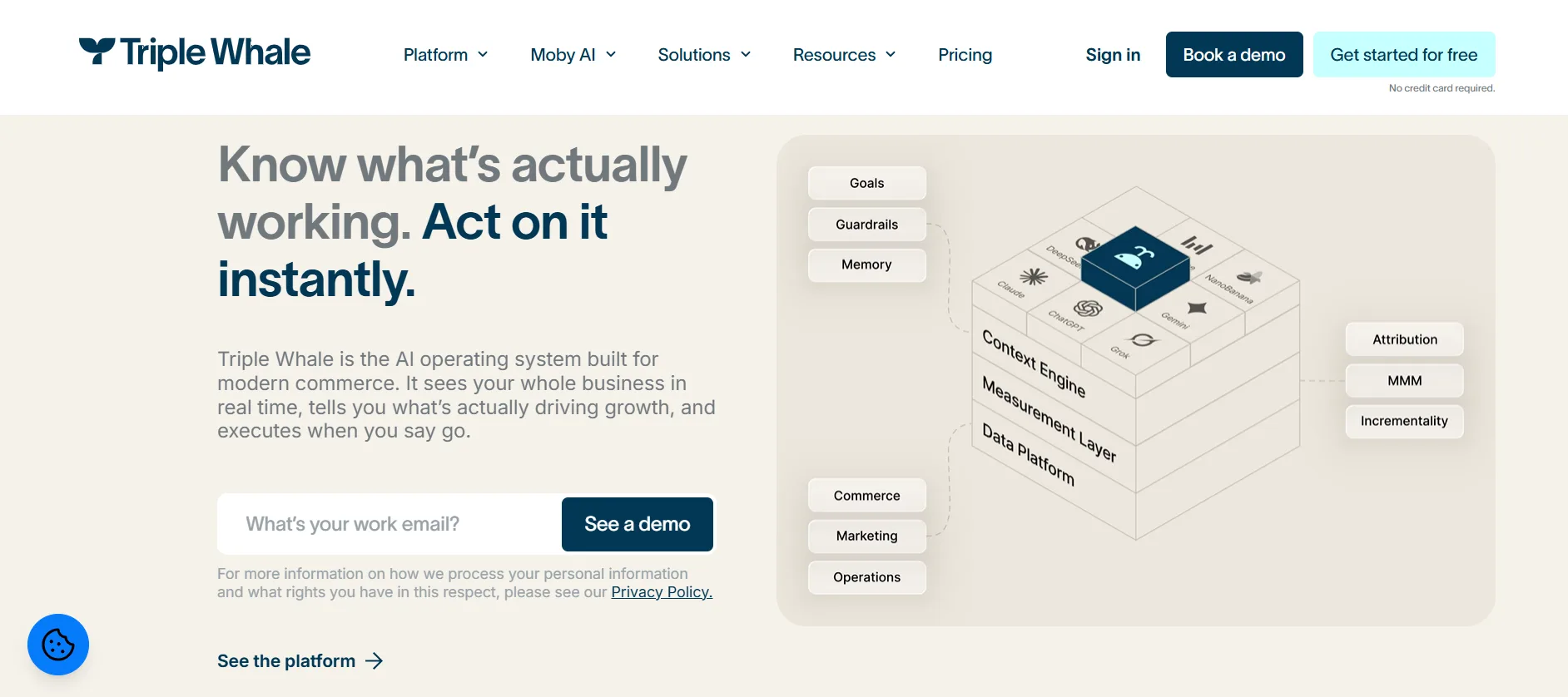
Triple Whale is an analytics and attribution platform for ecommerce brands. It gives marketing teams a broader view of performance, attribution, and profitability than individual ad platforms provide.
Triple Whale brings data from Shopify, Meta, Google, TikTok, email, and other channels into real-time dashboards. It adds first-party tracking, creative analytics, AI analysis, and profit reporting that includes ad spend, shipping, and fulfillment costs.
For Shopify stores, Triple Whale shows which channels and campaigns actually drive profitable revenue. That helps teams allocate budget based on business results rather than platform-reported ROAS alone.
Key Features
Limitations
Triple Whale becomes more valuable as advertising and data complexity increases. Smaller stores with limited paid media spend may get enough information from Shopify Analytics and GA4.
Pricing
Most stacks of Shopify marketing tools are built around acquisition and conversion. Email captures visitors. Ads bring them back. Upsells increase the value of the current order.
Retention is where the next purchase comes from.
That makes loyalty, gift cards, store credit, referrals, and cashback legitimate Shopify marketing tools rather than back-office features.
Gift cards can acquire customers as well as generate revenue.
Someone buying a $100 gift card for a friend is effectively introducing a new customer to the brand. During the holiday season, gift cards can also create a second purchasing cycle when recipients redeem them.
Merchants can go further by using gift cards as promotions. For example, a brand could offer a $20 gift card when a customer spends $100 during BFCM. The customer receives an incentive to return while the business gets an opportunity to generate another purchase.
This is different from a conventional discount because the reward is designed to bring the customer back.
Returns are often treated as a cost. Store credit can turn some returns into a retention opportunity.
A Shopify store might offer customers a 10% bonus when they choose store credit instead of a cash refund. A $100 refund could become $110 in store credit, giving the customer an incentive to spend again while keeping the original revenue inside the business.
Store credit can also work as a loyalty reward, goodwill gesture, referral incentive, or win-back mechanism.
A Shopify store is more likely to benefit from a loyalty program when:
The economics matter just as much as the features.
Suppose a store gives customers one point for every $1 spent and 100 points can be redeemed for $5. Each point is worth $0.05, so the effective reward rate is 5%.
That 5% needs to fit comfortably within the store’s margin. If the reward is too expensive, the loyalty program can increase sales while reducing profitability.
Referrals can turn existing customers into an acquisition channel. A double-sided offer is often simple to understand: the existing customer receives a reward, and the new customer receives an incentive on their first order.
Cashback works differently. Instead of giving an immediate discount, the merchant gives customers a future balance, often as store credit.
A customer who earns $10 in cashback has a reason to return and use it.
This is where an integrated customer loyalty platform can become useful. Instead of running separate systems for loyalty points, referrals, gift cards, and store credit, a merchant can manage these balances together and connect them to Shopify and the other Shopify marketing tools in the stack.
For omnichannel brands, the experience can extend to Shopify POS and digital wallet passes so that customers can access their rewards beyond the online storefront.
There is no reason for a $300,000 Shopify store to use the same Shopify marketing tools as a $30 million omnichannel retailer.
Start with Shopify’s native tools.
A lean stack could include:
Software cost: this stack can start at $0, because Shopify’s native tools come with your Shopify plan and apps such as Judge.me and Klaviyo have free plans. Costs rise as contacts, emails, and orders grow.
The priority at this stage is learning which marketing jobs actually require specialized software.
At this stage, the stack usually needs deeper automation and retention.
A practical setup could include:
Software cost: this depends heavily on contacts, order volume, tickets, and analytics requirements, so add up the plans in each tool’s pricing section above before committing.
Larger brands usually need their stack to work across more than one channel.
That can mean:
At this stage, software costs are usually customized around revenue, customer volume, channels, and operational complexity.
Every Shopify marketing tool should have one primary KPI.
| Tool category | Primary KPI |
|---|---|
| Lead capture | Signup rate |
| Email/SMS | Revenue per recipient |
| Upsell | Average order value |
| Retention | Repeat purchase rate |
| Loyalty | Redemption rate and repeat purchase rate |
| Reviews | Product-page conversion rate |
| Affiliate | Revenue and CAC |
| Support | Resolution rate and customer satisfaction |
| Attribution | Blended CAC and contribution margin |
A tool should not be judged only by the revenue it reports.
For example, an abandoned-cart platform may claim $50,000 in attributed revenue. That does not automatically mean the platform created $50,000 of incremental revenue. Some customers would have returned and purchased anyway.
A simple holdout test can help.
Exclude a small percentage of eligible customers from a specific campaign or retention flow for 60-90 days. Compare their purchase behavior with the customers who received the campaign.
The same principle applies to loyalty programs. Compare purchase frequency, AOV, and retention between members and a comparable non-member group.
The objective is to measure incremental business impact, not just platform-attributed revenue.
Start with Shopify’s built-in tools. Add one Shopify marketing tool when you have a clear job it needs to perform. Then audit the stack as the store grows.
The strongest set of Shopify marketing tools is not the one with the most apps. It is the one where every tool has a clear job, customer data can move between systems, and each investment can be tied to a measurable business outcome.
For merchants looking to strengthen the retention side of that stack, 99minds brings loyalty, gift cards, store credit, referrals, cashback, and memberships into one platform.
Book a 99minds demo to see how one platform can manage these retention programs for your Shopify store and connect them with the rest of your Shopify marketing tools.