We're building the future of agentic promotions. Sign up for early access!
Sign up
We're building the future of agentic promotions. Sign up for early access!
Sign up 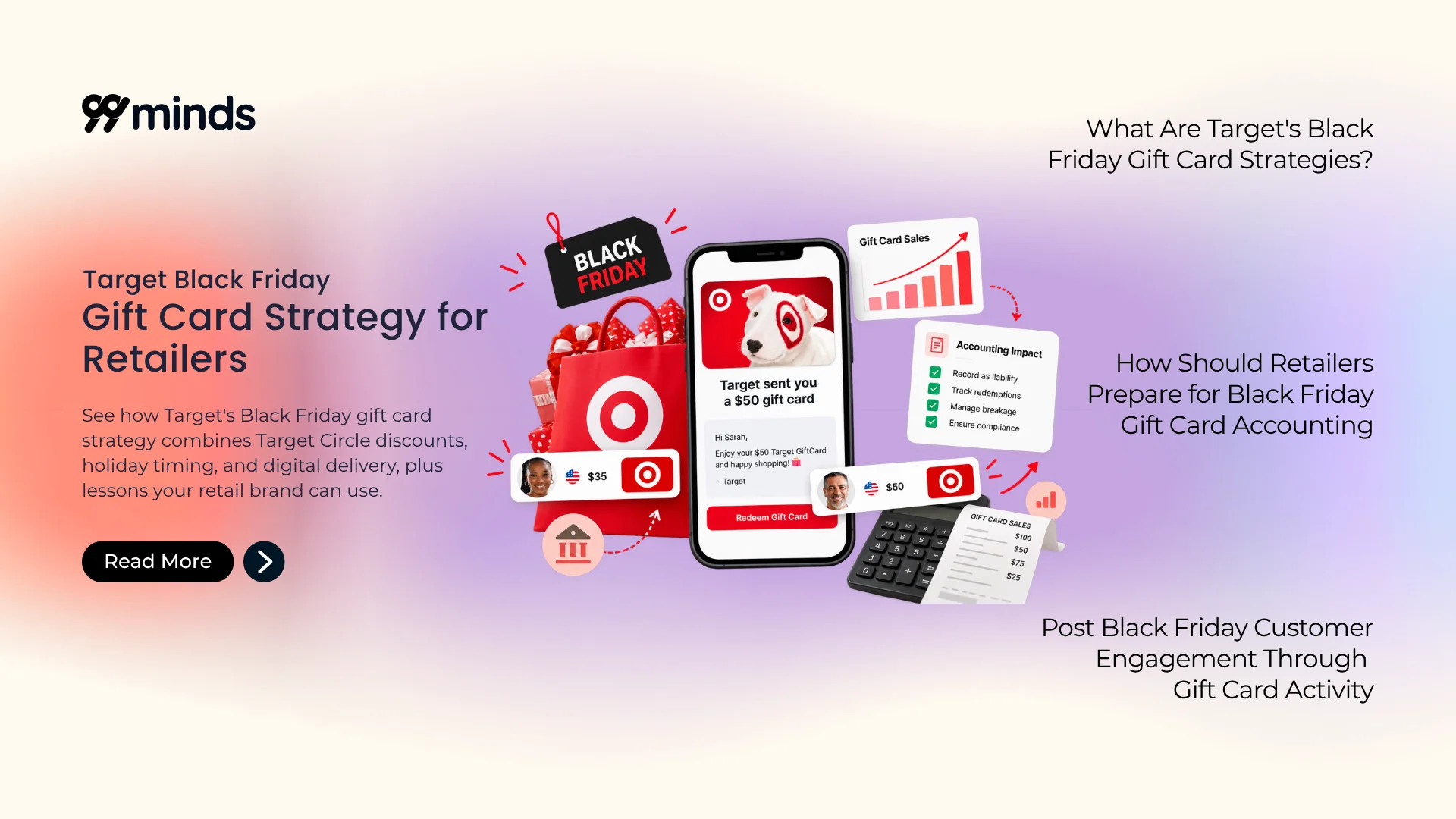
Black Friday has become a broader shopping period, giving retailers more opportunities to use gift cards before, during, and after peak promotional days. Target’s Black Friday gift card strategy provides a useful example of how gift card discounts, loyalty membership, holiday timing, multiple channels, and digital delivery can work together.
Target’s Black Friday gift card strategy rests on six moves: a short discount window, a loyalty-only offer, promotions that run past Black Friday, a capped discount, availability in every channel, and digital cards that can be scheduled. Each one is easy for another retailer to copy at a smaller scale.
| Strategy | What Target did | Takeaway for retailers |
|---|---|---|
| Limited-time discount | 10% off GiftCards on December 6 and 7, 2025 | Run short, dated windows you can measure |
| Loyalty-member exclusive | Offer limited to Target Circle members and applied automatically | Make gift card deals a member benefit |
| Season-long promotions | Daily deals from November 1 through December 24, and gift card usage up four times after Christmas | Plan campaigns for early, late, and post-Christmas shoppers |
| Promotional mechanics | Discount applied to up to $500 in GiftCards, a $50 maximum | Choose mechanics that protect margin and are easy to redeem |
| Multiple channels | Physical, email, and mobile cards sold in stores, on Target.com, and in the app | Keep terms consistent wherever customers buy |
| Scheduled digital delivery | Email and mobile cards arrive within four hours or on a date up to three months ahead | Cut the steps between purchase and delivery |
A limited-time discount gives customers a clear reason to buy gift cards during a high-intent shopping period. Set a defined start and end date, keep eligibility simple, and announce the offer in every channel where customers will see it.
A short window does three jobs at once:
For its 2025 holiday season, Target offered Target Circle members 10% off Target GiftCards on December 6 and 7. Target said more than 6 million GiftCards sold during the same deal the year before, according to its GiftCards deal fact sheet. The promotion ran online and in stores.
The lesson is that a gift card discount does not need to run all through Black Friday. Two well-defined days created urgency and gave Target a specific period to measure.
Tying a gift card promotion to a loyalty program makes the offer more targeted and gives customers a reason to join. It works best when eligibility is simple and the benefit is clear before customers reach checkout.
Membership adds three things to the offer:
Target’s 2025 gift card promotion was exclusive to Target Circle members, which Target describes as a free-to-join loyalty program. The discount applied automatically at checkout for members, online and in stores.
If you already run a loyalty program, make gift card promotions a member benefit rather than another sitewide discount.
Gift card demand does not end after Black Friday weekend. Promotions that continue into the wider holiday period reach customers who buy later for family, friends, coworkers, and last minute gifts. Keep each promotional window distinct so the offer never feels permanent.
A longer season pays off for a few reasons:
Target’s 2025 holiday program ran daily deals from November 1 through December 24 rather than one isolated Black Friday event, and its holiday resource hub tracked activity well past Black Friday.
Target also pointed to demand after Christmas. On December 26, 2025, Target reported that gift card usage rose four times between Christmas and New Year’s Eve.
Treat gift cards as a holiday season product, not a Black Friday product. Plan separate campaigns for early shoppers, holiday gift buyers, and customers shopping after Christmas.
A gift card promotion does not have to rely on one discount structure. Percentage discounts, bonus value, minimum purchase requirements, and member only incentives each suit different goals. The right choice depends on your margin, your customers’ behavior, and the role gift cards play in your wider promotional strategy.
Each mechanic pulls a different lever:
Target built a limit into its own offer. The 10% discount applied to up to $500 in GiftCards, which capped the discount at $50 and kept the cost of the promotion predictable.
Pick mechanics that customers understand quickly and that your business can track accurately. Every extra rule makes the offer harder to redeem.
Gift cards are easier to buy when customers reach them through the channels they already use. Stores, ecommerce, email, and mobile each suit different buying occasions, and consistent terms across all of them let customers move between online and offline shopping without friction.
More channels help in three ways:
Target offers physical GiftCards alongside email and mobile GiftCards. Target says its GiftCards can be purchased in stores, on Target.com, and through the Target app.
Make channel availability part of the gift card experience. Customers should know exactly where they can buy, receive, and redeem the card.
Digital gift cards remove most of the timing problems of physical gifts. Customers buy them when convenient and choose when the recipient receives them, which suits both planned gifting and last minute holiday purchases.
Digital delivery removes three kinds of friction:
Target’s email and mobile GiftCards usually arrive within four hours, and eligible digital cards can be scheduled up to three months in advance. Recipients can use Target eGiftCards in stores and on Target.com.
Reduce the number of steps between purchase and delivery. Clear delivery times and scheduling options make digital gift cards an easier choice.
Black Friday gift card campaigns increase the amount of outstanding gift card value a retailer needs to track. The work does not stop when the promotion ends. Retailers also need visibility into redemptions, remaining balances, breakage, reconciliation, audit records, and applicable unclaimed property requirements.
A gift card sale is generally recorded as gift card liability rather than immediate revenue because the retailer still has an obligation to provide goods or services when the customer redeems the card. The accounting treatment depends on the applicable accounting framework and the retailer’s circumstances.
For a detailed explanation of journal entries, liability, breakage, and compliance, see our guide to gift card accounting.
Black Friday can create a significant increase in gift card transactions across ecommerce and physical stores. Retailers should reconcile issued value, redeemed value, refunds, adjustments, and outstanding balances.
Reconciliation is about more than confirming that the numbers match. It surfaces transaction differences early and gives finance teams a clearer view of the remaining gift card liability.
Some gift card balances may never be redeemed. This is commonly referred to as breakage.
Retailers should monitor historical redemption patterns and apply the accounting treatment required for their business. Breakage should not simply be treated as revenue because the retailer expects that a portion of gift cards will remain unused.
For a deeper explanation, see our guide to gift card breakage.
Holiday promotions can involve high transaction volumes, promotional discounts, refunds, cancellations, and adjustments. Keeping a clear transaction history helps finance teams investigate discrepancies and support financial reporting.
Records should make it possible to understand when value was issued, redeemed, refunded, adjusted, or cancelled.
Unredeemed gift card balances may also be subject to unclaimed property requirements. These rules vary by jurisdiction, so retailers should review the requirements that apply to their business instead of assuming that one approach works everywhere.
The customer relationship often becomes more valuable after a gift card is redeemed. A gift card recipient may be a new customer, an existing customer purchasing for someone else, or a customer returning after a long gap.
That makes redemption an important point in the customer journey.
Look at when customers redeem their gift cards, what they purchase, how much they spend, and whether they return for another purchase.
For example, Target reported that gift card usage increased four times between Christmas and New Year’s Eve in 2025. That shows why the period after the initial gift card sale is commercially important.
The useful question for retailers is not only how many gift cards were sold. It is what customers do when they use them.
A gift card recipient may be visiting the retailer for the first time.
After redemption, relevant follow up communication can encourage a second purchase. The message could be based on the product category purchased, customer preferences, or the customer’s previous relationship with the brand.
Aim to move the customer from a one time gift card redemption toward an ongoing relationship.
Gift card redemption is also a natural entry point into a loyalty program.
When the customer can be identified, retailers can use the purchase to introduce relevant rewards, member benefits, or future offers. That turns the first redemption into part of a longer customer lifecycle rather than the end of the campaign.
Store credit serves a different purpose from promotional gift cards, but it is just as useful during the same post holiday period.
Customers returning gifts may prefer store credit over a refund to the original payment method. Retailers can use store credit as another way to retain value within the business while giving customers flexibility.
For retailers evaluating this approach, store credit management can be part of the broader customer retention workflow.
Once redemption and customer events are available, retailers can automate follow up actions.
For example:
Gift card purchased → Gift card redeemed → Customer identified → Relevant follow up → Loyalty or retention offer → Repeat purchase
The exact workflow depends on the retailer, but the principle is consistent. Use the transaction as a customer signal rather than treating it as an isolated payment event.
The operational challenge is connecting the promotion, the gift card program, customer engagement, and post purchase activity. 99minds brings gift card management, loyalty, store credit, coupons, referrals, automated workflows, membership, wallet passes, and multi currency gift cards into one platform.
Issuing a gift card is the easy part. Retailers also need to manage the lifecycle around it: issuance, activation, redemption, refunds, and other transactions. 99minds connects with gift card processors and ecommerce platforms, and supports gift card programs across multiple channels.
Plan each campaign around the promotional mechanics above, whether that is a limited time discount, a loyalty member offer, or part of a wider holiday campaign. Define the campaign rules first, then automate the operational steps around them. For retailers evaluating the category, gift card software gives you one place to run gift card operations.
Black Friday campaigns usually involve more than one customer or order event. Automated workflows trigger actions based on customer activity, order events, or other conditions you define, which cuts manual campaign work and applies the same rules every time.
A gift card brings the customer into the store, and loyalty gives that customer a reason to return. 99minds provides both gift card management and loyalty program management, so retailers run the two programs in the same platform. For retailers exploring this model, loyalty program software supports the retention side of the customer journey.
Coupons and referrals work alongside gift cards rather than replacing them. Coupons support promotional campaigns, while referral programs turn existing customers into an acquisition channel, and 99minds manages both.
Store credit covers returns, refunds, and retention use cases that are separate from promotional gift cards. Keeping these value types distinct makes it easier to track why customers received stored value and how they use it.
Retailers selling across markets also need gift cards that handle different currencies and storefronts. 99minds provides a multi currency gift card solution built for global gifting and omnichannel use, which matters most for retailers running multiple stores, markets, or storefronts.
Black Friday gift card promotions shouldn’t be treated as short-term discounts. Treat them as a full program: start with clear promotions, ensure a smooth redemption experience, track accounting properly, monitor breakage, and invest in post-purchase engagement. When connected to loyalty programs, gift cards can help drive repeat purchases and long-term customer value.
If you’re planning a Black Friday gift card promotion and want strategic help, you can get started with 99minds to align your gift card program with your overall holiday strategy.