We're building the future of agentic promotions. Sign up for early access!
Sign up
We're building the future of agentic promotions. Sign up for early access!
Sign up 
The best Thanksgiving marketing ideas for 2026 win sales over the holiday weekend and bring shoppers back in December and January. Bonus gift cards, double loyalty points, store credit, and Friendsgiving referrals do both.
Thanksgiving 2026 falls on Thursday, November 26. Black Friday follows on November 27, and Cyber Monday lands on November 30.
Of course, Thanksgiving isn’t just about family, football, and a plate piled high with turkey. It’s also the start of the busiest shopping stretch of the year.
Last year set a record. In 2025, 202.9 million U.S. consumers shopped from Thanksgiving Day through Cyber Monday. Online, Cyber Week brought in $44.2 billion, up 7.7% from 2024. Cyber Week means the five days from Thanksgiving Day through Cyber Monday.
Many of those shoppers bought once and vanished until the next holiday. This year, these effective ideas help you thank the customers who keep your business thriving, and give them a reason to return.
Beyond the turkey and cranberry sauce, Thanksgiving now kicks off holiday shopping for millions of Americans. Last year’s numbers show how much is at stake in 2026.
In 2025, shoppers spent $6.4 billion online on Thanksgiving Day, according to Adobe. Black Friday reached $11.8 billion. Cyber Monday hit $14.25 billion.
Shoppers plan around these dates, too. In the NRF 2025 holiday survey, 63% said they would do most of their holiday shopping over Thanksgiving weekend. The share was up from 59% in 2024.
The trend points one way. Each year, more of the holiday budget lands in this five-day window, and 2026 should be no different.
So how do you stand out in a sea of holiday offers? A deeper discount rarely does it on its own, and it eats into your margin.
A better plan for 2026 treats Thanksgiving as the first chapter, not the whole story. Win the first order over Thanksgiving weekend. Then give the customer a warm reason to come back in December or January 2027.
Turn Thanksgiving Shoppers Into Repeat Customers
99minds runs bonus gift cards, loyalty points, store credit, and referrals from one platform built for Shopify and BigCommerce brands.
These Thanksgiving marketing ideas are ordered by impact. The first five are Thanksgiving promotion ideas built for repeat purchases. The other six cover early access, email, bundles, giveaways, Giving Tuesday, and selling online and in store.
Gift cards are one of the easiest Thanksgiving promotions to run, and a small bonus makes them even more tempting.
Offer a $10 bonus gift card with every $50 gift card purchase from November 26 to November 30. Make the bonus card valid only from January 2 to January 31, 2027.
January is a quiet month for most retailers. A bonus card with January dates brings shoppers back just as holiday traffic fades.
The demand is already there. Gift cards topped the list of gifts people wanted in the NRF 2025 holiday survey. Half of all respondents chose them.
A few details make the offer easier to buy and use:
A gift card platform can issue the bonus card automatically with each qualifying purchase. Your team never has to send bonus codes by hand. For more offer formats, browse these gift card promotions.
Who says a Thanksgiving promotion has to be a discount?
A 20% discount costs you margin on every single order. Double loyalty points cost you money only when customers come back to redeem them.
Shoppers still feel rewarded, and your prices stay where they are. You can keep the cost in check with a few simple rules:
The real payoff arrives in December. Customers who earned extra points now have a reason to come back and spend them.
The approach works in practice. TasselsShoes.com, a 99minds customer, offered double points during key seasons and reminded shoppers about unused points. The program helped deliver 20% more repeat purchases, according to the TasselsShoes case study.
A loyalty program lets you offer double points for a limited window, like Thanksgiving week.
Thanksgiving is all about giving thanks. So why not thank the people who kept your business going through 2026?
Store credit is a balance that customers can spend only at your store. Pick your best customers from the past year, and send each one $10 in store credit that expires on January 31, 2027.
Keep the message short and sincere:
“Thanks for shopping with us in 2026. We added $10 in store credit to your account for your next order.”
It feels far more personal than another percentage-off code. And it costs you nothing unless the customer comes back to shop.
There is one catch. Customers forget balances that live in old emails.
Deliver the store credit as an Apple or Google Wallet pass instead. The balance then sits on the customer’s phone, ready to use online or at your register.
Friendsgiving is a holiday meal shared with friends, usually the weekend before or after Thanksgiving. Somewhere between the stuffing and the pie, people swap tips on brands they love.
Make it easy for your customers to recommend yours. Here is how a “Give $20, Get $20” offer works:
Paying the reward as store credit, not cash, matters. It brings the loyal customer and the new friend back for another order.
The $60 minimum keeps the offer profitable. Launch it in mid-November so it overlaps with Friendsgiving weekends. Promote it in your emails and on your order confirmation page, since shoppers are most likely to share right after they buy.
A referral program can create each referral link, check that orders qualify, and issue the store credit for you. Need more angles? See these referral program ideas.
Cashback often works like a discount that customers quickly forget. A redemption window turns it into a reason to come back.
Offer 5% cashback on every order placed from November 26 to November 30. Issue it as store credit that customers can spend only from December 15, 2026, to January 31, 2027.
For example, a $130 order earns $6.50 in store credit. That small balance gives the customer a concrete reason to visit again during the holidays.
Show the rules clearly at checkout:
“You earned $6.50 in store credit. Spend it between December 15 and January 31.”
Then send two reminder emails. Send one when the window opens and another a week before it closes. Those reminders drive most of the redemptions.
Looking for more ways to keep customers coming back after the holidays? Try these post-holiday gift card incentives.
Thanksgiving is the warm-up for Black Friday, and your most loyal customers deserve a head start.
Early access rewards them without a bigger discount. Members simply see your Black Friday prices first. In 2026, open the sale to members on Tuesday, November 24, and to everyone else on Friday, November 27.
Send the news by text message as well as email. In 2025, 57.5% of Cyber Monday online sales came from mobile devices, according to Adobe.
Keep the text short and clear:
“Your Black Friday prices are live for members. Shop before everyone else on Friday.”
Early access also gives shoppers a reason to join your loyalty program before the busiest week of the year. To plan the rest of the weekend, see this guide to Black Friday and Cyber Monday marketing.
It’s Thanksgiving, and what better way to celebrate than by thanking your customers?
Some of the most memorable Thanksgiving emails contain no offer at all. Send a short note from the founder or team on Thursday, November 26.
Thank customers for their support in 2026. Mention one real moment from the year, like a new product launch or your first store opening.
If you want to include a reward, put it at the end, not the top:
“Thank you for being part of our community this year. As a small thank-you, here’s $10 in store credit for your next order.”
Leading with gratitude keeps the email personal. Ending with store credit lets you measure it, because you can see how many customers redeem it.
Choose subject lines that sound like a person wrote them:
Are you a candle maker? Why not create a 2026 Thanksgiving set with pumpkin spice, cranberry, and roasted chestnut scents?
Run a bakery? Try a limited-edition pie bundle with pecan, apple, and pumpkin.
Bundles raise order value without cutting the price of individual products. Start with items customers already buy together, and give the set a seasonal name.
A limited-edition product adds urgency. When shoppers know it disappears after Thanksgiving week, they buy now instead of waiting.
Build your bundles from products with healthy margins. That way, you protect profit even if you add a small bundle discount.
Bundles also help you skip the sitewide sale. A focused offer on a few festive sets keeps customers from learning to wait for discounts on everything.
A giveaway is a fun way to celebrate the spirit of generosity and get people talking about your brand.
Make the prize a gift card to your store, not a random product bundle. Winners get to pick exactly what they want, and they have to come back to spend it.
Want more engagement? Run a user-generated content (UGC) contest. UGC means photos or videos that customers create and share themselves.
Ask customers to share their Thanksgiving table, a favorite product, or a family tradition. Ask them to tag your brand or use a contest hashtag.
Keep entry to one or two steps. Every extra requirement means fewer people enter. Close entries on Sunday, November 29, so you can announce winners on Cyber Monday.
Always ask winners for permission before you reuse their content. Then feature the best entries on product pages, in emails, and across your social posts.
Thanksgiving is a season of gratitude, and Giving Tuesday carries that spirit into December. Giving Tuesday is the Tuesday after Thanksgiving, which falls on December 1 in 2026.
Tie your donation to gift cards rather than total sales. For example, donate $2 to a local food bank for every gift card sold on December 1.
A clear link between the purchase and the donation is easy for shoppers to understand. It also keeps your campaign focused on gift cards, which people are already buying as holiday gifts.
Share the details on your website and in your emails:
If you partner with a local nonprofit, invite them to share the campaign too. Their supporters may become your newest customers.
Picture this. A shopper sees your offer on Instagram and buys a gift card online. The next week, they visit your store to spend it.
If that gift card fails at your register, you lose the sale and some of the customer’s trust.
Every one of these Thanksgiving marketing ideas should work in both places. The next section shows what to check before you launch.
Holiday shoppers move between your website and your store, so your offers need to move with them.
During the 2025 Thanksgiving weekend, 129.5 million people shopped in stores and 134.9 million shopped online. Plenty of them did both, and you can expect the same in 2026.
Before your campaign goes live, check that:
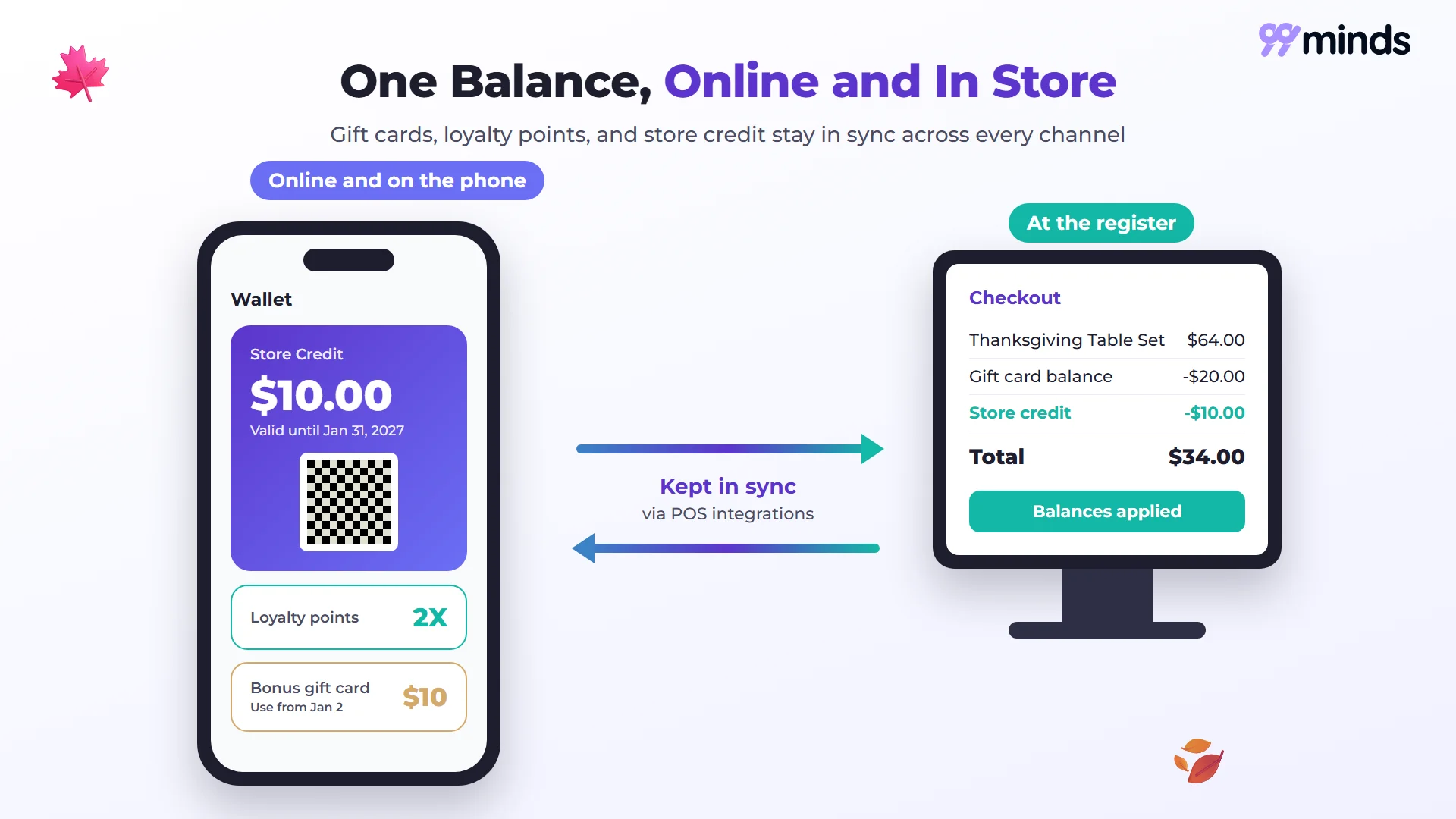
These checks fail most often when your online store and POS run on separate systems. The customer’s balance lives in one place but not the other.
POS integrations fix this. They keep gift card balances, loyalty points, and store credit in sync with systems like Shopify POS, Lightspeed, and Hike.
To reward customers the same way in every channel, see how omnichannel loyalty programs work.
Launch Your Thanksgiving 2026 Promotions
Set up bonus gift cards, double points, and store credit in one platform, and keep every balance in sync online and in store.
Thanksgiving is your chance to thank the customers who keep your business thriving. It’s also your best chance to bring them back.
The best Thanksgiving marketing ideas start with one clear goal. Choose yours first:
Then put your dates on the calendar. This sample timeline covers Thanksgiving 2026 from setup to redemption:
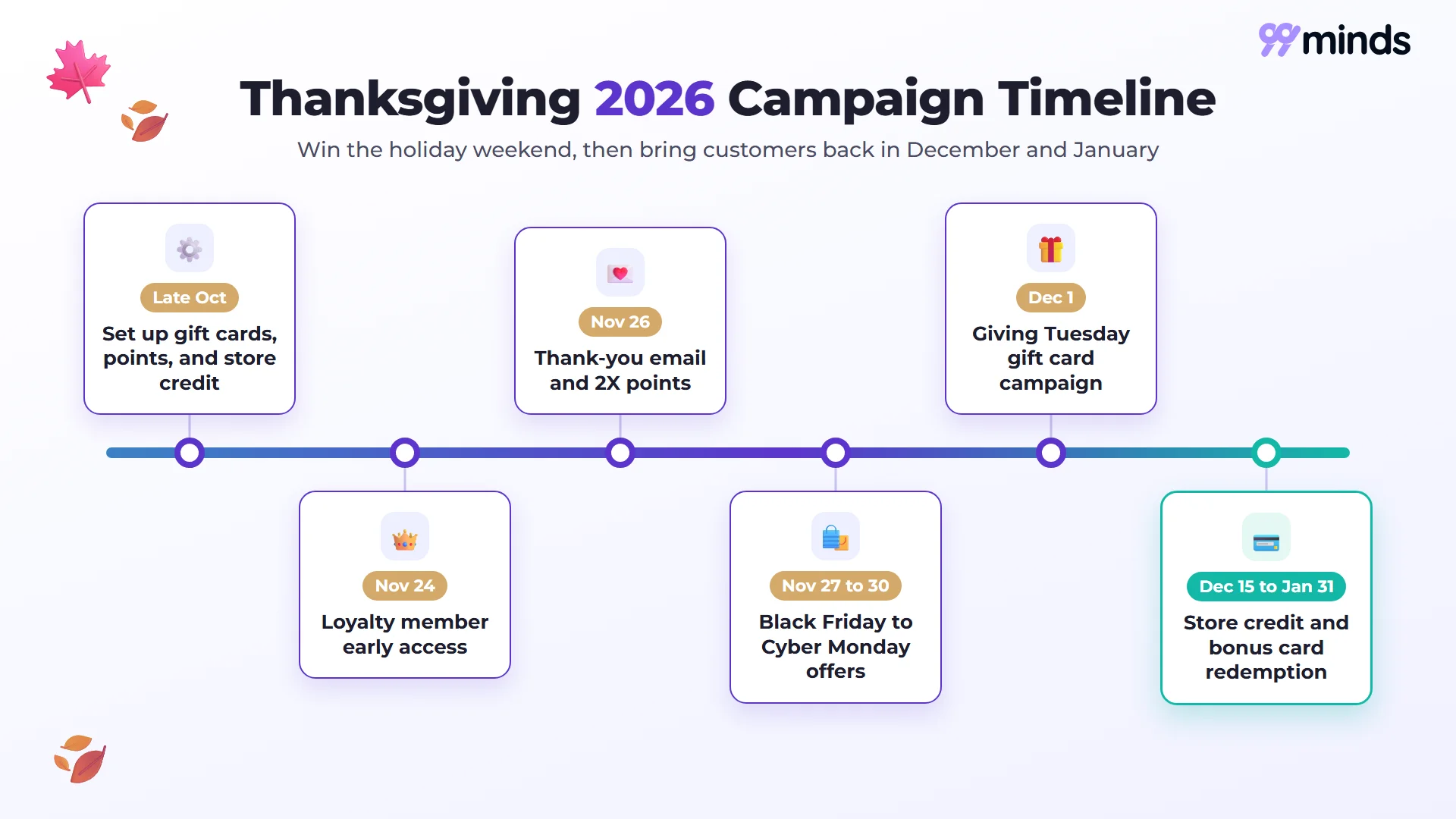
Finally, measure more than weekend revenue. Track how many Thanksgiving customers buy again by January 31, 2027. That number tells you whether you built lasting loyalty or a one-weekend spike.
Plan early, keep your offers simple, and make Thanksgiving 2026 one your customers remember long after the leftovers are gone!
Set up bonus gift cards, points multipliers, and store credit before Thanksgiving week. Book a demo with 99minds to see how they work together online and in store.