We're building the future of agentic promotions. Sign up for early access!
Sign up
We're building the future of agentic promotions. Sign up for early access!
Sign up 
The best Black Friday promo code ideas do more than reduce prices. The right code can help you increase average order value, attract first-time shoppers, recover abandoned carts, reward loyal customers, and encourage another purchase after the holiday rush.
A simple code such as SAVE20 may work for a broad promotion, but more targeted codes give merchants greater control over who receives an offer, how it is redeemed, and what business outcome it supports. The Black Friday coupon code ideas below each come with example code names, the discount mechanic, and the audience it fits best.
Black Friday shoppers already expect discounts, but promo codes give merchants more control over how those discounts are delivered. Instead of offering the same deal to everyone, brands can create offers around specific customers, products, channels, and purchase behaviors.
Promo codes also make it easier to measure individual promotions. A merchant can compare the performance of an email code with an SMS code, or see whether a VIP offer generates more valuable orders than a general sitewide discount.
Black Friday is a particularly important opportunity because online spending hit a new high in 2025. U.S. shoppers spent $11.8 billion online on Black Friday 2025, up 9.1% from 2024, according to Adobe Analytics.
Shopper turnout set a record as well. A record 202.9 million consumers shopped over the five days from Thanksgiving through Cyber Monday, according to the National Retail Federation. NRF CEO Matthew Shay described “a highly engaged consumer who is focused on value, responds to compelling promotions,” which is exactly the shopper a well-targeted code is built for. Many of those shoppers start on Thanksgiving Day, so pair your codes with a few Thanksgiving marketing ideas that reach them early.
Promo codes can help merchants:
The key is to match the code with the outcome you want instead of treating every Black Friday shopper the same way.
Black Friday coupon code ideas work best when the discount mechanic matches a specific business goal. A well-planned promo code can help increase average order value, encourage customers to complete a purchase, attract new shoppers, or bring existing customers back for another purchase.
The right code also gives merchants greater control over their Black Friday promotions. Instead of relying on one generic discount, you can create offers that fit your customers, products, and sales objectives while tracking how each promotion performs.
Here is a quick reference for all 20 ideas before the detail on each one.
| Promo code idea | Example codes | How it works | Best for |
|---|---|---|---|
| 1. Sitewide percentage off | BF25, BFCM30 | One flat discount on eligible products | Broad, simple campaigns |
| 2. Tiered spend more, save more | SPEND100SAVE20, TIER3 | Bigger discount at higher cart totals | Raising AOV |
| 3. VIP early access | VIPEARLY, BFVIP | Shop the sale before it goes public | Loyal and high-value customers |
| 4. BOGO | BOGOBF, DOUBLEUP | Second item free or discounted | Units per order, moving inventory |
| 5. Mystery discount | MYSTERYBF, SCRATCHBF | Shopper reveals a discount within a set range | Engagement and email capture |
| 6. Hourly flash | FLASH9AM, POWERHOUR | A different offer for each short window | Urgency and repeat visits |
| 7. First-buyer only | FIRST50, EARLYBIRD | One-time discount for new customers | Acquisition |
| 8. Free shipping threshold | FREESHIP75, SHIPFREEBF | Free shipping above a minimum spend | Checkout friction and AOV |
| 9. Bundle and gift set | BUNDLE20, GIFTSET | Discount on a curated product set | AOV and gift shopping |
| 10. Gift card bonus | BONUS20, GIFT100GET20 | Bonus gift card with a gift card purchase | Gift card sales, future visits |
| 11. Loyalty points multiplier | 3XPOINTS, BFPOINTS | Extra points instead of a price cut | Loyalty engagement |
| 12. Loyalty tier | GOLDBF, PLATINUM30 | Bigger benefit for higher tiers | Retention |
| 13. Double-sided referral | GIVE20GET20, BFFRIEND | Reward for both referrer and new buyer | Acquisition through customers |
| 14. SMS only | TEXTBF, TXT25 | Short-lived offer sent by text | SMS engagement |
| 15. Email signup | JOINBF15, LISTONLY | Discount in exchange for a subscription | List growth |
| 16. Hidden scavenger hunt | FOUNDIT, SECRETBF | Code hidden across pages and posts | Engagement and discovery |
| 17. Abandoned cart recovery | COMEBACKBF, FINISHBF | Time-limited nudge to finish checkout | High-intent shoppers |
| 18. Win-back | MISSYOUBF, WELCOMEBACK | Targeted offer for lapsed customers | Reactivation |
| 19. Giving Tuesday give-back | GIVEBACK, GIVING10 | Discount plus a donation per order | Cause-related campaigns |
| 20. January bounce-back | JAN20, NEWYEARBF | Code redeemable only after the holidays | Repeat purchases |
A sitewide percentage-off code is one of the easiest Black Friday promotions for customers to understand. A code such as BF25 can give shoppers 25% off eligible products, while BFCM30 could provide a 30% discount during a specific campaign period.
Use it when you want one clear offer that can be promoted across email, SMS, social media, paid advertising, and onsite banners. It removes complexity from the shopping experience because customers do not need to understand different discount tiers or eligibility rules.
However, a sitewide discount can affect margins quickly. Merchants should check product-level profitability before applying the same percentage to the entire catalog.
Tiered discount codes encourage shoppers to increase their order value by offering a larger discount when they reach a higher spending threshold. A typical ladder is 10% off orders over $75, 15% off over $125, and 20% off over $175.
The structure gives shoppers a clear reason to add another product to their cart. Instead of checking out immediately, someone with a $68 basket may look for another item to reach the $75 threshold.
Tiering pays off when increasing AOV is more important than giving every customer the maximum possible discount. Adobe reported that competitive discounts during the 2025 holiday season encouraged shoppers to purchase higher-ticket products.
VIP early access codes give selected customers the opportunity to shop before the main Black Friday promotion becomes available to everyone. A code such as VIPEARLY could unlock a 24-hour early access period for loyalty members or high-value customers.
The value of this promotion is not necessarily a larger discount. Early access can make loyal customers feel recognized while giving them a chance to purchase popular products before inventory becomes limited.
You can distribute the code through segmented email campaigns, SMS, or a loyalty program. Higher-value customers can also receive additional benefits alongside early access.
Buy-one-get-one promotions encourage customers to purchase an additional item by making the second product free or discounted. BOGOBF might make the second product free, while DOUBLEUP takes 50% off the second item.
BOGO works especially well for consumable products, products that customers naturally buy in multiples, and items with enough margin to support the offer. It can also help merchants move seasonal inventory before demand falls after the holiday period.
You do not have to offer the second product completely free. A Buy One, Get One 50% Off structure can provide a strong incentive while giving the merchant more control over margins.
Mystery discounts make the promotion itself part of the shopping experience. Instead of telling customers exactly how much they will save, you can ask them to reveal a discount after clicking a promotion, subscribing to a list, or reaching checkout.
One shopper might reveal 10% off and another 30%, with 15% and 20% in between. The uncertainty creates curiosity and gives customers another reason to interact with the promotion.
You can present the reveal through gamified experiences such as a digital scratch card or a discount wheel, which makes the Black Friday offer more interactive.
Hourly flash codes create short promotional windows inside your larger Black Friday campaign. Instead of using one code throughout the entire day, you can release a different offer for a specific period.
FLASH9AM might run 25% off from 9 AM to 10 AM, then POWERHOUR switches to free shipping from 2 PM to 3 PM.
Shoppers get a reason to come back several times in one day, and each window carries its own urgency because the offer disappears on schedule.
First-buyer codes are designed specifically for customers who have never completed an order. FIRST50 might take $50 off a qualifying order, while EARLYBIRD gives 15% off a first purchase.
The main benefit is that you can use Black Friday traffic to acquire new customers without automatically giving the same discount to people who already purchase from your brand.
A minimum order value can help make the acquisition offer more sustainable. Limiting it to one use per customer, and blocking it for existing accounts, keeps the discount aimed at genuinely new buyers.
Free shipping can be a strong Black Friday incentive, particularly when shipping costs create hesitation at checkout. In Baymard Institute’s checkout research, 40% of shoppers who abandoned an order during checkout said extra costs such as shipping, taxes, and fees were too high. Instead of offering free shipping on every order, merchants can require customers to reach a minimum spend.
FREESHIP75, for instance, would unlock free shipping on orders of $75 or more. A shopper with a $62 basket now has a reason to add another product instead of paying a shipping fee.
The threshold should reflect your average order value and shipping economics. A threshold that is too low may increase fulfillment costs without improving order value, while one that is too high may not influence many shoppers.
Bundle codes combine multiple products into one Black Friday offer. Instead of discounting individual products, you can create a curated set and apply a code such as BUNDLE20 to the complete package.
The best bundles usually contain products that naturally belong together. A skincare brand could combine a cleanser, serum, and moisturizer, while an apparel brand could package complementary accessories with a bestselling product.
Bundles make holiday shopping easier too, because customers receive a ready-made gift option. A well-built bundle increases perceived value and encourages larger purchases.
Gift card promotions can extend the impact of Black Friday beyond the original transaction. One simple structure is to give customers a bonus gift card when they purchase a qualifying gift card amount.
For example, a merchant could offer a $20 bonus gift card when a customer purchases $100 in gift cards. The shopper receives additional value, while the brand gains an opportunity for a future purchase when the bonus card is redeemed.
Bonus offers suit holiday gifting well, because customers can buy gift cards for friends and family without choosing a specific product.
For managing promotional gift cards, a gift card platform can help merchants automate issuance, track balances, and manage promotional gift card activity.
A Black Friday promotion does not always need to rely on a direct price reduction. Loyalty points multipliers can give customers additional value while keeping the product’s selling price unchanged.
BFPOINTS might give loyalty members three times their normal points on qualifying Black Friday purchases. A customer who normally earns 100 points on an order would receive 300 points during the promotion.
Multipliers suit brands that want to drive sales while encouraging customers to stay engaged with their loyalty program. You can limit the offer to specific products, customer tiers, or campaign dates.
Loyalty tier codes give different Black Friday benefits to customers based on their membership level. Gold members might get 20% off with GOLDBF, while Platinum members get 30% off with PLATINUM30.
Tier codes let merchants recognize high-value customers without giving the highest discount to every shopper. They also make loyalty tiers more meaningful because customers can see a direct benefit from reaching a higher level.
The promotion does not have to be limited to percentage discounts. Higher tiers could receive free shipping, bonus points, early access, or additional gifts.
Double-sided referral codes reward both the existing customer and the new customer. With GIVE20GET20, a new shopper gets $20 off their first qualifying order, and the referring customer earns a $20 reward once that purchase is completed.
Black Friday can be a useful time for this format because shoppers naturally share deals with friends and family. Instead of relying entirely on paid acquisition, merchants can use existing customers to introduce the brand to new shoppers.
Unique referral codes also make attribution easier. Each customer can receive their own code, allowing the merchant to identify which referrals generated completed purchases.
SMS-only promo codes create an offer that is available exclusively to mobile subscribers. TEXTBF might deliver 25% off for four hours, with the code delivered directly through a Black Friday SMS campaign.
The main advantage is exclusivity. Customers who joined your SMS list receive a benefit that is not necessarily visible to everyone else. It also makes campaign attribution easier because you can measure orders generated by the SMS-specific code.
Keep the code short because customers will likely enter it on a phone. On Cyber Monday 2025, 57.5% of online sales came through a mobile device, according to Adobe. A simple code such as TXT25 is easier to remember and type than a long phrase.
Email signup codes use Black Friday traffic to build a larger owned audience. A shopper can receive a code such as JOINBF15 after subscribing to your email list, giving them an immediate reason to provide their email address.
The promotion can then become part of a larger Black Friday email sequence. New subscribers can receive the initial discount, followed by product recommendations, sale reminders, early access messages, and a final last-chance email.
The code keeps working after the first transaction. The customer becomes part of an audience that the brand can continue communicating with after BFCM.
Hidden promo codes turn a standard discount into a discovery experience. Instead of displaying the code prominently on your homepage, you can hide clues across product pages, social posts, stories, emails, or other campaign assets.
Hide FOUNDIT on one product page, and the customers who find it can enter it at checkout to unlock a special Black Friday discount.
The hunt encourages shoppers to explore more of your store and interact with multiple marketing channels. It works well as a social campaign too, when clues are distributed across different platforms.
Abandoned cart codes target shoppers who have already added products to their cart but left without completing the purchase. That group is large: Baymard Institute puts the average documented online cart abandonment rate at 70.22%. Instead of sending the same Black Friday discount to everyone, you can create a targeted incentive for this specific group.
FINISHBF might offer 10% off if the customer returns and completes the purchase within six hours. A reminder email or SMS can introduce the code and reinforce the expiration time.
The goal is not to train customers to abandon carts for discounts. That is why the incentive should be controlled and used only when a shopper has demonstrated purchase intent.
Win-back codes are designed for customers who purchased in the past but have not returned recently. Black Friday gives merchants a natural reason to reconnect with these shoppers without making the message feel completely unrelated to their previous relationship with the brand.
A code such as MISSYOUBF could provide a targeted discount to customers who have not purchased for six or twelve months. You can adjust the offer based on historical purchase value or product category.
Personalization is important here. A customer who previously purchased skincare products should receive recommendations related to those products rather than a generic message about the entire store.
A Give-Back promotion can extend your Black Friday campaign into Giving Tuesday by connecting qualifying purchases with a charitable contribution. A brand might use GIVING10 to give a customer discount while donating a fixed amount from eligible orders to a selected organization.
The promotion should make the contribution easy to understand. Customers should know what portion of their purchase supports the cause, which purchases qualify, and when the campaign ends.
A give-back offer also shifts the brand from a purely transactional Black Friday message toward a purpose-driven campaign.
A bounce-back code gives customers a reason to return after Black Friday instead of ending the relationship with the holiday purchase. JAN20 might offer 20% off a qualifying January order.
The code can be included in the order confirmation, packaging insert, post-purchase email, or a message sent shortly after the Black Friday purchase. Setting the redemption period after the holiday rush helps shift demand into January.
Bounce-back codes work especially well for products that customers purchase repeatedly or categories that see demand after the holidays.
A good Black Friday promo code should be easy to read, type, remember, and communicate across marketing channels. Long or confusing codes create unnecessary friction, especially when shoppers are entering them on mobile devices.
Start with a simple naming formula based on the purpose of the promotion:
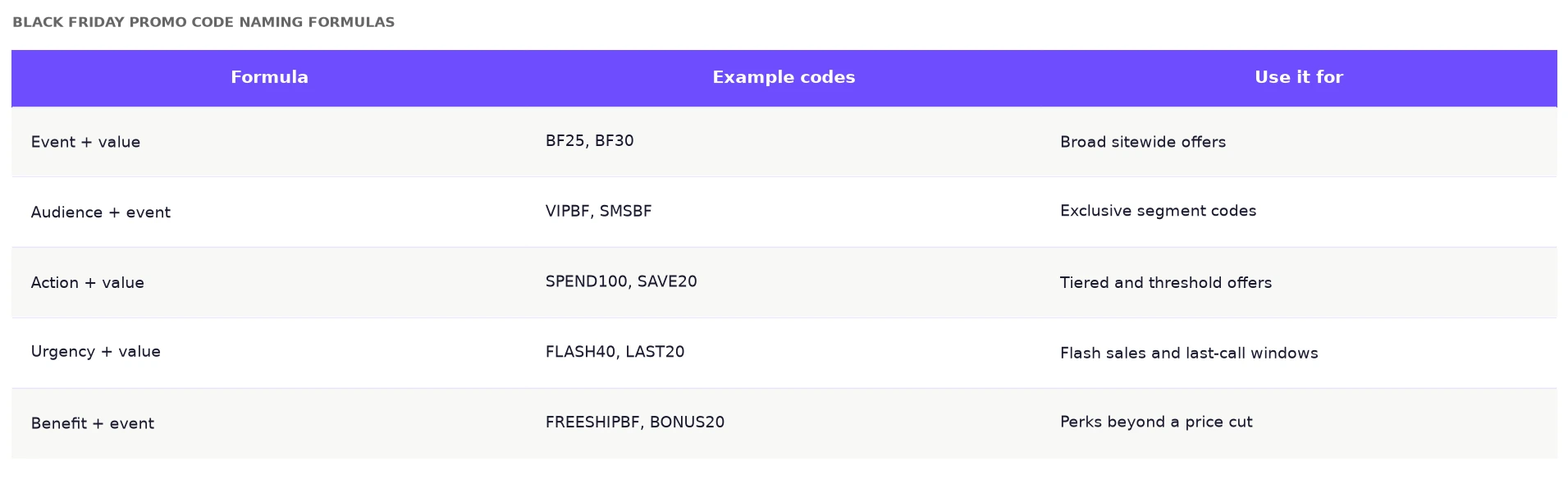
Keep codes short where possible. Avoid confusing combinations such as O and 0 or I and 1, particularly when customers may type the code manually.
You should also avoid outdated year references. A code such as BF2025 can create confusion when the campaign is running in 2026.
For merchants creating multiple codes, a coupon code generator can help produce unique codes while maintaining a consistent naming structure.
Public Black Friday codes can spread quickly beyond the audience you originally intended to target. This is especially important for VIP, SMS-only, first-buyer, and abandoned-cart promotions.
One way to reduce leakage is to use unique codes instead of one shared code. For example, instead of giving every VIP customer VIP30, you could generate individual codes such as BF30-7KX2Q. If one code appears on a coupon site, the merchant can disable that specific code without affecting the entire campaign.
Other controls include:
Coupon stacking should also be considered before launch. If customers can combine multiple Black Friday offers, the final discount may become much larger than expected.
Code abuse can also appear through repeated account creation, shared codes, automated redemption, or attempts to combine promotions that were intended to remain separate. Our guide to coupon fraud prevention covers these patterns in more detail.
A coupon management software solution can help merchants create, control, and track promotional codes from a centralized system.
A Black Friday promo code is only useful if customers know about it at the right time. Promotion should start before the sale rather than waiting until Black Friday morning.
A simple campaign timeline could look like this:
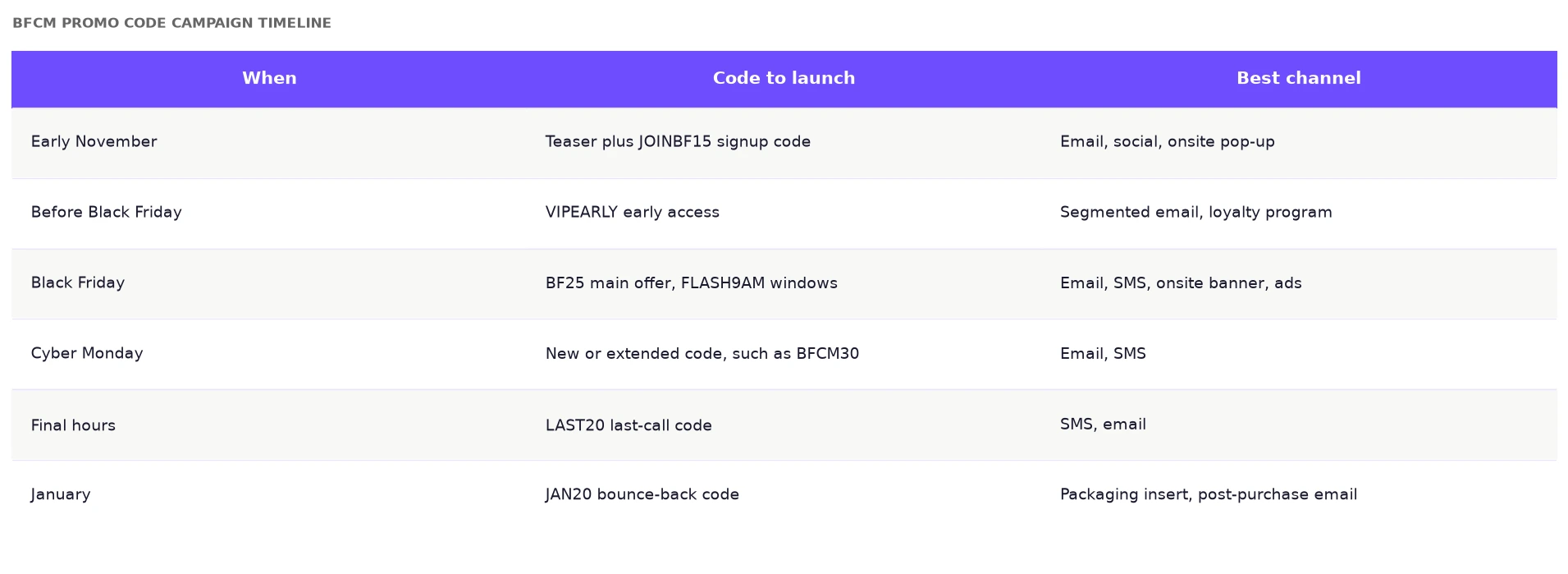
Cyber Monday deserves its own code rather than a leftover Black Friday offer. Shoppers spent $14.25 billion online that day in 2025, up 7.1% year over year, according to Adobe.
Match the code with the channel where it makes the most sense. SMS-only codes should be distributed through SMS, while VIP codes can be sent through segmented email or loyalty communications.
Onsite banners, pop-ups, social media posts, paid ads, and packaging inserts can support the wider campaign. The key is to avoid publishing every code everywhere.
For the broader BFCM campaign strategy, connect your code strategy with your Black Friday and Cyber Monday marketing plan.
Revenue alone does not tell you whether a Black Friday promo code was successful. A promotion can generate high sales while reducing margins significantly.
Track performance at the individual code level so you can understand which offers generated meaningful results.
Important metrics include:
For example, a 30% discount may generate more orders than a 15% discount, but the lower discount could produce stronger contribution margin. Similarly, a VIP code may generate fewer orders while attracting customers with a higher AOV or stronger repeat-purchase behavior.
For bounce-back campaigns, continue measuring results after Black Friday. The real value of the promotion may appear weeks later when customers use their second-purchase code.
The best Black Friday promo code is not necessarily the one with the biggest discount. It is the one that supports a clear business goal while giving customers a compelling reason to purchase.
Use sitewide codes when simplicity matters, tiered codes when you want to increase AOV, VIP codes when you want to reward loyal customers, and targeted codes when you need to reach a specific customer segment. For post-purchase growth, gift card bonuses, loyalty rewards, and January bounce-back codes can extend the value of your Black Friday campaign beyond a single weekend.
Before launching, make every code easy to understand, set clear eligibility and redemption rules, and measure performance beyond total revenue. Track AOV, margin, redemption rate, customer type, and repeat purchases to understand which promotions actually contributed to profitable growth.
With the right coupon management software, merchants can create unique Black Friday codes, control redemption rules, manage gift card promotions, and connect promotional activity with customer loyalty from one platform.
Create your Black Friday promo codes, gift card bonuses, and loyalty incentives with 99minds, or start with the free coupon code generator.