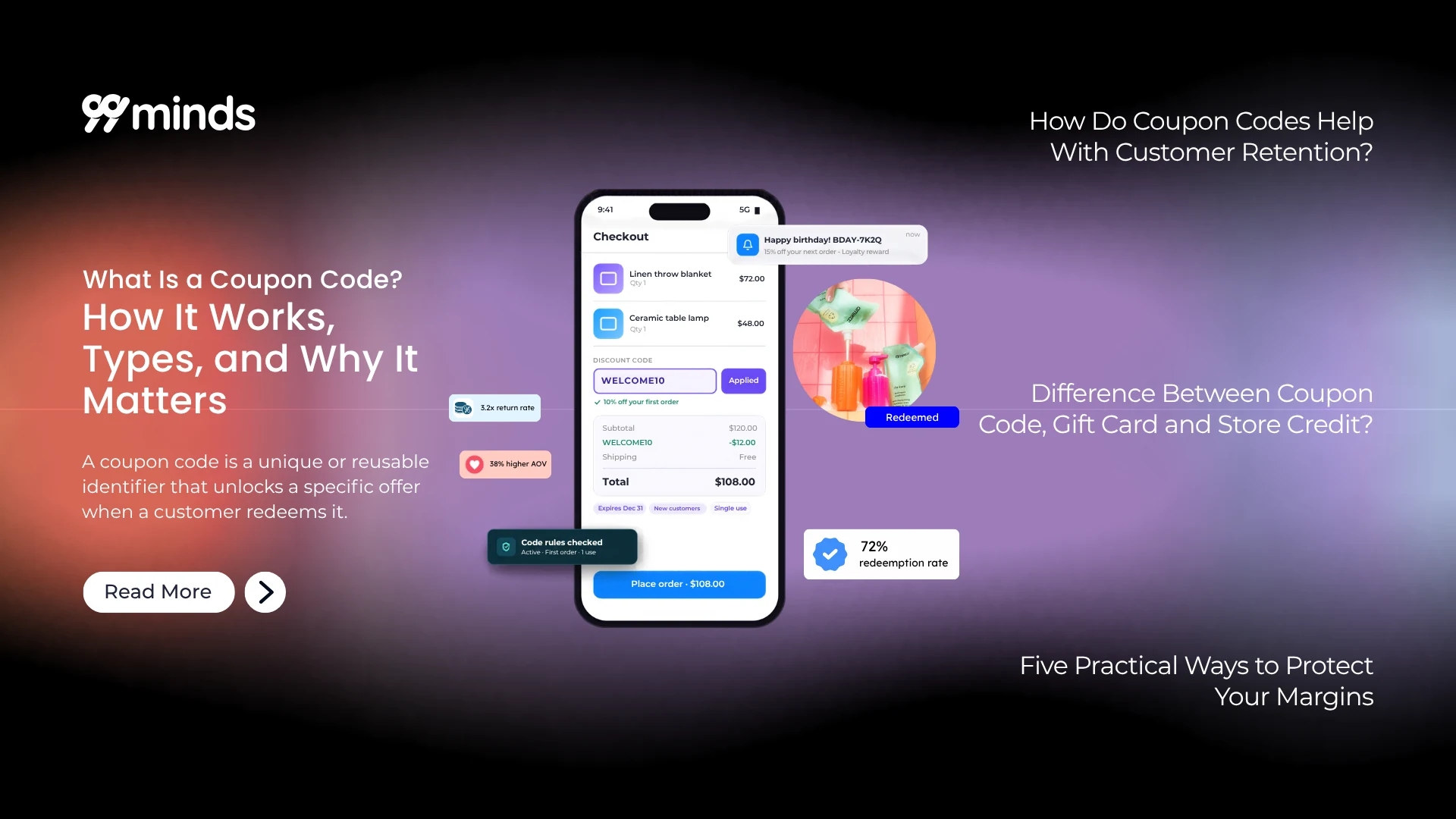
A coupon code is a short combination of letters, numbers, or both that a shopper enters at checkout to receive a discount, free shipping, or another promotional offer. For example, entering WELCOME10 might give a first-time customer 10% off an order. The merchant sets the rules, including when the code expires, which products qualify, and how many times it can be used.
If you’re wondering what is a coupon code and why online stores use them, the answer goes beyond saving money. Coupon codes help merchants win first-time buyers, grow order size, and give existing customers a reason to return.
The difference comes down to how you use them. A public discount code can drive sales during a promotion. A personal code can reward a loyal customer, thank someone for a referral, or win back a shopper who hasn’t bought in months.
TL;DR
- A coupon code is a set of letters or numbers a shopper types at checkout to get a discount or free shipping
- The code just names the offer, and the merchant’s rules decide if it applies
- Common types are percent off, dollars off, free shipping, BOGO, and deals on certain products
- Public codes suit big sales, and single-use codes give you more control over who uses them
- Codes linked to loyalty, referrals, birthdays, and next orders give customers a reason to come back
- A coupon lowers the price, a gift card holds prepaid value, and store credit is value a store gives back
- Minimum spends, usage caps, product limits, and stacking rules protect your margin
What Is a Coupon Code?
A coupon code is a unique or reusable identifier that unlocks a specific offer when a customer redeems it. Shoppers usually enter the code in a discount field on an ecommerce checkout page. Once the store validates the code, the qualifying discount or benefit is applied to the order.
The coupon code meaning is simple. The code identifies an offer. The rules attached to it decide who can use it and what they get.
For example, a store might create these coupon code examples:
- WELCOME10: 10% off a first purchase.
- SUMMER20: 20% off eligible products during a summer sale.
- FREESHIP: Free standard shipping.
- F78JK6H2: A randomly generated code issued to one customer.
Some codes are designed to be memorable and easy to share. Others use random letters and numbers to make them harder to guess or reuse. Merchants can also distribute coupons as printable offers with barcodes for in-store redemption.
Coupon codes are often called discount codes, promotional codes, promo codes, or voucher codes. The terminology varies by retailer, but these terms commonly describe the same basic idea.
How Does a Coupon Code Work at Checkout?
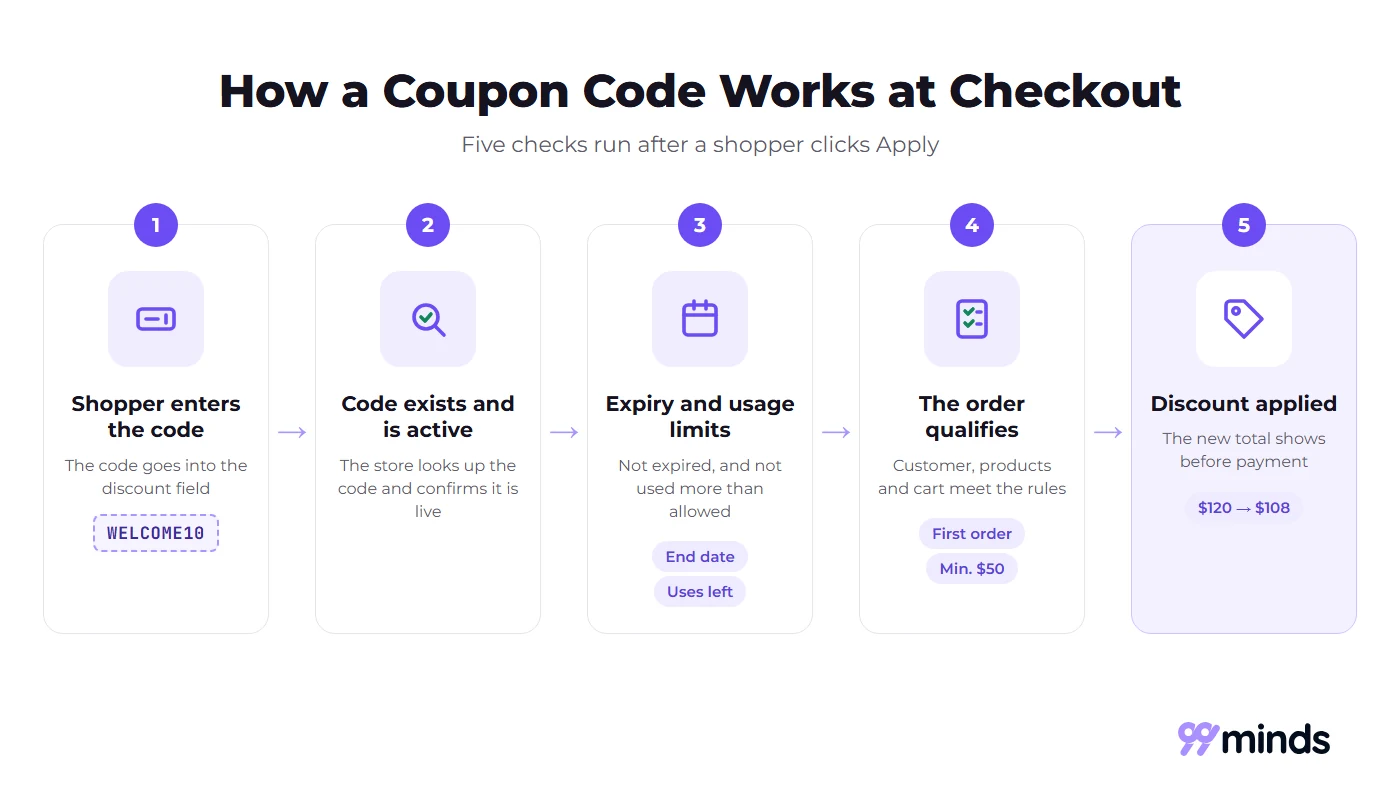
A code is only as useful as the rules behind it. When a shopper enters a code and clicks Apply, the ecommerce platform checks whether the offer is valid for that order.
Here’s what typically happens:
- The shopper enters the code at checkout.
- The store checks whether the code exists and is active.
- The system verifies the expiration date and any usage limits.
- It checks whether the customer, products, and cart meet the offer’s requirements.
- If everything qualifies, the discount is applied to the order total.
Consider a customer buying $120 worth of eligible products. They enter SAVE20, which offers 20% off. The discount is $24, bringing the merchandise total to $96 before any applicable taxes, shipping charges, or other fees.
Now imagine the same customer tries to use a code that requires a $150 minimum purchase. The order doesn’t qualify, so the discount won’t apply. The customer would need to add eligible products first.
This is why a code that looks correct can still fail. The code itself is just the identifier. The merchant’s settings determine the outcome.
What Are the Main Types of Coupon Codes?
Not every code serves the same purpose. Some reduce the price of an order. Others encourage customers to try a product, spend more, or buy again.
Types of discounts
| Coupon type | How it works | Example |
|---|---|---|
| Percentage discount | Reduces the price by a percentage | SAVE15 gives 15% off |
| Fixed-dollar discount | Deducts a specific amount | TAKE10 gives $10 off |
| Free shipping | Removes eligible shipping charges | FREESHIP provides free standard shipping |
| Buy one, get one (BOGO) | Offers a free or discounted item with a qualifying purchase | BUY1GET1 |
| Product-specific coupon | Applies to selected products or variants | SKINCARE20 gives 20% off eligible skincare products |
| Category-specific coupon | Discounts products within a category | SHOES15 gives 15% off eligible footwear |
| Welcome coupon | Rewards a qualifying first purchase | WELCOME10 gives 10% off |
These are different ways to structure an offer. Merchants can combine them with eligibility rules, minimum order values, and expiration dates to fit a campaign.
Types of codes based on access
The second distinction is who can redeem the code.
- Public codes are available to a broad audience. A retailer might publish one on its website, in an email campaign, or through a marketing partner.
- Private codes are sent to a selected audience, such as VIP customers, subscribers, or shoppers who haven’t purchased recently.
- Single-use unique codes are generated individually and intended for a specific customer or redemption. Depending on the rules, each code can be restricted to one use.
For example, a retailer could share a public SUMMER20 code during a seasonal sale. At the same time, it could send individual birthday coupons to loyalty members.
The right setup depends on your goal. Public codes are convenient for broad promotions. Personalized and unique codes give merchants more control over eligibility and redemption.
For large campaigns, coupon management software helps you generate codes in bulk and assign offers to specific customers. You can also set expiration dates and review redemptions. You can also explore these discount code ideas for campaign inspiration.
How Do Coupon Codes Help With Customer Retention?
A sitewide coupon can drive a sale. It doesn’t give the customer a reason to come back. The bigger opportunity is to tie each offer to the customer.
Don’t send the same discount to everyone. Use purchase history, loyalty activity, referrals, and customer milestones to decide when an offer makes sense.
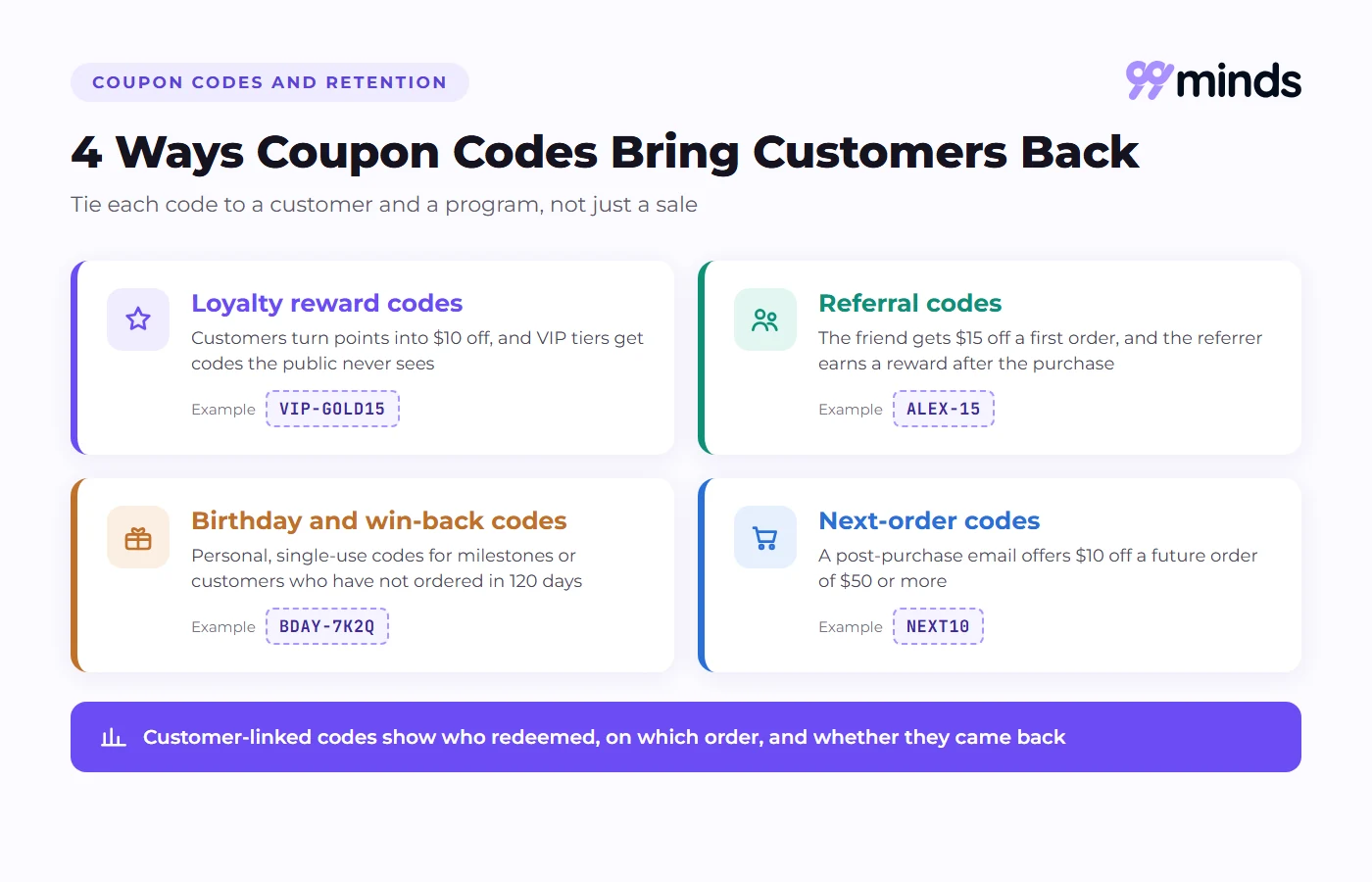
Loyalty reward codes
Loyalty programs give customers a reason to keep choosing the same brand. Codes make some of those rewards easy to redeem.
For example, a customer might earn points on purchases and exchange them for a $10 discount or 15% off their next order. A VIP member could receive an exclusive code that isn’t available to the general public.
The reward should feel connected to the customer’s activity, rather than like another generic promotion.
A loyalty platform can help merchants connect points, rewards, and redemption in one place. Brands can also test different loyalty discounts to see which ones drive another purchase without hurting margins.
Referral codes
Referral codes turn customer recommendations into a trackable acquisition channel.
Suppose an existing customer shares a personal referral code with a friend. The friend gets $15 off a first order. The customer who referred them earns a reward once that order is placed.
Both customers have a reason to take part, and the merchant can see which referrals lead to orders.
The important detail is attribution. A general discount code only tells you that an offer was redeemed. A referral code linked to a customer shows who referred the buyer and which order followed.
With referral program software, merchants can set rewards and rules once instead of managing each offer by hand.
Birthday, anniversary, and win-back codes
Not every purchase happens on a predictable schedule. Some customers need a timely reminder or a relevant incentive to return.
Birthday and anniversary codes recognize milestones. Win-back codes target customers who haven’t purchased within a chosen period.
For example, a beauty retailer could send a loyalty member a birthday coupon for 15% off eligible products. A home goods store could send a personalized $10 coupon to a customer who hasn’t ordered in 120 days.
These campaigns work best when the timing and offer fit the audience. A customer who purchased last week probably doesn’t need the same win-back incentive as someone who hasn’t visited in six months.
Single-use codes also stop an offer from being reused or shared beyond the people it was meant for.
Post-purchase and next-order codes
The period immediately after a purchase is another opportunity to encourage a return visit.
A merchant might include a next-order coupon in a post-purchase email, offering $10 off a future purchase of $50 or more. The minimum encourages a bigger basket. The expiry date gives the customer a clear deadline.
The offer should also fit what the customer bought. Someone who orders running shoes will likely value a discount on running gear more than a generic offer.
Why does customer-level tracking matter?
Without good redemption data, it’s hard to tell if a coupon campaign created new sales. It may have just discounted orders that would have happened anyway.
Customer-linked codes and usage reports show who redeemed an offer, on which order, and how the campaign performed. Use that data to choose the audience, reward value, and timing for the next campaign.
Say birthday codes drive more repeat purchases than a newsletter discount. That campaign may deserve more budget. Compare the results against a baseline group, not redemption volume alone.
Retention isn’t about sending more coupons. It’s about making each offer relevant enough to encourage the next purchase.
What Is the Difference Between a Coupon Code, a Gift Card and Store Credit?
These three tools can all influence a customer’s next purchase, but they work differently.
A coupon code reduces the price. A gift card represents prepaid value. Store credit represents value a merchant has credited to a customer, often following a return, refund, or reward.
| Feature | Coupon code | Gift card | Store credit |
|---|---|---|---|
| What it is | An offer that applies a discount or benefit | Prepaid value redeemable for eligible purchases | Value credited to a customer by a merchant |
| Who funds it | The merchant generally funds the discount | Usually the purchaser, or the issuer for promotional gift cards | Usually the merchant |
| Does it hold cash value? | No, the code itself generally has no stored monetary balance | Yes, it represents a monetary balance | It represents a credited monetary balance |
| Can it expire? | Often, subject to the merchant's terms and applicable law | Federal rules generally require at least five years before expiration of covered gift card funds, subject to applicable exceptions | Set by the merchant's terms, subject to applicable state law |
| Effect on revenue and margin | Reduces revenue on qualifying discounted sales | The merchant receives payment when a paid gift card is sold, before the card is redeemed | Keeps credited value available for eligible future purchases |
| Best used for | Promotions, acquisition, and repeat-purchase incentives | Gifting and prepaid spending | Returns, refunds, and customer compensation |
A coupon can encourage a purchase, but it doesn’t create a balance the customer can spend later. A gift card works differently because the customer redeems stored value rather than receiving a conventional discount. Store credit is useful when a merchant wants to offer value back to a customer without necessarily issuing a cash refund.
Gift cards also have legal rules. Under federal law, covered gift card funds can’t expire sooner than five years after the card is issued or last loaded, with some exceptions. The rule comes from 15 U.S.C. 1693l-1, part of the Credit CARD Act of 2009, and is implemented in Regulation E. Review the Consumer Financial Protection Bureau’s gift card requirements and your state’s laws before setting expiration terms.
Choose a coupon when the goal is to encourage a particular purchase. Choose a gift card when you want to sell prepaid value or offer a giftable product. Choose store credit when you need a practical way to handle returns or provide customer compensation.
With gift card software and store credit software, merchants can run these programs next to coupons and loyalty rewards. Every customer incentive lives in one place instead of separate tools.
How Do You Keep Coupon Codes From Cutting Into Your Margin?
A discount can help close a sale. A poorly designed one also cuts the value of orders that would have sold at full price.
Start with a clear goal. Do you want new customers, bigger orders, less seasonal stock, or lapsed buyers back? The answer should shape the discount, the audience, and the rules.
Here are five practical ways to protect your margins:
- Set a minimum order value. A $10 discount on a $60 purchase has a different impact from the same discount on a $150 purchase. Minimums can encourage larger baskets.
- Limit usage. Cap total redemptions and uses per customer so an offer isn’t used more than you planned.
- Add expiration dates. Time limits create urgency and stop old promotions from staying live forever.
- Exclude selected products or categories. Protect products with limited margins or items that already sell well without an incentive.
- Define stacking rules. Decide whether a coupon can be combined with another discount, loyalty reward, or promotional offer.
The choice between a fixed-dollar discount and a percentage discount also matters.
Consider a $10-off code and a 15% discount. They provide the same savings on a qualifying purchase of about $66.67. Below that basket value, the $10 discount gives away more than 15%. Above it, the percentage discount costs more.
Neither option is automatically better. The right choice depends on average order value, product margins, customer behavior, and campaign goals.
You should also consider where codes are distributed. Public codes can spread to coupon sites and social media. Unique coupon codes tied to one customer give you more control, especially for referral rewards, VIP offers, and win-back campaigns.
Finally, track more than redemptions. Review order value, discount cost, and repeat purchases. Compare customers who got the offer with a similar group who didn’t. A campaign with many discounted orders isn’t always a profitable one.
What Should You Take Away About Coupon Codes?
A coupon code is a simple way to offer a discount. Its value depends on how you use it. Public codes help with seasonal sales and new customers. Personal codes make loyalty rewards, referrals, birthday offers, and next-order deals feel relevant.
What turns a one-off discount into a retention strategy is the link between the offer, the customer, and the result. Clear rules protect your margin. Customer-level data shows which campaigns are worth more budget.
For Shopify, BigCommerce, and omnichannel retailers, managing these incentives together can make campaigns easier to coordinate. 99minds brings coupon management, loyalty programs, referrals, gift cards, and store credit into one platform. Book a demo to explore how these tools can support your customer acquisition and retention strategy.
Frequently Asked Questions
What Is the Difference Between a Coupon Code and a Promo Code?
Coupon code and promo code are generally interchangeable terms. Both refer to a code that a customer enters to receive a discount or another offer. Some retailers use the terms differently in their marketing, but the basic function is the same. The specific rules attached to the code determine who qualifies and what benefit they receive.How Do Coupon Codes Work?
A shopper enters a code at checkout, and the store checks its validity, expiration date, usage limits, and eligibility requirements. If the order meets the conditions, the system applies the discount or benefit. If a requirement isn't met, the code may be rejected or the offer may not apply to the entire order.Can You Use More Than One Coupon Code on an Order?
That depends on the retailer's coupon stacking rules. Some stores allow multiple offers to be combined, while others permit only one code per order. Even when stacking is allowed, certain discounts may be excluded from combination. Check the offer's terms or the checkout page to understand which combinations are permitted.Why Is My Coupon Code Not Working?
A code may fail because it has expired, has already been used, requires a minimum order value, or excludes products in your cart. The code may also be restricted to particular customers or incompatible with another discount. Check the terms, spelling, capitalization, and eligible items before trying again.Do Coupon Codes Expire?
Yes, codes often have expiration dates set by the merchant. An offer might remain active for a weekend sale or a customer's birthday month. Once the expiration date passes, the code generally stops working. Gift cards are different because covered gift card funds are subject to federal and state rules governing expiration.Can You Use Coupon Codes in Stores?
Some retailers accept these codes at physical checkout, either by scanning a barcode or entering a code into their point-of-sale system. Others restrict their codes to online purchases. Before visiting a store, check the offer's terms to see whether it is valid in person, online, or across both channels.Is a Coupon Code the Same as a Gift Card?
No. A coupon applies a discount or promotional benefit to an eligible purchase. A gift card represents prepaid value that can be redeemed for purchases under its terms. A coupon lowers what the customer pays. A gift card is a way to pay for some or all of an order.What Does a Coupon Code Look Like?
It can be a readable word or a random combination of letters and numbers. Examples include WELCOME10, FREESHIP, and F78JK6H2. Readable codes work well for public promotions. Random codes suit individual offers with their own redemption limits.Boost Customer Engagement with 99minds. The Ultimate Gift Card & Loyalty Solution!
Sign up for free