Only 31% of US employees were engaged at work in 2025, according to Gallup. That’s down from 36% in 2020. Worldwide, the number is even lower at 20%.
A good incentive won’t fix a bad job, but it can give people a clear reason to go the extra mile. The problem is that most lists of employee incentive ideas stop at the idea. They don’t tell you what it costs or whether the IRS treats it as wages.
60-Second Summary
- Employee incentives are rewards for a specific behavior or result, given on top of regular pay and benefits
- The 35 ideas below cover cash, recognition, time off, gift cards and rewards, wellness, career growth, and team incentives
- Free incentives like public recognition, first pick of shifts, and a note from a leader often work as well as cash
- Frontline and hourly teams value incentives built around shifts and schedules, like first pick of shifts
- Most cash and gift card incentives are taxable wages, while some recognition and team perks are usually tax-free
- Start with one goal, pick two or three ideas, and track what changes before expanding
What Are Employee Incentives?
Employee incentives are rewards offered to motivate a specific behavior or result, such as hitting a sales target, showing up for every scheduled shift, or referring a new hire. They sit on top of regular pay and benefits, and they’re usually tied to something the employee does rather than to the job itself.
Incentives often get mixed up with benefits and recognition. Here’s how the three differ.
| Type | What it is | Who gets it | Example |
|---|---|---|---|
| Incentive | A reward promised for a specific result or behavior | Employees who meet the goal | A $100 bonus for perfect attendance in December |
| Benefit | Part of the standard compensation package | All eligible employees | Health insurance or a 401(k) match |
| Recognition | Appreciation shown after the fact, often unplanned | Anyone who did something worth noticing | A shout-out from the store manager at a shift huddle |
Incentives can be monetary, like bonuses, profit sharing, and gift cards, or non-monetary, like extra time off, flexible schedules, and career opportunities. The best programs mix both, because not everyone is motivated by the same thing.

Why Do Employee Incentives Still Matter in 2026?
Employee incentives matter in 2026 because engagement is stuck, turnover is rising again in retail, and incentive budgets are under pressure. Together, these trends make it more important than ever to reward the right behavior, at the right time, without wasting money.
In practice, a well-designed incentive gives employees a clear reason to stay and put in extra effort, at a time when many have quietly checked out. Here’s what’s driving the need for smarter workplace incentives this year.
Engagement is stuck
Only 31% of US employees were engaged at work in 2025, the same as in 2024 and well below the 2020 peak of 36%. Gallup’s State of the Global Workplace research paints a similar picture worldwide, with global engagement falling for a second straight year to 20%.
Managers are struggling too, with only 22% of managers worldwide engaged in 2025. That matters because disengaged managers tend to lead disengaged teams. Incentives that reward specific, visible behavior give both managers and their teams something concrete to work toward.
Turnover is climbing again in retail
The Bureau of Labor Statistics reported a retail quits rate of 3.0% in August 2026, up from 2.4% a year earlier. That’s well above the 2.1% rate for private industry as a whole, and accommodation and food services ran even higher at 3.5%.
Every person who quits mid-season means another round of hiring, onboarding, and training, usually at the busiest time of year. Retention and season-completion incentives are one of the most direct ways to keep experienced staff on the floor.
Incentive budgets are tight
The Incentive Research Foundation’s 2026 Trends Report found that about 58% of North American organizations expect their event-gifting budgets to grow in 2026. Only about 10%, though, expect increases that outpace inflation.
That means incentives in 2026 need to be targeted. Instead of spreading a small budget across generic perks, focus it on the behaviors that matter most to your business, so every dollar buys more change.
What Are the Best Employee Incentive Ideas?
The best employee incentive ideas combine quick, low-cost recognition with a few meaningful rewards. Top options include spot bonuses, peer-to-peer recognition, extra paid time off, first pick of shifts, digital gift cards, tuition reimbursement, and team goal bonus pools.
Below are 35 incentive ideas for employees, grouped into seven types. Each one includes a typical cost per employee and how it’s usually taxed. Treat the tax notes as a starting point, and check with your payroll provider before you launch anything. Treat these employee incentive ideas as a menu, not a checklist, and pick the ones that fit your goals and budget.
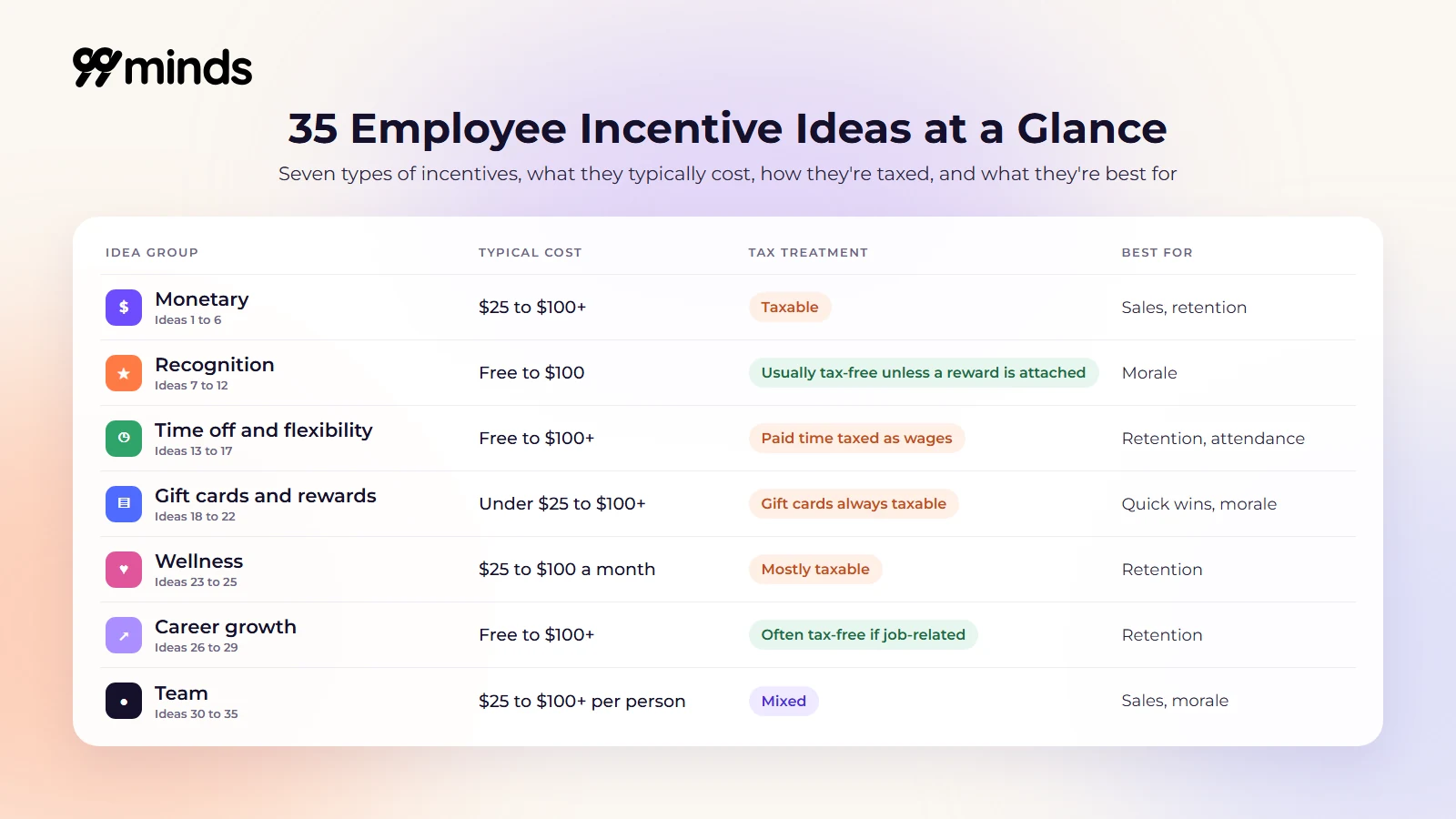
Here’s how the seven types compare at a glance.
| Idea group | Typical cost | Tax treatment | Best for |
|---|---|---|---|
| Monetary (ideas 1 to 6) | $25 to $100+ | Taxable | Sales, retention |
| Recognition (ideas 7 to 12) | Free to $100 | Usually tax-free unless a reward is attached | Morale |
| Time off and flexibility (ideas 13 to 17) | Free to $100+ | Paid time is taxed as wages | Retention, attendance |
| Gift cards and rewards (ideas 18 to 22) | Under $25 to $100+ | Gift cards are always taxable | Quick wins, morale |
| Wellness (ideas 23 to 25) | $25 to $100 a month | Mostly taxable | Retention |
| Career growth (ideas 26 to 29) | Free to $100+ | Often tax-free if job-related | Retention |
| Team (ideas 30 to 35) | $25 to $100+ per person | Mixed | Sales, morale |
Monetary incentive ideas
Cash is still the most direct incentive, and it’s the one employees understand instantly. The trick is tying it to something specific.
1. Spot bonuses for a specific win
A spot bonus is a small, unplanned cash award given right after an employee goes above and beyond. Think $50 for the associate who stayed late to finish a holiday floor reset. Keep the gap between the action and the reward to a few days. Say exactly what earned it, so the whole team learns what “going above and beyond” looks like. Give managers a small monthly spot bonus budget, so they don’t need sign-off every time. Most spot bonuses fall between $25 and $100, and they’re taxed as regular wages.
2. Performance bonuses tied to a measurable goal
Set a clear target, like hitting 105% of the monthly sales plan or cutting shrink by a set amount, and attach a fixed bonus. The goal should be measurable and within the employee’s control, or the bonus starts to feel like luck. Share progress weekly on a whiteboard or in a team message, so people can see how close they are. A goal that’s visible every day motivates far more than one that’s only checked at month-end. Performance bonuses usually start at $100, and like any cash bonus, they’re taxable.
3. Profit sharing
Profit sharing sets aside a slice of profits, often quarterly or yearly, and splits it among eligible employees. It gives everyone a reason to care about margins, not just sales. Explain the formula up front, such as a fixed percentage of profit above a set threshold, so payouts don’t feel arbitrary. Cash payouts are taxed as wages, while contributions to a qualified retirement plan are tax-deferred, so decide which route suits your team before launch. Expect payouts of $100 or more per employee.
4. Referral bonuses
Pay employees when someone they referred is hired and stays for a set period, such as 90 days. A well-run employee referral program fills open roles faster and usually brings in people who fit the team. Pay part of the bonus at hire and the rest after the waiting period, so the reward feels immediate but still encourages good referrals. Raise the amount for hard-to-fill roles or before a busy season. Referral bonuses typically start at $100 and are taxed as wages.
5. Short sales contests (spiffs)
A spiff is a short-term bonus for selling a specific product or hitting a target in a set window, like $5 for every premium warranty sold this weekend. Keep contests short and the rules simple, so people know exactly what counts. Use spiffs to move slow inventory or launch a new product, not as a permanent part of pay. Rotate the focus each time, so the same top seller doesn’t win every contest. Most spiffs cost anywhere from under $25 to $100 per person, and the payouts are taxable.
6. Retention or season-completion bonuses
Promise a bonus to employees who stay through a busy period or a set tenure. For seasonal staff, paying it after the last peak shift is one of the most direct ways to cut mid-season quits. Put the terms in writing on day one, including the amount, the end date, and what happens if someone leaves early. A clear promise gives people a concrete reason to stay through the hardest weeks of the year. These bonuses usually run $100 or more, and they’re taxed like any other cash bonus.
Recognition incentive ideas
These non monetary incentives for employees cost little or nothing. They work because people want their effort to be seen.
7. Peer-to-peer recognition
Let employees recognize each other, through a shared channel, a kudos board, or a monthly vote. Peers often notice things managers miss, like the coworker who quietly covers a break or trains a new hire. Make it easy, with a one-line format such as “Thanks to Sam for…”, and read a few out at team meetings. If peer recognition comes with points that convert to cash or gift cards, those rewards become taxable. Basic peer recognition costs nothing to run.
8. Public shout-outs
Call out great work by name at an all-hands meeting, a shift huddle, or in the internal newsletter. Be specific about what the person did and why it mattered, because “great job, team” doesn’t land the same way. A good shout-out names the action, the result, and the person, all in a sentence or two. Check first with quieter employees, since some would rather be thanked privately than in front of the whole team. Shout-outs are free, and since no money changes hands, there’s nothing to tax.
9. Employee of the month with a real reward attached
Employee of the month only works when it means something. Pair the title with a reward people actually want, like a reserved parking spot, a gift card, or an extra day off, and make the criteria public. Let peers nominate candidates, so the award reflects the whole team’s view, not just the manager’s. Avoid giving it to the same person month after month, or everyone else will stop paying attention. Budget $25 to $100 for the reward. A gift card is taxable, while the title and recognition alone aren’t.
10. A handwritten note from a senior leader
A short note from the owner or a regional manager, naming exactly what the employee did, often gets pinned to a fridge for years. It takes five minutes and costs nothing. The key is specificity, so mention the customer they helped or the problem they solved, not just “thanks for your hard work.” Ask store managers to flag one or two people each month, so leaders always have a real story to write about. Because it’s just a note, there’s no tax to worry about either.
11. Custom awards or trophies for milestones
Mark work anniversaries, safety records, or big achievements with a plaque or engraved award. Present it in front of the team, so the moment matters as much as the object. Keep the design simple and consistent, so a five-year award looks like part of a set people want to collect. Tangible awards for length of service or safety can be tax-free under IRS achievement award rules if you follow them. Most plaques and engraved awards cost between $25 and $100.
12. Wall of fame in the break room
Post photos and short write-ups of recent wins where everyone on the team will see them. It’s especially useful for frontline teams who don’t check email or Slack during a shift. Refresh it every month, so it never turns into old wallpaper, and include a mix of wins, from customer compliments to safety milestones. Ask before posting photos, since not everyone wants their picture on the wall. A wall of fame costs nothing beyond a printer and some pins, and it isn’t taxable.
Time off and flexibility incentive ideas
Time is one of the most valued rewards, and for hourly staff, control over their schedule can matter as much as pay.
13. Extra PTO or a bonus day off
Give a paid day off after a demanding project, a strong quarter, or a busy season. Let the employee pick the date, within reason, so it feels like a reward rather than a scheduling decision. Set a window for using it, such as within 60 days, so it doesn’t get forgotten. Plan coverage in advance, too, so the rest of the team doesn’t feel punished when someone takes their reward. A paid day off typically costs $100 or more in wages, and that pay is taxed as normal.
14. Birthday off
A paid day off on or near each employee’s birthday is simple to run and easy to remember. It shows you care about people’s lives outside work. Let employees choose any day in their birthday month, since the birthday itself may fall on a weekend or a peak day. Add the days to the shared calendar early, so managers can plan coverage well before the schedule is built. Like any paid day off, it costs a day’s wages, usually $100 or more, and the pay is taxed as normal.
15. Flexible schedules or compressed weeks
Let employees who hit their goals choose start times, swap shifts more freely, or work a compressed week. Flexibility costs little, but it’s one of the hardest perks for a competitor to match. Start with a trial period of a month or two and set clear rules on coverage, so the store or office never runs short. If it works, make it a standing reward that people can earn and keep. Flexible scheduling is free to offer and doesn’t create any taxable income.
16. First pick of shifts for top performers
Let the week’s top performers choose their shifts before the schedule opens to everyone else. For hourly teams, this is one of the most valued incentives you can offer, and it’s free. Base it on a clear measure, like attendance, sales, or customer feedback, so everyone knows how to earn it. Rotate eligibility over time, so new or quieter team members also get a realistic chance. It also creates no taxable income.
17. Leave early on a Friday after a goal is hit
If the team hits its weekly target, everyone leaves two hours early on Friday with full pay. It turns a group goal into a reward everyone feels at once. Post the target on Monday and update progress midweek, so the team can rally if they’re falling behind. For stores that can’t close early, offer the paid hours as a later start on a quieter day instead. Two paid hours usually cost $25 to $100 per person, paid and taxed as regular wages.
Gift card and reward incentive ideas
Incentive rewards like gift cards and points let employees choose what they want, which takes the guesswork out of gifting. Gift cards have even overtaken merchandise as the most common event gift in North America, according to the Incentive Research Foundation.
18. Digital gift cards for quick wins
Digital gift cards arrive by email or text within minutes, which makes them ideal for rewarding a win the same day. A $20 coffee or lunch card works well for everyday thank-yous, while travel or experience employee gift cards suit bigger milestones like a work anniversary. Add a short personal message with every card that says what the employee did. Check that the brand is usable where the employee lives, especially for remote staff. Most cards cost anywhere from under $25 to $100, and every gift card is taxable, whatever the amount.
19. Store credit or branded gift cards at your own store
If you run a retail business, reward employees with store credit or your own branded gift cards. The reward costs you less than its face value, and staff who use your products sell them with more confidence. It also gives them firsthand stories to share with customers on the sales floor. Retailers can issue these through the same gift card software they use for customers, and track when and where each balance is redeemed. Most rewards fall in the $25 to $100 range, and like gift cards, store credit given as a reward is taxable.
20. Choose-your-own reward catalogs or points
Give employees points for wins and let them redeem from a catalog of merchandise, experiences, and gift cards. Choice makes the reward feel personal, even at scale. Publish a simple points menu, such as 50 points for perfect attendance in a month and 100 for a customer compliment, so people know what earns what. Points that turn into cash or gift cards are taxable. Most catalog rewards cost $25 to $100 each.
21. Company swag employees actually want
Skip the cheap stress balls. A quality hoodie, a good water bottle, or comfortable work shoes for people on their feet all day get used and noticed. Ask employees what they’d wear before you order, and offer a few sizes and styles instead of one design for everyone. Limited-edition items, like a hoodie only for people who worked the holiday season, can feel like a badge of honor. Most swag costs under $25 to $100 per item, and low-value items given occasionally are usually tax-free.
22. Experience rewards
Concert tickets, a dinner for two, or a cooking class create a memory that cash doesn’t. Match the experience to the person, since a sports fan and a foodie won’t value the same reward. Offer two or three options and let the employee choose, and include time off if the event falls on a workday. Occasional event tickets can count as a tax-free de minimis benefit, but season tickets and regular perks don’t. Most experience rewards cost $100 or more.
Wellness incentive ideas
Wellness incentives show employees you care about how they feel, not just what they produce.
23. Wellness stipend
Give employees a monthly or yearly budget for fitness, meditation apps, or healthy food. Keep the list of eligible expenses broad, since wellness looks different for everyone, from a yoga class to a new pair of running shoes. A simple receipt upload keeps the process easy for employees and the paperwork light for you. A cash stipend is taxed as wages, so plan for the payroll cost on top of the stipend. Most stipends run $25 to $100 a month.
24. Mental health days
Offer one or two paid days a year that employees can take without explaining why. Make it clear managers won’t ask questions, or no one will use them. Keep the request process as simple as a regular day off, and have leaders take their own mental health days too. When managers use the benefit openly, employees feel safe doing the same. Each day costs about a day’s wages, usually $100 or more, and that pay is taxed as normal.
25. Gym or fitness class reimbursement
Reimburse part of a gym membership or a set number of classes each month. Set a clear monthly cap and a simple claim process, so employees know exactly what they’ll get back. Partnering with a local gym can also unlock a group discount and make it easier for people to start. Gym memberships and reimbursements are taxable. Only an on-site gym that you run yourself is tax-free. Most reimbursements run $25 to $100 a month.
Career growth incentive ideas
For ambitious employees, a path forward is often the strongest incentive of all.
26. Tuition or certification reimbursement
Pay for courses, degrees, or industry certifications that help employees grow. Connect the reward to a real next step, like a supervisor role or a specialist position, so the learning leads somewhere. Some employers ask people to stay for a set period after reimbursement, so set your terms in writing before anyone enrolls. Under a written section 127 educational assistance plan, up to $5,250 a year is tax-free to the employee. Courses and certifications usually cost $100 or more.
27. Mentorship, job shadowing, or lunch with a senior leader
Pair high performers with a mentor, let them shadow a manager for a day, or invite them to lunch with leadership. It shows you see a future for them and gives them access most people never get. Give the session a light structure, such as a question the employee wants answered, so it doesn’t turn into small talk. Follow up afterward with a concrete next step, like a project or a training opportunity. It costs little more than a lunch, usually under $25, and it isn’t taxable.
28. Innovation time or a stretch project
Give strong performers a few hours a week, or a full project, to work on an idea of their choice, like a new store display or a better closing checklist. Ownership is motivating on its own. Ask them to share what they built with the team at the end, and put the best ideas into practice. Seeing their idea used every day is often a bigger reward than any bonus. It costs nothing beyond paid time already on the schedule, and there’s nothing to tax.
29. Paid conference or training day
Send employees to an industry event or a training day, with registration and travel covered. Pick events that match their role and goals, not just the biggest name in the industry. Ask them to share two or three takeaways with the team when they’re back, which spreads the value and builds their confidence. Job-related training is usually a tax-free working condition benefit. Expect to spend $100 or more per person on registration and travel.
Team incentive ideas
Team incentives build a sense of “we” and stop top performers from competing against their own colleagues. They’re also the source of most fun work incentive ideas.
30. Team goal bonus pool
Set a team or store-level target and split a bonus pool equally if the team hits it. Everyone has a reason to help the person next to them. Pick a goal the whole team can influence, like total sales, customer satisfaction scores, or shrink, rather than one person’s numbers. Show progress where everyone can see it, and celebrate the payout together when the team hits the target. Pools usually start at $100 per team, and each person’s share is taxed as wages.
31. Catered lunch after a big push
After inventory week or a big sales event, bring in lunch for the whole team. Let the team vote on the menu, and include options for different diets, so no one is left out. For stores that run multiple shifts, order food for each shift instead of only the midday crew. Occasional meals like this are usually a de minimis benefit and aren’t taxed. A team lunch usually costs $100 or more.
32. Team outing or activity
Bowling, an escape room, or a team dinner gives people time together outside the daily grind. Schedule it during paid hours if you can, so it doesn’t eat into anyone’s day off. Choose activities that everyone can join, regardless of fitness or interests, and keep drinking optional. Ask a few team members to help plan it, which makes the outing feel like theirs rather than another work obligation. Budget $25 to $100 per person, and company outings like this are usually tax-free.
33. Paid volunteer day
Give the team a paid day to volunteer together at a local cause they choose. It builds pride in the company and connects your store to its community. Let employees vote on the organization, and handle the logistics in advance, so the day runs smoothly. Share photos afterward, with permission, so the rest of the company and your customers can see the impact. The day costs about $100 or more per person in wages, which are taxed as normal.
34. Charitable donation in the team’s name
When the team hits a goal, donate to a charity they pick. It’s a good option for teams who’d rather give back than receive another gift. Set the donation amount up front, such as $500 when the quarterly target is met, so the goal feels concrete. Announce the gift with the team’s name attached, and share any thank-you the charity sends back. Since the money goes to the charity, not the employees, it isn’t taxable income for the team.
35. Annual retreat or celebration
Close the year with a party, an offsite, or a retreat that celebrates what the team achieved. Use part of the time to look back on the year’s wins and recognize the people behind them by name. Hold it at a time that works for frontline staff too, not just the office team, so everyone can attend. A business meeting is usually tax-free, but a reward trip that’s mostly leisure is taxable. Expect to spend $100 or more per person.
Reward Your Team the Right Way With 99minds
The best employee incentive ideas share three things. They reward a specific behavior, they fit your budget, and they follow the IRS rules, so a thank-you doesn’t turn into a payroll headache later.
For retail and frontline teams, they also need to fit the way people actually work. That means rewards built around shifts, attendance, and store goals, delivered quickly, and visible on the sales floor rather than buried in an inbox.
Start small. Pick one goal, such as cutting mid-season quits or improving attendance, choose two or three ideas from this list, and track what changes. Then expand the incentives that work and drop the ones that don’t.
Want to reward staff with store credit or branded gift cards that work in your store and online? 99minds can help you issue them in bulk and schedule delivery. Book a demo to see how it works.
Frequently Asked Questions on Employee Incentive Ideas
What Are Some Effective Incentives for Staff?
An incentive is effective when it's tied to a clear behavior, given soon after that behavior, and something the employee actually values. Price matters less than fit. For example, a spot bonus for covering a short-notice shift can work well. So can first pick of next week's schedule or a public shout-out at the shift huddle, as long as they're timely and specific.What Are Some Good Incentive Gifts for Employees?
Good incentive gifts include flexible gift cards or cards for an employee's favorite store. Experience gifts like concert tickets or a dinner out work well too, along with quality swag people will use. For retail teams, store credit at your own store is another strong option. Keep in mind that gift cards and store credit given as rewards are taxable, so they need to be reported through payroll.What Are Some Creative Ways to Reward Employees for Good Work?
Let the employee pick the spot for the next team lunch, or give them a pass to swap a shift with no questions asked. You could also name a store display or a menu special after them. You could also let them choose the playlist for a week. Small, personal rewards like these are memorable because they're unexpected.What Are the Three Main Ways of Rewarding Employees?
The three main ways are monetary rewards, non-monetary recognition, and time off or experiences. Monetary rewards include bonuses, profit sharing, and gift cards. Recognition covers public praise and awards, while time off and experiences include extra PTO, flexible schedules, and event tickets. Most strong programs use a mix of all three.How Often Should Employees Receive Incentives?
Recognition should happen weekly, or whenever someone earns it. Smaller rewards, like spot bonuses and gift cards, work well monthly. Bigger incentives, such as profit sharing or season-completion bonuses, suit a quarterly or seasonal cycle. The closer a reward is to the behavior, the more it reinforces that behavior.Are Expensive Incentives More Effective?
Not usually. Timing, fairness, and personal fit matter more than price. A $20 reward given the same day often motivates more than a large bonus paid months later. Bigger rewards make sense for major milestones, retention bonuses through a busy season, and goals that need sustained effort over several months.How Can HR Measure the ROI of Employee Incentives?
Measure the outcome the incentive targets, such as turnover, absenteeism, goal attainment, or reward redemption, before and after launch. Put a dollar value on the improvement, like the hiring and training costs saved from fewer quits. Then use a simple formula: ROI equals the value gained minus the program cost, divided by the program cost.How Can Smaller Companies Compete With Big Company Benefits Using Employee Rewards?
Small businesses win on speed and personal touch. An owner can recognize good work the same day, offer flexible schedules and first pick of shifts, and send small digital rewards without layers of approval. Many of the best employee incentive ideas for small business teams cost little or nothing but feel more personal than a corporate program.Boost Customer Engagement with 99minds. The Ultimate Gift Card & Loyalty Solution!
Sign up for free