We're building the future of agentic promotions. Sign up for early access!
Sign up
We're building the future of agentic promotions. Sign up for early access!
Sign up Table of Contents:
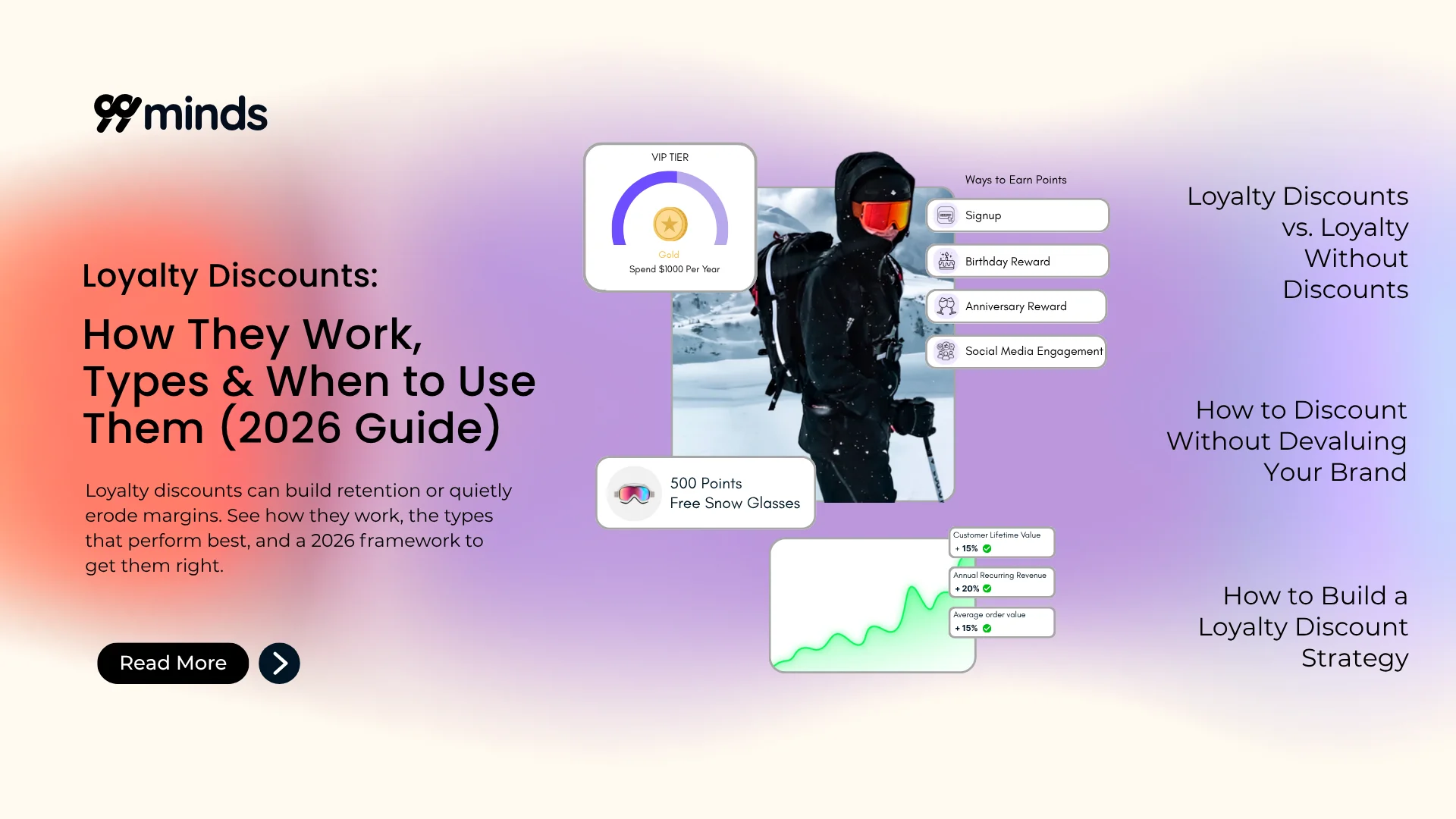
If you run an ecommerce or retail brand, you’ve probably already handed out a loyalty discount, whether it was a “welcome back” code, a birthday coupon, or a few dollars off for your top-tier members. The question isn’t whether loyalty discounts work. It’s whether you’re using them in a way that builds real loyalty or just trains customers to wait for the next markdown.
We’ll walk through what loyalty discounts actually are, how they differ from regular promotions, the structures top brands rely on, and what the latest data says about when discounts help versus when they quietly chip away at your margins and brand value.
A loyalty discount is a price reduction or special offer available only to members of your loyalty program. It’s fundamentally different from a sitewide sale or a coupon code you hand out in a Google Ads campaign. A general discount is available to anyone; a loyalty discount is a reward for how loyalty programs work and for the relationship a customer has already built with your brand.
That distinction matters more than it sounds. A sitewide 20% off sale attracts bargain hunters who may never come back. A loyalty discount, on the other hand, is designed to deepen a relationship that already exists: it rewards someone for their third purchase, their one-year anniversary as a member, or for climbing into your top spending tier.
Loyalty discounts also differ from one-off coupons and promo codes in an important way: they’re tied to program membership and, usually, to specific behaviors like a purchase milestone, a referral, or account longevity, not just a subscribe-to-our-newsletter pop-up.
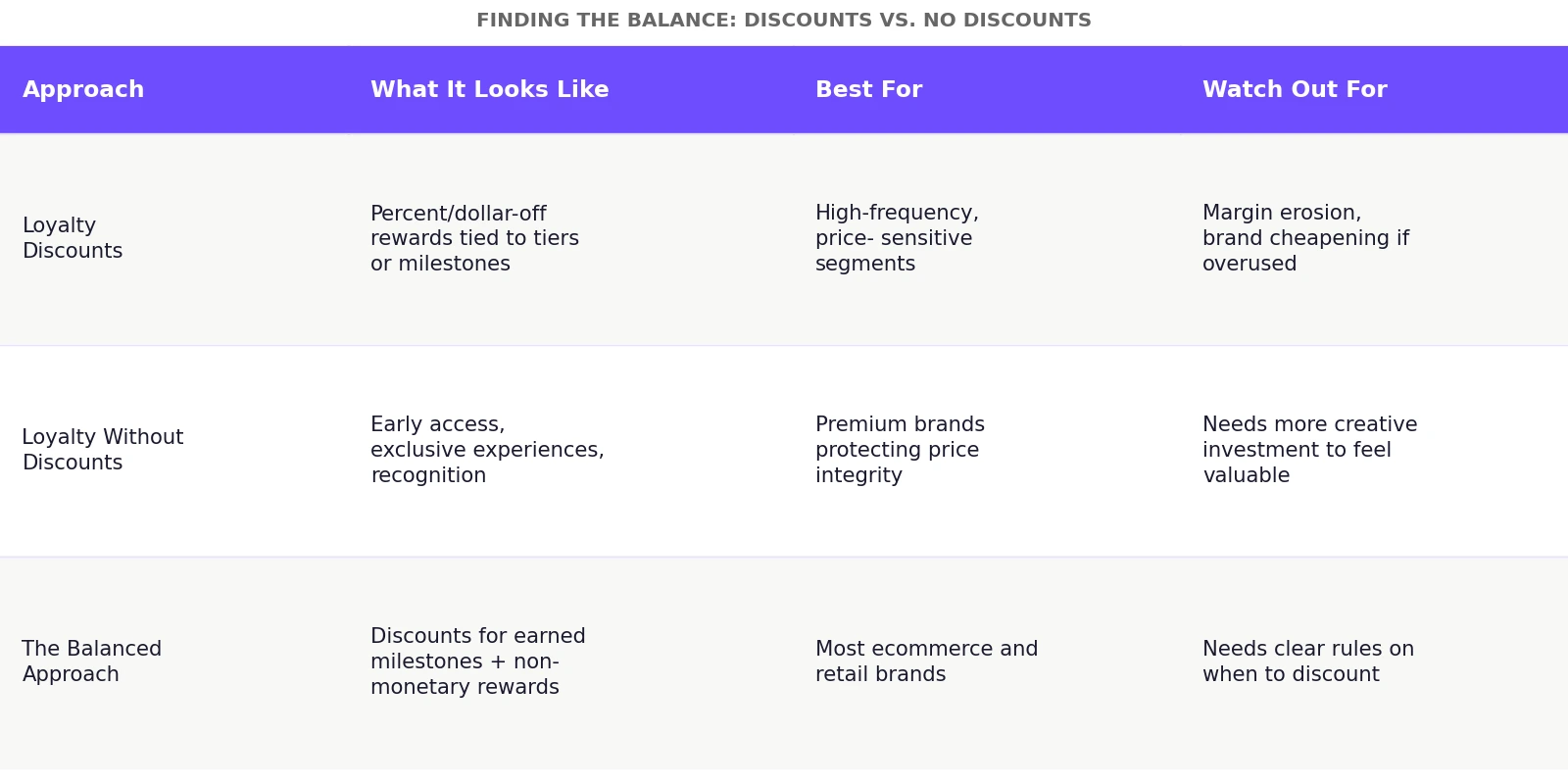
Search around, and you’ll find two camps arguing past each other. One side says loyalty discounts are the backbone of a good loyalty program strategy: they’re measurable, they drive repeat purchases, and customers explicitly ask for them. The other side warns that leaning too hard on discounts trains your most loyal customers, the ones who’d buy from you anyway, to expect a lower price every time, which quietly erodes both margin and brand equity.
Both camps are right, which is exactly the problem. The honest answer is that loyalty discounts are a tool within a broader loyalty strategy, not the strategy itself.
For enterprise and mid-market brands, this distinction carries real weight. When you’re managing tens of thousands of loyalty members, an undisciplined discount structure doesn’t just cost you margin on individual orders, it can reshape how an entire segment of customers perceives your pricing.
A well-known apparel or beauty brand offering blanket 15% loyalty discounts every month is teaching its best customers to wait for the code rather than buy at will. That’s a different risk profile than a smaller, growing brand testing a modest loyalty discount to build early habit and prove out its retention math before scaling spend.
The practical framework: use discounts as one lever among several (also consider early access, exclusive products, experiential perks, and status recognition), reserve your deepest discounts for genuinely earned milestones rather than routine transactions, and watch whether your discount usage rate is climbing among customers who were already going to purchase regardless. If it is, you’re subsidizing behavior you already had for free.
Not all loyalty discounts are structured the same way, and the right choice depends heavily on your business model, purchase frequency, and customer base. Here’s how the main structures stack up.
| Structure | How it works | Best for | Margin risk |
|---|---|---|---|
| Points-to-dollar | Customers earn points per dollar spent, redeemable for a discount (for example, 100 points = $5 off) | High-frequency categories like fashion, beauty, and consumables | Moderate, scales with purchase frequency |
| Tiered membership | Silver, gold, and platinum-style tiers unlock increasing discount percentages as customers spend more | Brands with clear customer segments by lifetime value | Low to moderate if tier thresholds are set correctly |
| Milestone rewards | A discount unlocks at a specific purchase count (third, fifth, tenth order) | Building purchase habits in newer customers | Low, since it's a one-time unlock per milestone |
| Birthday and anniversary | An automatic discount code sent on a customer's birthday or program anniversary | Emotional connection and surprise-and-delight moments | Low, limited to once a year per customer |
| VIP early access | Top-tier customers get early access to sales or new drops, sometimes paired with a modest discount | Exclusivity-driven retention without constant markdowns | Very low, since the value is access, not necessarily price |
Most mature loyalty programs don’t rely on just one of these. A tiered loyalty program might combine points-to-dollar redemption with milestone unlocks and VIP early access for its top tier, layering structures rather than choosing just one. Whichever structure you pick, model the impact against your average order value first, since a discount that lifts order size in one segment can quietly shrink it in another.
The data is clear that loyalty programs, discounts included, move the needle. Loyalty program owners report an average ROI of 4.8x, with 90% seeing a positive return overall. Members who actively redeem rewards spend 3.1 times more annually than members who don’t, and loyalty program members generate 12% to 18% more incremental revenue per year than non-members.
Discounts specifically remain a top draw: access to deals and discounts consistently ranks as consumers’ top priority for joining a loyalty program in the first place, and when asked what makes a loyalty program succeed, customers point to ease of use (53%), strong discounts (39%), and being easy to understand (37%).
But the more current data also supports a note of caution. A growing share of loyalty program owners are actively moving away from discount-only models: 90% plan to revamp their programs in the next three years, and nearly nine in ten plan to increase non-transactional engagement, meaning experiences, recognition, and perks that don’t rely on cutting price.
Outside of free shipping and discounts, the benefits customers rank highest are early access to sales (60%), early access to new products (51%), and personalized recommendations (39%), none of which cost you margin the way a straight discount does.
The takeaway: loyalty discounts work, and the data backs that up clearly, but the brands getting the most out of them in 2026 are pairing discounts with non-monetary value rather than relying on discounts alone.
The risk with loyalty discounts isn’t that they don’t work. It’s that overusing them teaches your most valuable, least price-sensitive customers to wait for a deal, which is expensive in a way that doesn’t show up cleanly on a single order’s margin line.
A few guardrails help keep loyalty discounts from turning into a race to the bottom:
Brands that get this right treat loyalty discounts as a precision tool: sharp, occasional, and reserved for moments that matter, rather than a blunt instrument used on every order.
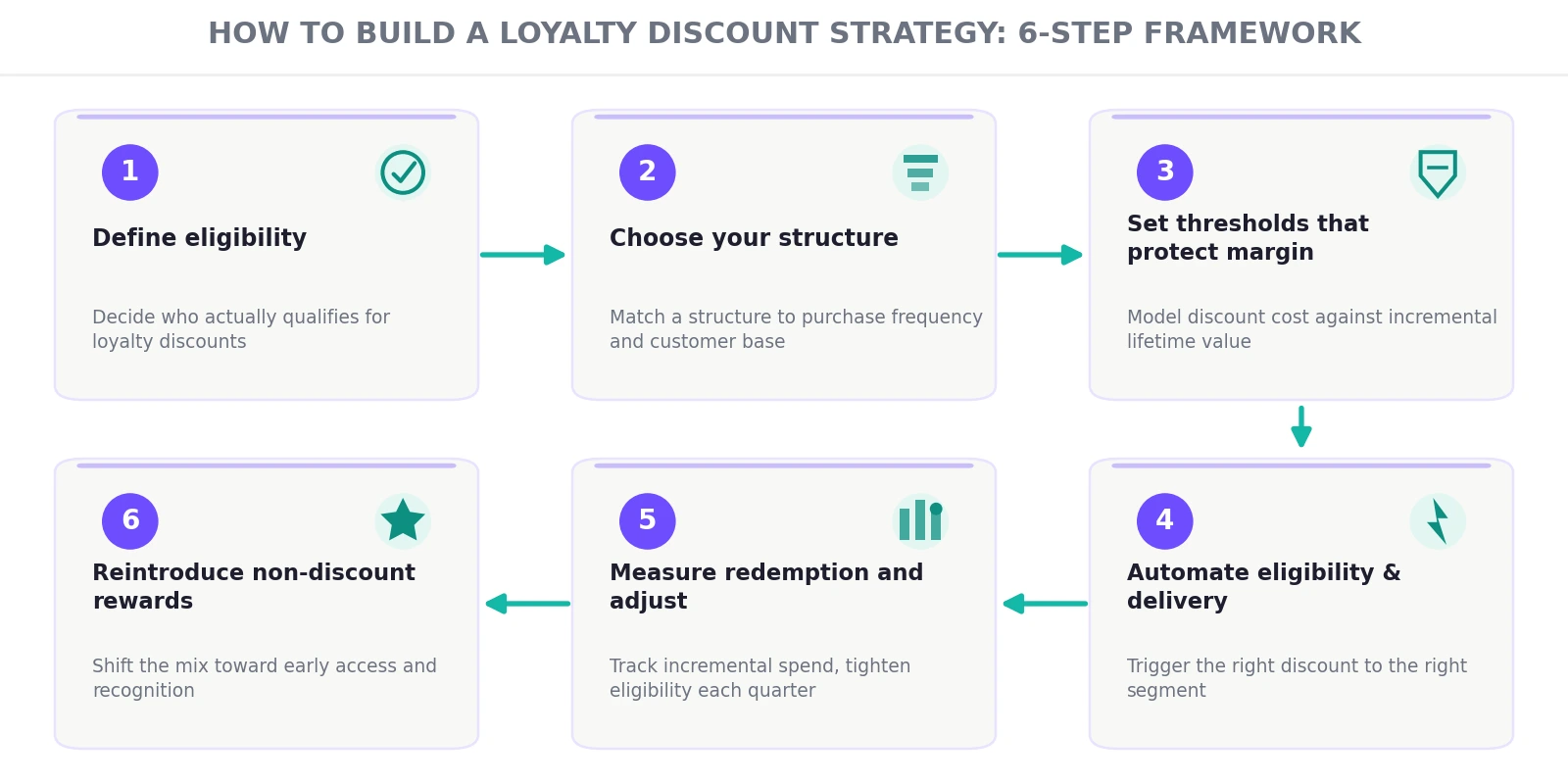
Here’s a practical, step-by-step approach to launching or refining a loyalty discount strategy without falling into the discount-fatigue trap.
Step 1: Define eligibility. Decide who actually qualifies for loyalty discounts. Program membership alone, a spending tier, account age, or a specific milestone are all valid starting points, but be specific rather than opening it up to everyone.
Step 2: Choose your structure (or structures). Use the comparison table above to pick a primary discount structure that matches your purchase frequency and customer base, and consider layering a second structure (like pairing tiered membership with birthday offers) once the first is running smoothly. If you’re still deciding on the actual code format or offer type, these discount code ideas are a useful starting point.
Step 3: Set thresholds that protect margin. Model out what a given discount actually costs against the incremental customer lifetime value it’s likely to generate before you set a percentage or dollar amount. A discount that isn’t sustainable at scale isn’t a strategy, it’s a leak.
Step 4: Automate eligibility and delivery. Manually tracking who’s hit a milestone or which tier a customer belongs to doesn’t scale past a few hundred customers. This is where a loyalty platform earns its keep, automatically triggering the right discount to the right segment at the right time.
Step 5: Measure redemption and adjust. Track redemption rates, incremental spend from discount users versus non-users, and whether discount usage is concentrated among customers who needed the nudge or customers who would’ve bought anyway. Use that data to tighten eligibility or adjust thresholds each quarter.
Step 6: Reintroduce non-discount rewards where you can. As your program matures, look for opportunities to shift some of the reward mix toward early access, exclusive products, or recognition rather than adding more discount depth. This is how you keep customer retention strong and keep turning one-time buyers into repeat customers without constantly deepening your discounts.
Running the framework above manually, tracking tiers, milestones, birthdays, and win-back segments across a spreadsheet, breaks down fast once your loyalty program has more than a few hundred active members. This is exactly where an ecommerce loyalty program platform like 99minds fits in.
99minds lets you build automated workflows that trigger loyalty discounts based on the exact rules you set: a customer hits their fifth order and automatically unlocks a milestone discount, a top-tier member gets early access paired with a small discount code the moment they cross into your highest spending tier, or a lapsed customer automatically receives a win-back offer after 90 days of inactivity.
Because these workflows run on customer segments rather than a single sitewide rule, you avoid the most common mistake covered above: discounting customers who were already going to buy at full price.
The platform also supports both flat and multi-tiered loyalty structures within the 99minds Loyalty Program, so you can start simple with points-to-dollar redemption and layer in tiered membership or milestone rewards as your program matures.
If you’re also running standalone promotions alongside your loyalty tiers, 99minds Coupons handles the issuance and tracking side, all from a single dashboard with reporting that shows exactly which discount types and segments are driving incremental revenue versus which ones are just cutting into margin.
Loyalty discounts aren’t going anywhere, and the data makes a strong case for why: they drive measurable ROI, they increase repeat purchases, and customers genuinely want them. But the brands winning with loyalty discounts in 2026 treat them as one tool in a bigger toolkit, not a replacement for building genuine loyalty through recognition, access, and personalization.
If you’re ready to move past manually tracking tiers and milestones in a spreadsheet, 99minds lets you automate your entire loyalty discount strategy, from points and tiers to birthday offers and win-back campaigns, all from one dashboard built for ecommerce and retail brands. Get started with 99minds to see how it fits your loyalty program.