US shoppers spent $257.8 billion online between November 1 and December 31, 2025, up 6.8% from the year before. Adobe also found that discounts peaked at 30.9% off in electronics and 25.1% off in apparel. The season pays, but retailers are giving away more margin every year to win it.
That’s the real challenge of seasonal promotions marketing. It isn’t getting shoppers to buy during a holiday. It’s getting them to buy without training them to wait for the next sale, and then getting them to come back after the season ends.
TL;DR
- Seasonal promotions marketing ties time-bound offers to holidays, weather seasons, and calendar events when shoppers are already ready to buy
- NRF expects November and December 2026 retail sales to reach $1.013 trillion, so demand is there, but discounts got deeper in most categories
- Each promotion should have one goal: new customers, bigger orders, or repeat purchases
- Deferred-value offers like store credit, gift card bonuses, and bonus points cost nothing on the first order and bring customers back for a second one
- Start planning your biggest seasons, like Black Friday and Christmas, at least eight to 12 weeks ahead
What Is Seasonal Promotions Marketing?
Seasonal promotions marketing is the practice of running time-bound offers around predictable moments in the year, like holidays, weather changes, and life events, when customer demand naturally rises. Each promotion has an offer, a target audience, and a clear end date.
It’s a little different from seasonal marketing in general. Seasonal marketing is about themed messaging, like a fall color palette or a holiday gift guide. A seasonal promotion is the offer itself, the reason a shopper buys now instead of later.
Most seasonal promotions fall into one of three groups:
- Holidays: Valentine’s Day, Mother’s Day, Black Friday, Cyber Monday, and Christmas
- Weather seasons: spring refreshes, summer clearance, fall launches, and winter essentials
- Life and calendar events: back-to-school, graduation, and tax refund season
Why Do Seasonal Promotions Still Matter in 2026?
Spending during peak seasons keeps growing, and so does the competition for it. Here’s what the latest data shows:
- The National Retail Federation forecasts 2026 holiday sales will grow 4.2% to $1.013 trillion, after 2025 holiday sales rose 3.1% to $972 billion
- Cyber Week 2025 brought in $44.2 billion online, up 7.7%, with Black Friday alone reaching $11.8 billion, up 9.1%, according to Adobe
- Discounts pushed shoppers to trade up, with the share of units sold for the most expensive goods rising 20% compared to the rest of the year
- Social media’s share of holiday revenue rose to 4.6%, up 40.3% year over year, so where you promote matters as much as what you offer
The takeaway is simple. Shoppers are spending, but they expect deeper deals each year. In seasonal promotions marketing, that makes the design of your offer just as important as its timing.
When Should You Plan Each Seasonal Promotion?
Most seasonal campaigns fail because they start too late. The table below covers the main US retail moments for 2027, when to start planning, and which offer fits best. The lead times are our recommendations, so adjust them for your inventory and production needs.
| Event | 2027 date | Start planning | Best-fit offer | Main goal |
|---|---|---|---|---|
| New Year and January clearance | January 1 onward | Early December | Clearance, exchange bonus | Clear stock and convert gift card holders |
| Valentine's Day marketing | February 14 | Early January | Bundles, bonus points | Bigger orders |
| Presidents' Day | February 15 | Mid January | Tiered spend-and-save | Revenue in a slow month |
| Easter and spring promotions | March 28 | Mid February | Bundles, gift with purchase | Bigger orders |
| Mother's Day promotions | May 9 | Late March | Gift card bonus, gift with purchase | Gifting revenue |
| Memorial Day | May 31 | Mid April | Bonus points weekend, tiered discount | Member engagement |
| Father's Day promotions | June 20 | Early May | Gift card bonus | Gifting revenue |
| Fourth of July and summer | July 4 | Late May | BOGO, volume discount | Clear summer stock |
| Back-to-school | July to early September | Late May to June | Bundles, member early access | New customers |
| Labor Day | September 6 | Late July | Tiered spend-and-save | End-of-season clearance |
| Halloween campaigns | October 31 | Early September | Themed bundles, flash sale | Engagement |
| Thanksgiving promotions | November 25 | August | Member early access, bonus points | Early holiday sales |
| Black Friday and Cyber Monday | November 26 to 29 | August to September | Spend-and-get store credit, member early access | New customers and repeat purchases |
| Christmas season | December 1 to 24 | September | Gift card bonus, countdown flash sale | Gifting revenue |
| Post-holiday | December 26 to mid January | November | Exchange-for-credit bonus | Keep revenue from returns |
Don’t skip the post-holiday window after Christmas. Adobe found that one in seven 2025 holiday-season returns happened between December 26 and 31. That’s a lot of refunds walking out the door, and a perfect moment to offer store credit instead of cash back.
10 Best Seasonal Discount Examples to Increase Your Sales
Most lists of seasonal promotion ideas stop at a name like “flash sale” or “bundle.” The seasonal discounts examples below go further. Each one shows how the offer works, which season it fits, and what it does to your margin.
The right seasonal discount example depends on the goal behind your promotion. Some offers grow the size of each order, some bring in new customers, and others give shoppers a reason to come back after the season ends.
Here’s a quick reference for all 10 ideas before the detail on each one.
| Seasonal discount | Example offer | Main goal | Best season |
|---|---|---|---|
| 1. Tiered spend-and-save | $15 off $75, $40 off $150 | Bigger orders | Black Friday, Labor Day, Presidents' Day |
| 2. Spend-and-get store credit | Spend $100, get $20 in credit | Repeat purchases | Black Friday, Christmas |
| 3. Gift card bonus | Buy a $100 gift card, get a $20 bonus card | Gifting revenue and return visits | December, Mother's Day, Father's Day |
| 4. Bonus points weekend | 2x or 3x points for 72 hours | Member engagement | Valentine's Day, Memorial Day |
| 5. Member early access | Shop the sale 24 to 48 hours early | Program sign-ups | Black Friday, back-to-school |
| 6. Seasonal bundles | Gift sets and holiday boxes | Bigger orders | Any gifting season |
| 7. BOGO or volume discount | Buy one, get one 50% off | Clearing stock | Summer clearance |
| 8. Gift with purchase | A free gift over a set cart value | Bigger orders | Mother's Day, Christmas |
| 9. Countdown flash sale | Six to 12 hours on select products | Urgency | Cyber Monday, last shipping day |
| 10. Post-holiday exchange bonus | $55 in credit on a $50 return | Keeping revenue from returns | December 26 to mid January |
1. Tiered spend-and-save: $15 off $75, $40 off $150
A tiered spend-and-save offer gives shoppers a bigger discount as their cart grows. A typical ladder is $15 off orders over $75 and $40 off orders over $150, so every step up feels worth it.
The structure gives shoppers a clear reason to add one more item. Someone just under the first threshold has a reason to keep browsing instead of checking out right away. And because the discount only applies once the cart grows, small orders keep their full margin.
Tiers work best when growing order value matters more than giving everyone the deepest discount. Adobe’s 2025 holiday data showed the same pattern, with deals pushing shoppers toward higher-ticket items.
- Example offer: $15 off orders over $75 and $40 off orders over $150
- Best season: Black Friday, Labor Day, and Presidents’ Day
- Tip: set your first tier just above your current average order value, so most shoppers need only one more item to reach it
2. Spend-and-get store credit: spend $100, get $20 back
A spend-and-get offer rewards the purchase with store credit instead of a price cut. A customer who spends $100 during your sale gets $20 in credit to use on a future order.
The customer pays full price today, so there’s no discount on the first order. The credit only costs you something when that customer comes back and buys again, which is exactly the behavior you want after a busy season.
This offer works well during Black Friday and Christmas, when you gain lots of first-time buyers. Setting the credit to work in January or February pulls those buyers back during a slower month.
- Example offer: spend $100 and get $20 in store credit for a future order
- Best season: Black Friday, Christmas, and end of summer
- Tip: make the credit usable only after the sale ends, so it brings in a second order instead of discounting the first one
3. Gift card bonus: buy $100, get a $20 bonus card
A gift card bonus gives buyers an extra card when they buy a gift card for someone else. A shopper who buys a $100 gift card gets a $20 bonus card to keep for themselves.
You collect the full $100 now, during your busiest gifting season. The bonus card usually gets spent on a brand-new order later, and shoppers often spend more than the card’s value when they redeem it.
Gift card bonuses fit any season built around gifting. Like many gift card promotions, the bonus can scale with the card’s value, which nudges shoppers toward a bigger card.
- Example offer: buy a $100 gift card and get a $20 bonus card for yourself
- Best season: December, Mother’s Day, and Father’s Day
- Tip: make the bonus card valid only after the holiday, so it drives a new visit in January instead of adding to a December order
4. Bonus points weekend: 2x or 3x points for 72 hours
A bonus points weekend gives loyalty members extra points on every order for a short window. Members might earn double or triple points from Friday through Sunday.
It costs nothing at checkout. The cost only lands when members redeem their points, and only members get the offer, so you aren’t discounting for every shopper.
Bonus points are a strong fit for smaller holidays like Valentine’s Day or Memorial Day, when a full sale feels like too much. They also give non-members a reason to join before the weekend starts.
- Example offer: loyalty members earn 2x or 3x points on every order for 72 hours
- Best season: Valentine’s Day, Memorial Day, and slow months
- Tip: announce the weekend a few days early by email or wallet pass notification, so members plan a purchase around it
5. Member early access: shop 24 to 48 hours early
Member early access lets loyalty members shop your sale before everyone else. The discount stays the same, but members get first pick of the best products.
The value isn’t a deeper discount. It’s recognition and first access to stock that might sell out, which matters most during busy events like Black Friday.
Early access also gives shoppers a reason to join your program before the rush. It costs less than the loyalty discounts many stores use to reward repeat buyers, since members still pay the same sale price as everyone else.
- Example offer: loyalty members shop the sale 24 to 48 hours before everyone else
- Best season: Black Friday and back-to-school
- Tip: tell members exactly when public access starts, so the head start feels real
6. Seasonal bundles and limited-edition products: gift sets and holiday boxes
Seasonal bundles group related products into one offer, like a Valentine’s gift set, a back-to-school kit, or a holiday box. Limited-edition seasonal promotional products work the same way, since they’re only available for a short time.
The discount sits on the bundle rather than on single items. That protects the full price of your regular products while still giving shoppers a deal.
Bundles also make gift shopping easier, since the shopper doesn’t have to pick each item. Gift sets, starter kits, and mix-and-match boxes are all product bundling examples that suit seasonal campaigns.
- Example offer: a holiday gift box priced below the cost of its items bought separately
- Best season: any gifting or event season
- Tip: build each bundle around a best-seller plus slower-moving items, so the offer also clears stock
7. BOGO or volume discount: buy one, get one 50% off
A BOGO offer gives a second item free or discounted when a customer buys the first. A volume discount works the same way across larger quantities, like three for the price of two.
These offers move units fast, which makes them best for overstock and consumable products that customers buy in multiples. They’re less suited to high-ticket items, where giving away a second product costs too much.
Buy one, get one 50% off is often safer than a free second item, since it still moves stock but protects more margin. Picking between BOGO and volume discounts mostly comes down to how many units a typical shopper buys at once.
- Example offer: buy one, get one 50% off, or three for the price of two
- Best season: summer clearance and consumable products
- Tip: limit the offer to selected products instead of your whole catalog
8. Gift with purchase: a free gift over a set cart value
A gift with purchase adds a free product once the cart passes a set amount. A beauty brand, for example, might add a travel-size item to larger orders.
It feels generous to shoppers, but it costs you the product’s cost, not its retail price. That often makes it cheaper than a percentage discount that shoppers would value the same way.
It works best when the gift is something shoppers actually want, like a sample of a popular product. Done well, it also introduces customers to products they may buy at full price later.
- Example offer: a free travel-size item on orders above your average order value
- Best season: Mother’s Day and Christmas
- Tip: limit quantities and say so, since “while supplies last” adds urgency
9. Countdown flash sale: six to 12 hours on select products
A countdown flash sale offers a deeper discount for a short, fixed window on a short list of products. A visible timer on your site and in your emails tells shoppers exactly how long they have.
The deep discount is capped twice, by time and by product selection. That makes it a controlled way to create urgency without discounting your whole store for days.
Flash sales fit the biggest single shopping days. Adobe found that Cyber Monday was the biggest online shopping day of 2025, with $14.25 billion in spend.
- Example offer: a deep discount on a handful of products for six to 12 hours
- Best season: Cyber Monday and the last shipping day before Christmas
- Tip: pick products with healthy margins and enough stock, so the sale doesn’t sell out in the first hour
10. Post-holiday exchange bonus: $55 credit on a $50 return
A post-holiday exchange bonus gives customers extra value when they choose store credit instead of a refund. A shopper returning a $50 gift could get $55 in credit instead of $50 back on their card.
Returns spike right after the holidays, and every refund takes that revenue out of your business. Store credit keeps it in your store, and the bonus gives the customer a reason to pick credit over cash.
It also brings the customer back to shop, often for something they actually want. If you sell on Shopify, you can add the bonus as store credit on the customer’s Shopify account, ready for their next order.
- Example offer: customers who choose store credit instead of a refund get $55 in credit on a $50 return
- Best season: December 26 to mid January
- Tip: offer the bonus at the moment the customer starts a return, online or in store
Run Seasonal Offers That Bring Customers Back
99minds automates spend-and-get store credit, gift card bonuses, and bonus points weekends across online and in-store channels.
How Do Discounts Compare With Store Credit and Points?
A flat percentage off gives up margin on the very first order. Worse, it teaches customers to wait for your next sale before buying anything at full price.
Seasonal offers that give future value work differently. Here’s how the main options compare:
| Offer | What the customer gets | When the cost hits | Brings the customer back? | Best for |
|---|---|---|---|---|
| 20% off sitewide | An instant price cut | At checkout | No | Clearing inventory |
| Spend $100, get $20 store credit | Future value | On the next order, only if redeemed | Yes | Black Friday and Christmas |
| Gift card bonus | A bonus card | When the bonus card is redeemed | Yes | Gifting seasons |
| Bonus points | Points toward rewards | When points are redeemed | Yes | Member engagement |
| Gift with purchase | A free product | At checkout, at product cost | Sometimes | Bigger orders |
Here’s a hypothetical example that compares 20% off with $20 in store credit on a $100 order. With 20% off, the store gives up $20 at checkout, and nothing brings the customer back. With $20 in store credit, the store keeps the full $100, and the $20 only gets spent if the customer returns for a second purchase.
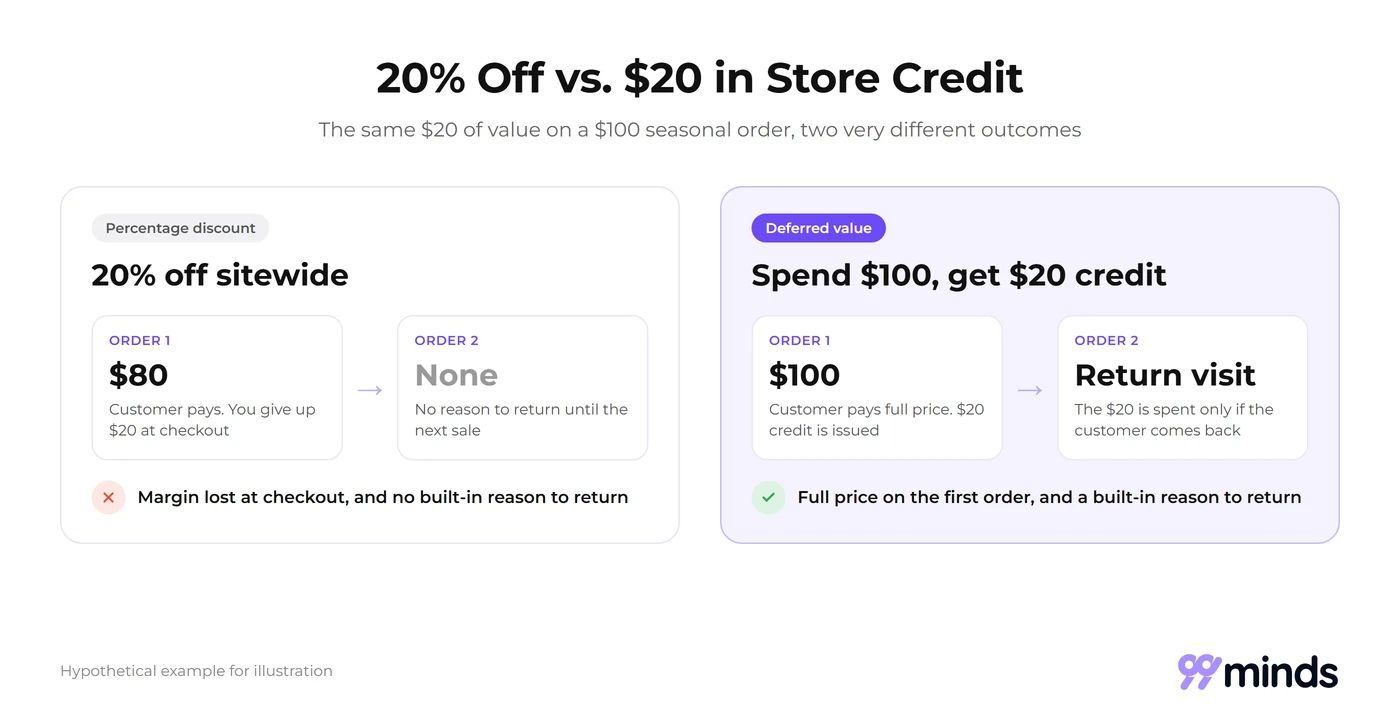
Percentage discounts still have a place. They work well for clearing aging stock and for price-driven days like Cyber Monday, when shoppers compare deals side by side. Just don’t make them your default seasonal offer.
What Does a Real Seasonal Promotion Look Like?
Jaxen Grey, a US fashion and lifestyle brand that sells online and in its own stores, used a holiday giveaway to grow its audience. For Valentine’s Day, the brand ran a $150 gift card giveaway on Instagram and Facebook. To enter, shoppers tagged three friends in the comments and followed the brand’s accounts.
Here’s what the Jaxen Grey gift card promotion case study reports:
- The Valentine’s Day giveaway grew Jaxen Grey’s Instagram and Facebook followers by 20%
- Across the brand’s gift card giveaways, average order value rose 8%, because winners often spent more than the card’s value
- Repeat purchases rose 12%, led by shoppers who first visited after a store-opening giveaway
Three lessons from this campaign carry over to any seasonal promotion:
- The prize was a gift card, not a discount, so the cost only landed when a winner came back to shop, often with a bigger basket
- The entry mechanic matched the season. Tagging friends fits a holiday that’s built around other people
- The promotion had one clear goal, audience growth, which made the result easy to measure
How Do You Build a Seasonal Marketing Strategy Step by Step?
A strong seasonal marketing strategy doesn’t mean running a promotion for every holiday. It takes the core of promotion marketing, a clear offer for a clear audience, and ties it to the right moments in the calendar. Here’s the six-step seasonal promotions marketing process we recommend:
- Pick four to six seasons that match your products and customers. A home goods store and a school supply store shouldn’t share a calendar
- Give each promotion one goal: new customers, bigger orders, or repeat purchases. Trying to hit all three usually means hitting none
- Match the offer to the goal using the comparison table above. Store credit and points drive repeat purchases, while tiered discounts and bundles grow order size
- Segment your audience. Loyalty members get early access or bonus points, and new visitors get your entry offer
- Choose your channels, like email, SMS, onsite banners, and digital wallet passes. Plan for social, too, since its share of holiday revenue keeps climbing
- Measure what matters. Compare revenue against a normal week, check margin per order, and track how many seasonal buyers order again within 60 to 90 days
What Mistakes Hurt Seasonal Promotions?
Even well-planned seasonal campaigns can backfire. Watch out for these common mistakes:
- Discounting deeper every year until customers won’t buy at full price
- Starting too late, which leaves no time for creative, inventory, or email warm-up
- Running the exact same offer every season, so shoppers tune it out
- Ignoring the post-holiday window and the gift card holders it brings back to your store
- Launching without a single clear goal, which leaves you no way to tell if the promotion worked
How Does 99minds Support Seasonal Promotions Marketing?
The offers that protect margin, like store credit, gift card bonuses, and bonus points, need a system that can issue them, track them, and let customers redeem them anywhere. 99minds is a customer retention platform that issues, tracks, and redeems these seasonal offers across online and in-store channels.
- Store credit campaigns: 99minds issues spend-and-get credit or exchange bonuses automatically, using store credit software workflows triggered by events like a completed order
- Gift cards for gifting seasons: 99minds lets you sell physical and digital gift cards and pair them with seasonal offers through its gift card software
- Bonus points and member perks: 99minds runs flat or tiered rewards, double-points weekends, and member-only early access on its loyalty platform
- Wallet delivery: 99minds sends offers and balances straight to Apple and Google Wallet passes, with location-triggered notifications that remind customers when they’re near your store
- Omnichannel sync: 99minds keeps store credit, gift card balances, and points in sync across your website, app, and physical stores in real time
- Campaign reports: 99minds shows issuance and redemption data for each promotion, so you know which seasonal offers actually brought customers back
99minds works with Shopify and BigCommerce stores, along with a range of POS and CRM integrations.
How Can 99minds Help Your Next Seasonal Promotion Pay Off Twice?
Seasonal promotions marketing works best when you plan early, give every offer one clear goal, and favor offers that bring customers back. Use the calendar to set your planning dates, the discount examples to pick your mechanics, and the comparison table to decide when a percentage off is really the right call.
The biggest shift is thinking past the season itself. A $20 discount is gone the moment the order ships. Twenty dollars in store credit, a bonus gift card, or a batch of bonus points works differently. It gives that same shopper a reason to come back in January, when demand is quiet and every repeat order counts.
Want seasonal offers that pay off twice, once during the sale and again on the next order? 99minds can help you set them up across every channel. Book a demo and we’ll walk you through it.
Frequently Asked Questions on Seasonal Promotions Marketing
What are seasonal promotional campaigns?
Seasonal promotional campaigns are time-bound marketing campaigns tied to holidays, weather seasons, or life events like back-to-school. Each one pairs a specific offer, such as a discount, store credit, or gift card bonus, with a clear deadline. That deadline gives shoppers a reason to buy during the window instead of waiting. Together, these campaigns make up your seasonal promotions marketing calendar.What does seasonal marketing mean?
Seasonal marketing means aligning your messaging, products, and offers with predictable moments in the calendar when customer demand changes. It includes themed content and creative, while seasonal promotions are the specific offers you run during those moments to turn that demand into sales.Can you give me some examples of seasonal marketing?
Common examples include a gift card bonus in December, back-to-school bundles in July and August, double loyalty points around Valentine's Day, and member early access before Black Friday. Each one ties a specific offer to a moment when shoppers are already planning to spend.What is a seasonal discount?
A seasonal discount is a price reduction or added value offered only during a defined season or event. It can be a straight percentage off, but it can also be deferred value, like store credit or bonus points, that customers use on a future order.What is an example of a seasonal discount?
A good seasonal discount example is "spend $100, get $20 in store credit" during Cyber Week. The customer pays full price today and gets $20 to spend on their next order. That protects your margin and gives them a reason to come back after the holiday rush.How far in advance should you plan seasonal promotions?
For major events like Black Friday, Cyber Monday, and Christmas, start planning eight to 12 weeks ahead, or even earlier if you need new inventory. For smaller holidays like Valentine's Day or Father's Day, four to six weeks is usually enough to prepare the offer, creative, and emails.What are seasonal promotional products?
Seasonal promotional products are limited-edition items, gift sets, or bundles sold only during a specific season, like holiday gift boxes or summer kits. They create urgency because they won't be around for long, and they let you promote a season without discounting your regular products.Boost Customer Engagement with 99minds. The Ultimate Gift Card & Loyalty Solution!
Sign up for free