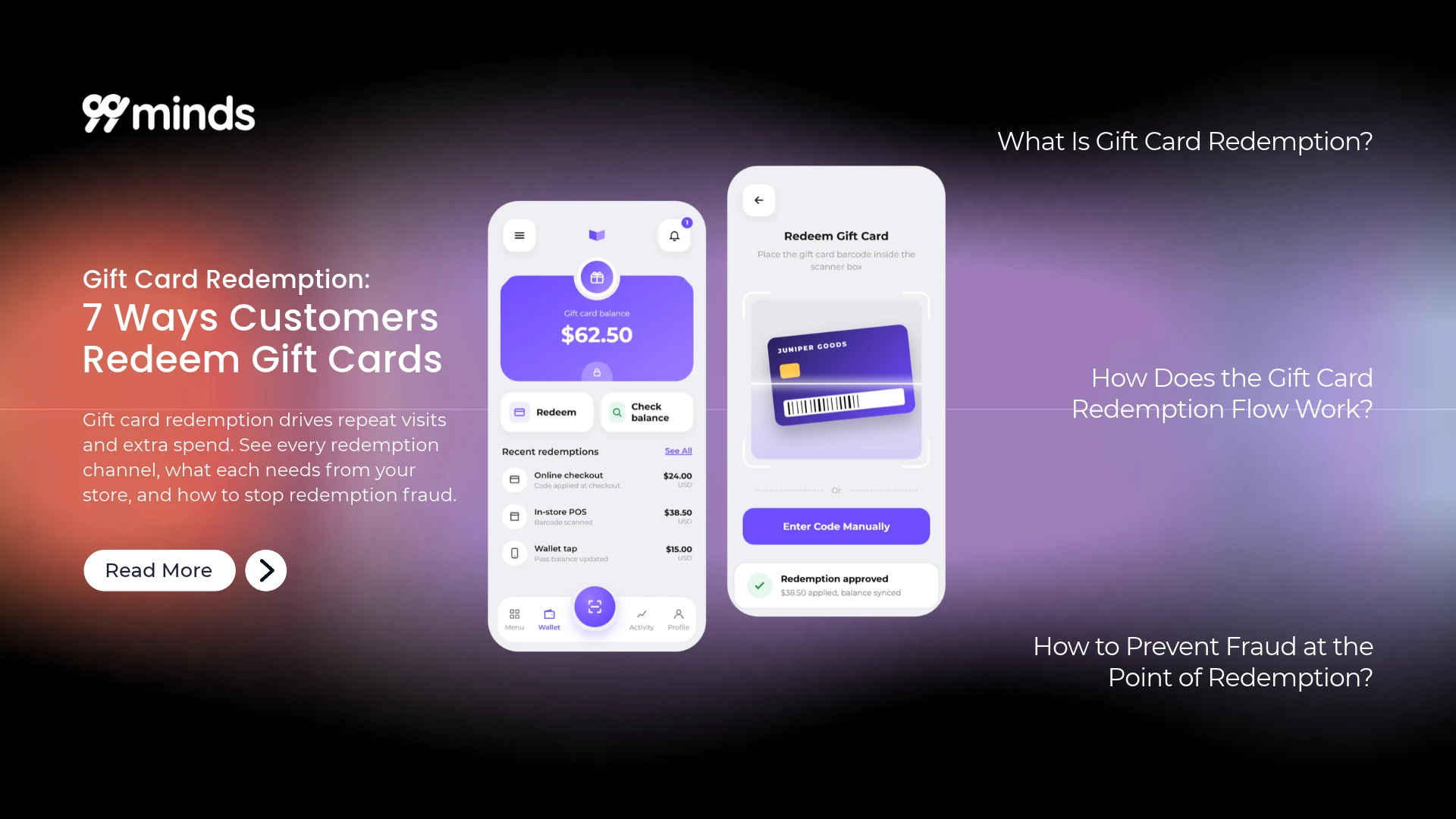
A customer opens their wallet app, sees your gift card, and walks into your store. Then the cashier says it only works online. That’s a lost sale, and probably a lost customer too.
It happens more than you’d think. A 2026 TSG and Bank of America study found that 39% to 49% of consumers are less likely to use a gift card when a specific redemption channel isn’t available, whether that’s in-store, online, a mobile app, or a digital wallet.
Gift card redemption is the moment a customer turns stored value into a purchase. Most brands put their energy into selling gift cards, but redemption is where the revenue, the extra spend, and the repeat visits actually happen. This guide covers why redemption drives revenue, how the redemption flow works, the seven ways customers redeem gift cards and how to support each one, and how to keep fraud out.
60-Second Summary
- Redemption is when a customer spends the stored value on a gift card. For you, it’s the moment deferred revenue becomes earned revenue
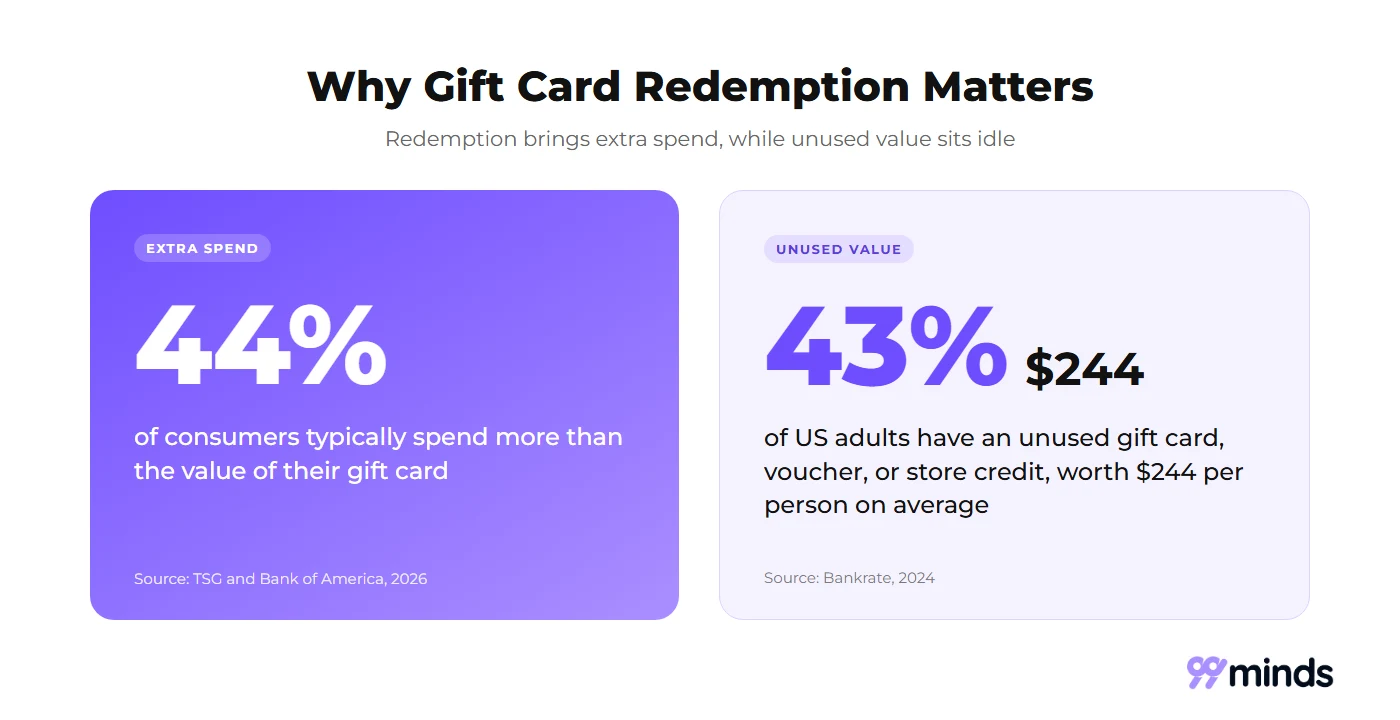
- Redemption brings extra spend: 44% of consumers typically spend more than the card’s value
- Unredeemed balances aren’t a windfall. They’re a liability, and breakage is regulated
- Track your gift card redemption rate, time to first redemption, and channel mix
- Every card follows the same path: issue, deliver, check balance, redeem, keep the remaining balance, and reload or return
- Customers redeem gift cards in seven main ways: online checkout, in-store POS, partial redemption, mobile wallets, store credit, small-balance cash-out, and B2B bulk redemption
- Every missing channel costs you redemptions, so support the channels your customers already shop and keep one synced balance
- Protect the redemption point with PIN checks, rate limits, and alerts for unusual patterns
What Is Gift Card Redemption?
Gift card redemption is the process of applying a gift card’s stored value to a purchase. The customer enters a code, scans a barcode, or taps a phone, and the amount comes off the card’s balance. Any value left over stays on the card for a future visit, unless state law lets the customer cash it out.
For merchants, redemption matters more than the sale. When you sell a gift card, you collect cash but owe the buyer goods or services, so the sale goes on your books as a liability. Only when the card is redeemed do you recognize the revenue, which is the core rule of gift card accounting.
That’s why redemption is the real revenue lever. A card that never gets used doesn’t bring a customer through your door, doesn’t lead to extra spend, and doesn’t build a buying habit.
Why Does Gift Card Redemption Drive Revenue?
Gift card redemption drives revenue because customers often spend more than the card’s value, and every redemption brings them back to your store. Unredeemed cards, on the other hand, stay on your books as a liability.
Customers spend more than the card’s value
The same TSG and Bank of America study found that:
- 44% of consumers typically spend more than the value of their gift card, and another 48% spend about the same amount
- 55% of US consumers say they’d try a new business because of a gift card, up from 49% two years earlier
That extra spend is full-margin revenue you wouldn’t have earned otherwise. And every redemption by a first-time recipient is a chance to win a new customer.
Unredeemed balances and breakage
A lot of gift card value never gets spent. Bankrate’s 2024 survey found that 43% of US adults have an unused gift card, gift voucher, or store credit, worth $244 per person on average. Those unredeemed gift cards sit on merchants’ books as a liability until someone spends them.
Gift card breakage is the value you expect customers never to redeem. It can look like free money, but counting on it is a poor strategy:
- It’s regulated. You can only recognize it as revenue under strict accounting rules, and state unclaimed property laws may require you to hand some of it to the state
- It costs goodwill. A customer who forgets a balance doesn’t come back, and doesn’t think of your brand when it’s time to buy again
- It gives up the overspend. An unredeemed card brings no extra spend and no repeat visit
Redemption rate as your KPI
Your gift card redemption rate shows how much of the value you’ve issued actually gets spent. To calculate it:
- Gift card redemption rate = value redeemed ÷ value issued, for the same period or cohort of cards
Measure it by cohort, such as cards sold in a given month, so new sales don’t skew the number. Then track these alongside it:
- Time to first redemption: how long cards sit before their first use
- Channel mix: which channels customers redeem through
- Average overspend: how much customers spend above the card value
- Outstanding liability: the total unredeemed value still on your books
A low rate or a long time to first redemption is a sign that customers face friction, or simply forget.
How Does the Gift Card Redemption Flow Work?
No matter the channel, every gift card follows the same path from issue to repeat visit:
- Issue: the customer buys the card, or you issue it as a reward or refund
- Deliver: by email, SMS, wallet pass, or as a physical card
- Check balance: on your site, the receipt, or the wallet pass
- Redeem: through any of the seven channels covered below
- Remaining balance: stays on the card for the next purchase
- Reload or return: the customer tops up the card or comes back to spend the rest
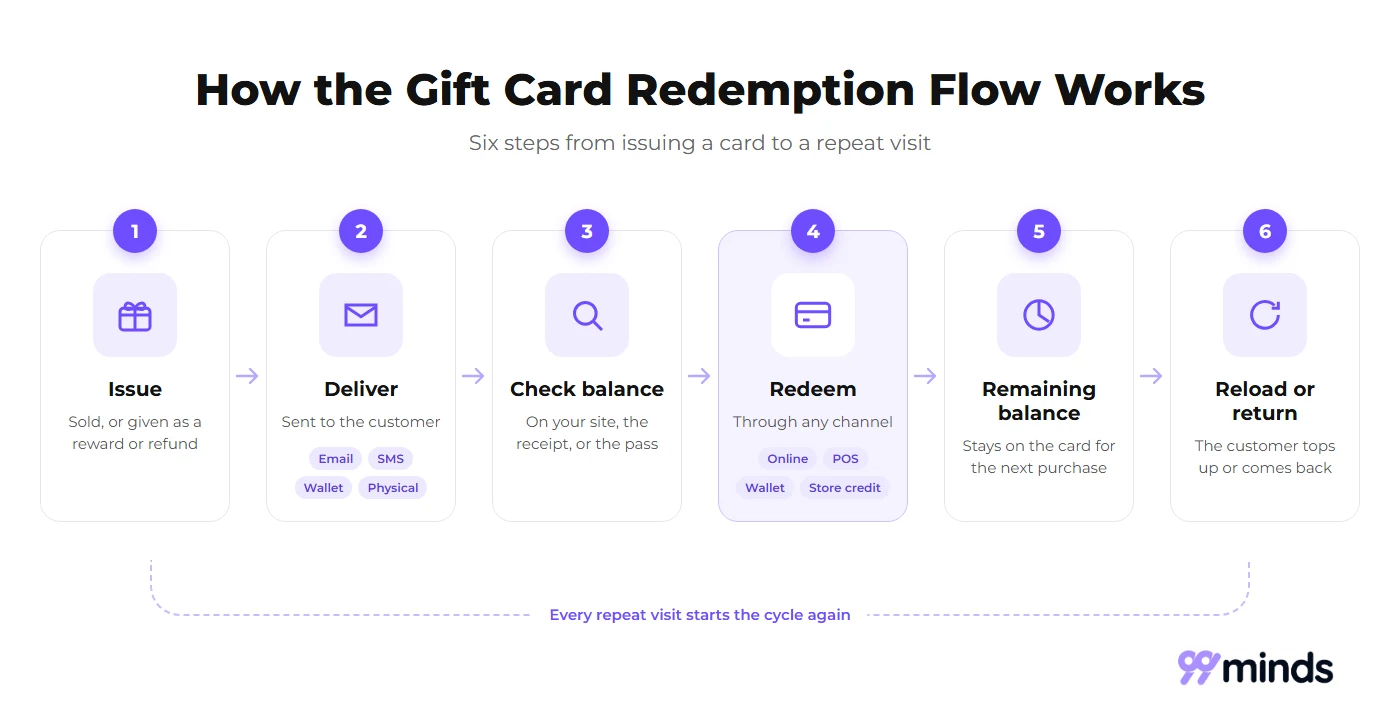
That last step is where retention happens. Offering reloadable gift cards turns a one-time gift into an ongoing relationship.
Here’s how the seven redemption channels compare at a glance, before we look at each one in detail:
| Channel | Setup effort | Customer friction | Data captured | Best for |
|---|---|---|---|---|
| Online checkout | Low | Low, if the field is easy to find | Customer, order, and product data | Ecommerce brands and digital gift cards |
| In-store POS | Medium (needs POS sync) | Low | Store location and basket data | Omnichannel retailers |
| Partial redemption and split tender | Low to medium | Low | Overspend beyond the card value | Every program |
| Mobile wallet | Medium | Very low | Pass installs, location visits, and redemptions | Brands with physical stores and repeat buyers |
| Store credit and account balance | Medium | Very low (applies automatically) | Customer account and return history | Returns, exchanges, and loyal customers |
| Cash-out of small balances | Low (a store policy) | Medium (customer has to ask) | Minimal | Compliance in states that require it |
| B2B and corporate bulk | Medium to high | Low for recipients | Redemption by recipient and by buyer | Corporate gifting and employee rewards |
What Are the 7 Ways Customers Redeem Gift Cards?
Customers redeem gift cards through seven main channels:
- Online checkout
- In-store POS
- Partial redemption and split tender
- Mobile wallet (Apple Wallet and Google Wallet)
- Store credit and account balance
- Cash-out of small balances
- B2B and corporate bulk redemption
Here’s how each one works for the customer, what you need to support it, and one tip to get it right.
1. Online checkout
The customer enters a gift card redemption code, or a card number and PIN, into a gift card field at checkout. The balance is applied to the order total.
- What you need: a platform-native gift card field or an app that adds one. If you run a Shopify gift card program, check whether the field works with your discount and checkout setup
- Tip: put the gift card field where customers can see it. When shoppers want to use a gift card online and can’t find the field, they leave
Online checkout is the default channel for digital gift cards, but it shouldn’t be the only one.
2. In-store POS
The cashier scans the card’s barcode or keys in the number, and the POS deducts the amount from the balance.
- What you need: real-time balance sync between your POS and your online store. Without it, a card bought online won’t work in store, and a card partly used in store shows the wrong balance online
- Tip: train staff to check balances and handle split payments, so the line doesn’t stall
Retailer Birdsnest faced exactly this when it moved to BigCommerce: its gift cards had to work in its ConnectPOS stores and online from one balance. According to the Birdsnest case study After switching to 99minds, balances updated in real time across both channels, and the brand saw 20% more repeat purchases and 15% higher customer lifetime value.
3. Partial redemption and split tender
The card covers only part of the order. Either the leftover balance stays on the card, or the customer pays the difference with another method.
- What you need: support for leftover balances and for combining several gift cards, or a gift card plus a credit card, on one order
- Tip: show the remaining balance on the receipt and in the confirmation email. A customer who knows they have money left is more likely to come back
4. Mobile wallet (Apple Wallet and Google Wallet)
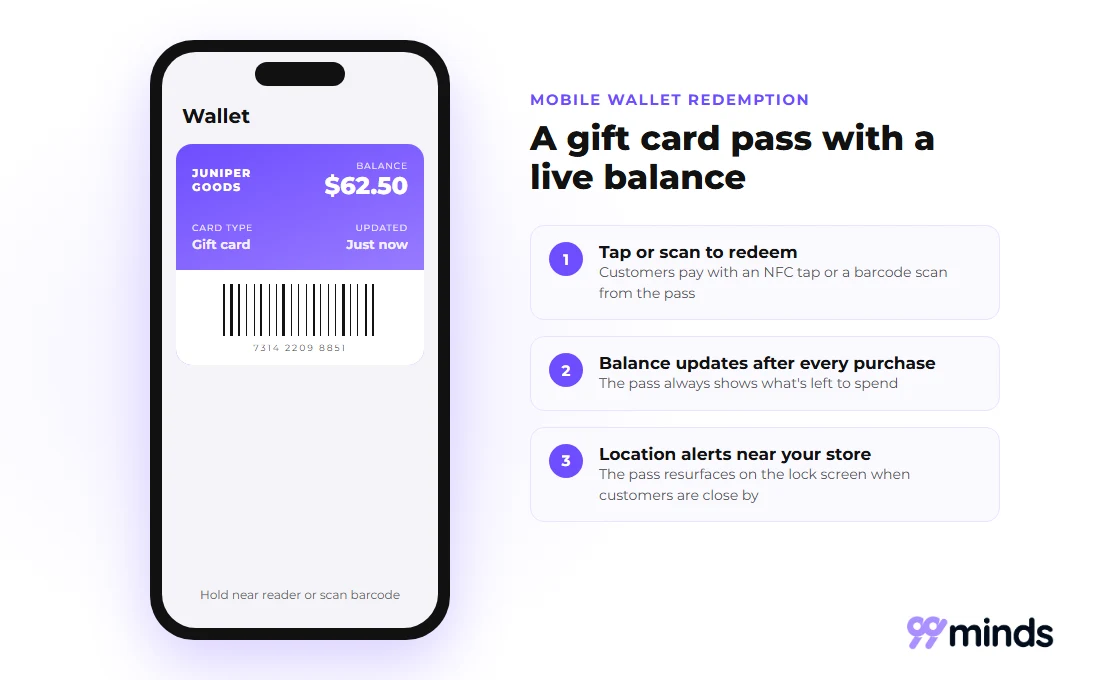
The gift card lives as a pass in the customer’s phone wallet. According to Google’s developer documentation, customers can redeem Google Wallet gift cards with an NFC tap or by scanning a barcode on the pass.
- What you need: a platform that issues mobile wallet passes and updates the balance on the pass after every purchase
- Tip: use location-triggered notifications. When a customer walks near your store, the pass pops up on their lock screen and reminds them they have a balance to spend
5. Store credit and account balance
The gift card’s value is loaded into the customer’s account, or a return is refunded as store credit instead of cash. The balance then applies to future orders automatically.
- What you need: a store credit wallet tied to the customer’s account, synced across channels
- Tip: offer store credit for returns and exchanges. It keeps the revenue in your business instead of sending it back as a cash refund
6. Cash-out of small balances
Some US states require you to give cash back for small leftover balances when the customer asks. California raised its threshold from $10 to $15 on April 1, 2026, according to Morgan Lewis, so a card with less than $15 left can be redeemed for cash there.
Thresholds and exemptions differ by state, and many states also set their own rules on whether gift cards expire, so check the rules wherever you sell.
7. B2B and corporate bulk redemption
Companies buy bulk gift cards for employee rewards, client gifts, and incentives. Recipients redeem them like any other card, but the buyer often wants to track which codes were used.
- What you need: bulk code generation, delivery to many recipients at once, and redemption reports by recipient
- Tip: give corporate buyers a simple redemption report. It makes the next order an easy yes
How Do You Make Gift Card Redemption Frictionless?
The fewer steps between a customer and their balance, the more cards get redeemed. Whether you run a large omnichannel brand or you’re setting up gift cards for small business, these basics matter most:
- Support every channel your customers shop: online, in store, on mobile, and in their wallet
- Keep one synced balance, so a card works anywhere, no matter where it was bought
- Publish a public gift card redemption page where customers can check their balance without logging in
- Offer wallet passes that show the live balance and resurface near your store
- Write clear terms that explain where the card works, whether it expires, and what happens to leftover balances
- Send reminder emails for idle balances, and before any promotional value expires
If you sell across borders, multi-currency gift cards let customers redeem in their own currency.
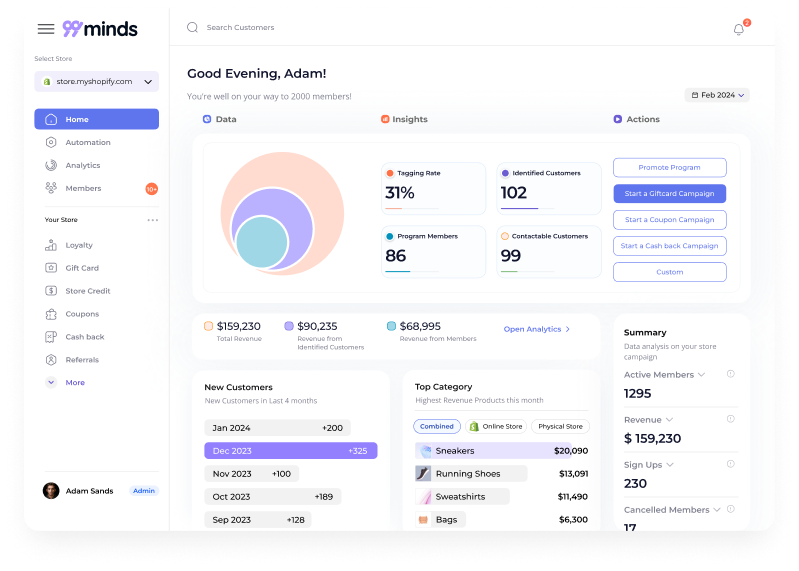
99minds’ gift card software keeps one balance in sync across your online store, POS, and retail stores in real time, with support for Shopify, BigCommerce, and Lightspeed. You can issue gift cards as Apple Wallet and Google Wallet passes with location-triggered notifications, convert returns into store credit, and track redemption and outstanding balances in gift card reports.
How to Prevent Fraud at the Point of Redemption?
Most advice about gift card scams is written for shoppers. But the redemption point is where merchants lose money, through bots guessing card numbers, stolen codes, and scams that target your staff. Here’s a merchant-side checklist:
- Require a PIN or scratch-off code alongside the card number, so a number alone can’t be redeemed
- Add rate limits and a CAPTCHA to your balance-check page to stop bots from guessing valid card numbers
- Set alerts for unusual redemption patterns, like many cards redeemed in a short window or from one account
- Activate physical cards only at the point of sale, so cards stolen off the rack have no value
- Use rotating barcodes on wallet passes where your platform supports them. Google Wallet’s documentation describes barcodes that change periodically, typically every minute, so a screenshot can’t be reused
- Train staff on social-engineering scams, such as callers asking for card numbers or pressuring cashiers to override checks
Kickstart Your 2027 With 99minds Gift Card Redemption
Redemption is the revenue moment of every gift card program. The sale books a liability, but redemption brings the customer back, lets you recognize the revenue, and often leads to extra spend on top of the card’s value.
To get more from it, support every channel your customers already use, from online checkout and in-store POS to mobile wallets and store credit. Track your redemption rate by cohort so you can spot friction early, and protect the redemption point with PINs, rate limits, and alerts.
Want to see how 99minds syncs redemptions across your online store, POS, and mobile wallet? Book a demo and we’ll show you how it works.
Frequently Asked Questions
What is gift card redemption?
Gift card redemption is the process of applying a gift card's stored value to a purchase. The customer enters a code, scans a barcode, or taps a phone, and the amount comes off the card's balance. For the merchant, redemption is the moment deferred revenue from the gift card sale becomes earned revenue.How do you make gift card redemption frictionless?
Support every channel your customers shop, including online checkout, in-store POS, and mobile wallets, and keep one balance synced across all of them so a card works anywhere. Add a public balance-check page, issue wallet passes that show the live balance, write clear terms, and send reminder emails for idle balances. The fewer steps between a customer and their balance, the more cards get redeemed.How do you calculate gift card redemption rate?
Divide the value redeemed by the value issued for the same period or cohort of cards, then multiply by 100. Measuring by cohort, such as all cards sold in one month, keeps new sales from skewing the number. Track it alongside time to first redemption, channel mix, and average overspend.Can customers redeem a gift card for cash?
Usually not, but some US states require merchants to give cash back for small leftover balances when the customer asks. In California, cards with less than $15 left have been redeemable for cash since April 1, 2026. Thresholds and exemptions vary by state, so check the rules wherever you sell.Can a customer use part of a gift card and save the rest?
Yes. With partial redemption, the card covers part of the order and the remaining balance stays on the card for a future purchase. If the order costs more than the card's balance, the customer pays the difference with another payment method, which is called split tender.What happens to unredeemed gift cards?
Unredeemed balances stay on the merchant's books as a liability. Over time, the value a business expects never to be redeemed can be recognized as breakage revenue under accounting rules, but state unclaimed property laws may require some of it to be handed to the state. Unredeemed cards also mean lost extra spend and fewer repeat visits, so most merchants are better off driving redemption.How can merchants prevent gift card redemption fraud?
Require a PIN or scratch-off code alongside the card number, and add rate limits and a CAPTCHA to your balance-check page to stop bots from guessing card numbers. Set alerts for unusual redemption patterns, activate physical cards only at the point of sale, use rotating barcodes on wallet passes where supported, and train staff to spot social-engineering scams.Boost Customer Engagement with 99minds. The Ultimate Gift Card & Loyalty Solution!
Sign up for free