Bulk gift cards are gift cards you issue in large quantities in a single batch. Brands issue them for corporate client orders, employee rewards, and seasonal promotions. If you sell your own gift cards, a bulk order is cash paid up front. Every card you issue also sends a shopper back to your store.
The demand is there. The National Retail Federation expected holiday gift card spending to reach $29 billion in 2025. A bulk order lets you capture a big slice of that demand in a single transaction.
TL;DR
- Bulk gift cards are gift cards issued in large quantities in one order for gifting, rewards, or promotions
- Issuing your own branded cards in bulk keeps the revenue and the redeeming customer with your brand
- You can issue bulk gift cards in seven steps, from creating a campaign to tracking redemption
- Digital cards suit most bulk orders, while physical cards work best for events and in-store handouts
- Bulk fraud controls include unique codes per campaign, duplicate-code checks, balance-check protection, approvals, audit trails, and card freezing
- Employee gift cards are taxable wages at any amount, and client gift deductions are capped at $25 per person
- 99minds issues bulk gift cards by CSV upload, customer details, or API, and tracks every batch
What Are Bulk Gift Cards and Who Buys Them?
Bulk gift cards are gift cards issued or bought in large quantities in a single order. One order can cover a small team or an entire company. The cards usually share an amount, a design, and a delivery date.
Most bulk orders come from businesses, not individual shoppers. Here’s who typically buys them:
- HR and people teams buying employee gift cards for rewards, holidays, and work anniversaries
- Sales and marketing teams paying out customer incentives and referral rewards
- Research teams sending survey and focus group incentives
- Event planners handing out prizes, giveaways, and thank-you gifts
- Companies buying a brand’s gift cards to thank their own clients
Every one of those buyers needs a brand to issue the cards. The rest of this guide is written for that brand.
Which type of bulk gift card should you offer?
Bulk gift cards come in three main types. Each one handles spending, fees, and customer data differently.
| Card type | Where it can be spent | Typical buyer fees | Branding and customer data |
|---|---|---|---|
| Branded closed-loop card | Only at the issuing brand, online and in store | Usually none beyond face value | The brand controls the design and sees who redeems |
| Multi-brand choice card | Any brand in the provider's catalog | Varies by provider | The provider's branding, with little data for each brand |
| Open-loop prepaid card (Visa or Mastercard) | Almost anywhere the card network is accepted | Purchase or activation fees per card are common | Network branding, with no shopper data for any brand |
For a brand, the branded card is the clear winner. The revenue stays with you, and the person who redeems the card becomes your customer.
Why Do Brands Issue Gift Cards in Bulk?
Brands issue gift cards in bulk because one order brings in cash up front. It also sends new shoppers to the store. Bulk issuance also covers several other jobs:
- Corporate client orders: a company buys your cards for its year-end staff gifts and pays one invoice
- Employee rewards: a bulk batch is one of the simplest employee incentive ideas to run for your own team
- Promotional campaigns: gift card promotions like “spend $100, get a $20 bonus card” bring shoppers back in January
- Store credit for returns: issuing gift cards for refunds keeps revenue in your business instead of sending cash back
- Service recovery: a batch of apology cards after a shipping delay helps win back frustrated customers
- Channel partner rewards: a B2B loyalty program can pay out gift cards to resellers who hit sales targets
Bulk programs also affect your numbers. Shoppers often spend more than a card’s value, which adds revenue. Some balances are never spent at all, which is known as gift card breakage. Plan for both when you price a bulk order.
How Do You Issue Bulk Gift Cards?
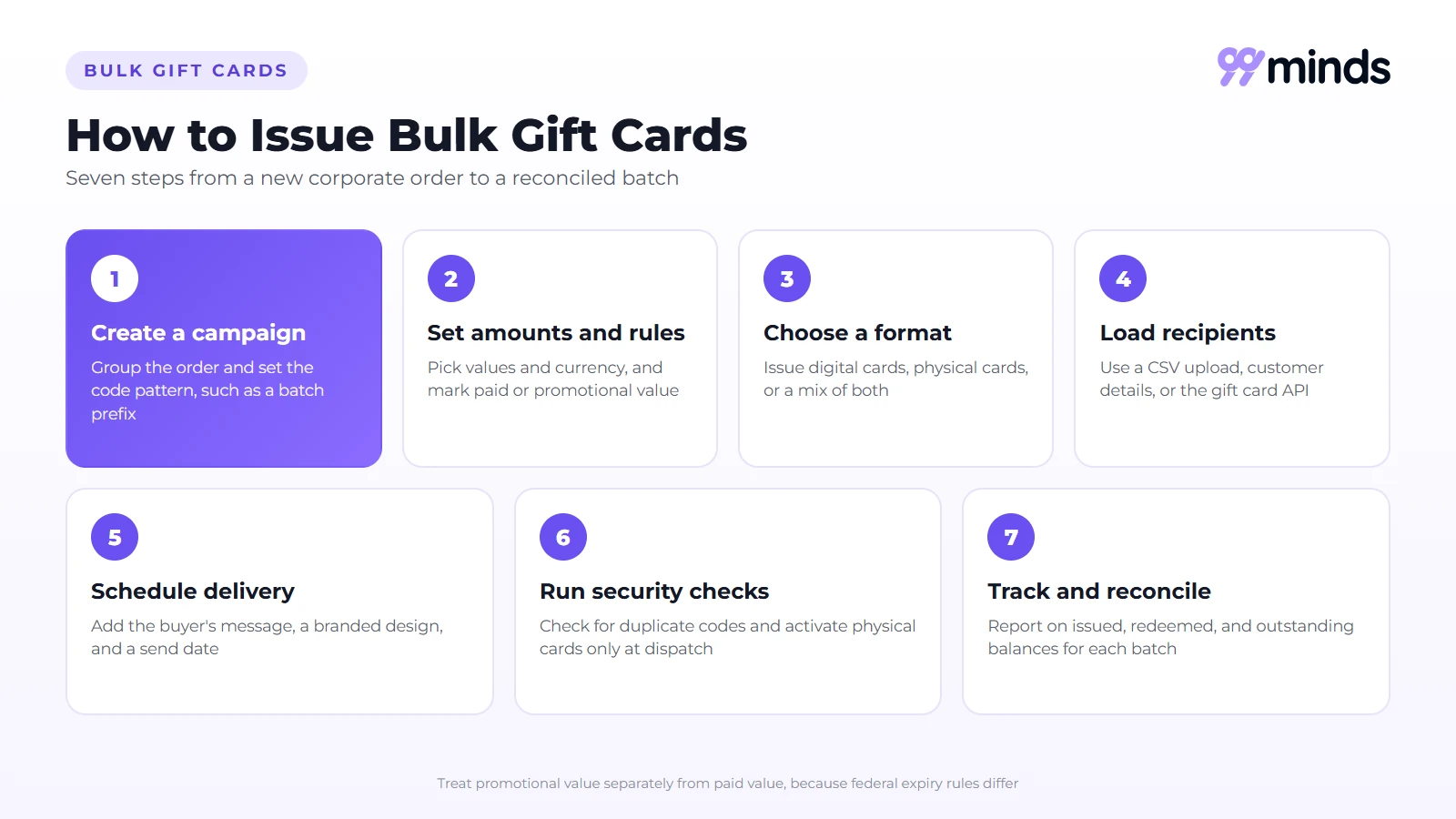
You issue bulk gift cards in seven steps. Create a campaign, set amounts and rules, pick a format, and load recipients. Then schedule delivery, run security checks, and track redemption.
Step 1: Create a campaign for the batch
A campaign groups every card in one order, so you can track and manage them together. Give each campaign a clear name, such as “Acme Corp holiday 2026” or “Spring bonus card.”
Inside the campaign, set the code generation pattern. That covers the code length, the character set, and any prefix or suffix. A prefix like ACME26 makes a batch easy to spot in reports.
In 99minds, every card in a batch is tied to its campaign and gets its own unique card number. Want to test a format first? Try the free 99minds gift card code generator.
Step 2: Set amounts, currency, and expiry rules
Decide whether every card gets the same amount or each recipient gets a custom value. Corporate orders usually use one amount, while rewards programs may vary by tier.
Pick the currency next. International clients may want cards in euros or pounds, and 99minds multi-currency gift cards handle that without a separate program.
Then mark the value as paid or promotional. Paid cards follow strict federal expiry rules. Promotional cards can expire sooner if the terms are disclosed, as the compliance section below explains.
Step 3: Choose physical, digital, or both
Digital cards reach recipients in minutes by email or SMS. Physical cards take longer, but they work well for events and in-store handouts. We compare the two formats in detail later in this guide.
Step 4: Load recipients by CSV, customer details, or API
There are three ways to load a bulk order, and each one fits a different job:
- CSV upload works best for large one-off orders, because one spreadsheet can issue both digital and physical cards
- Customer details work best for smaller digital batches, because you paste emails, phone numbers, or IDs into a form
- An API works best for recurring programs, because your HR system, CRM, or app can issue cards automatically
In 99minds, go to Gift Cards, then Issue Bulk Gift Cards, and choose By CSV upload. Download the sample CSV and fill in your recipients. You can add a customer note that recipients see, plus an internal note for your team.
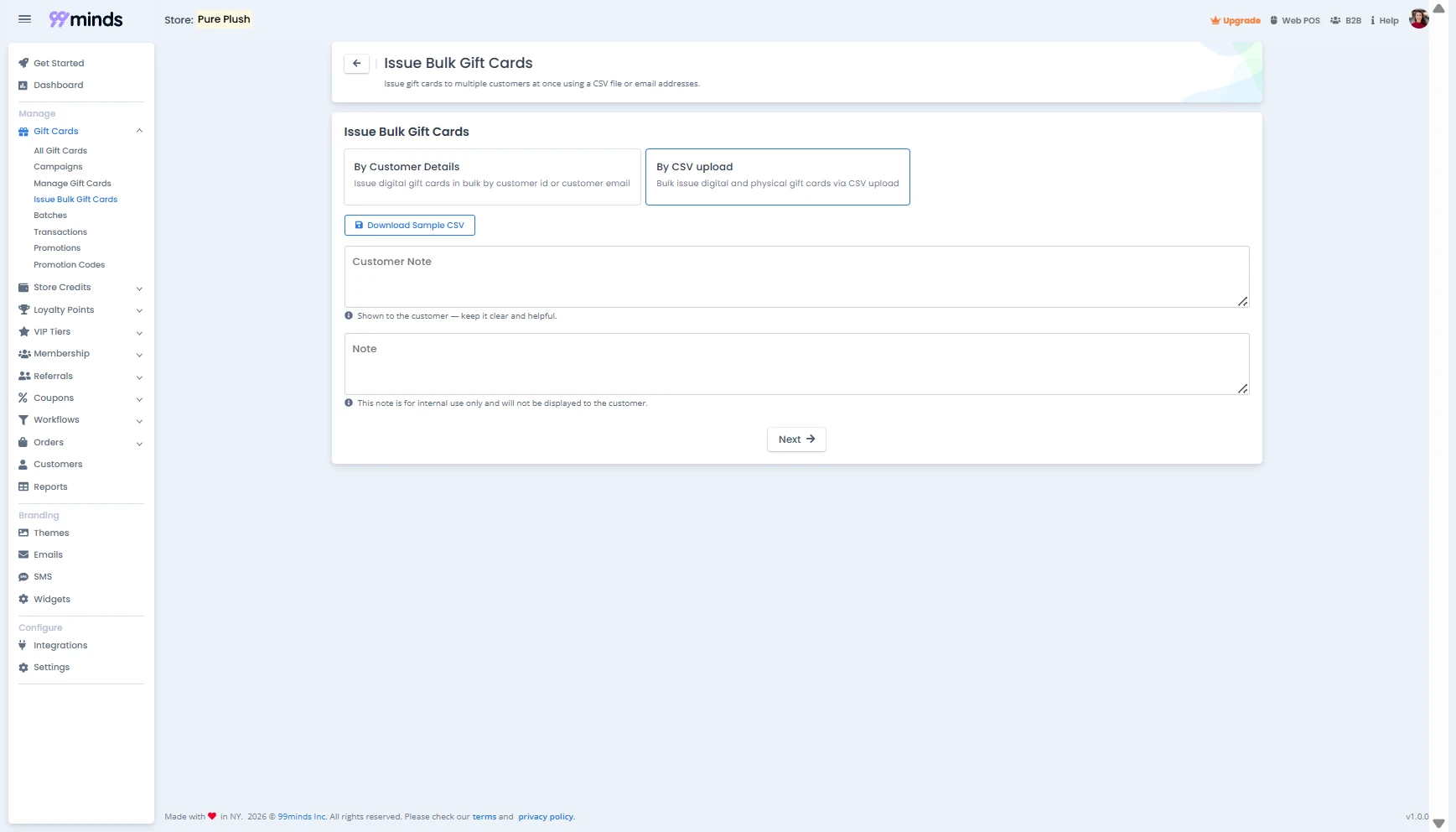
The By Customer Details option is built for digital cards. Choose customer email, phone, or ID, and enter your list. Then select the campaign, amount, and gift card style, and click Issue Giftcards.
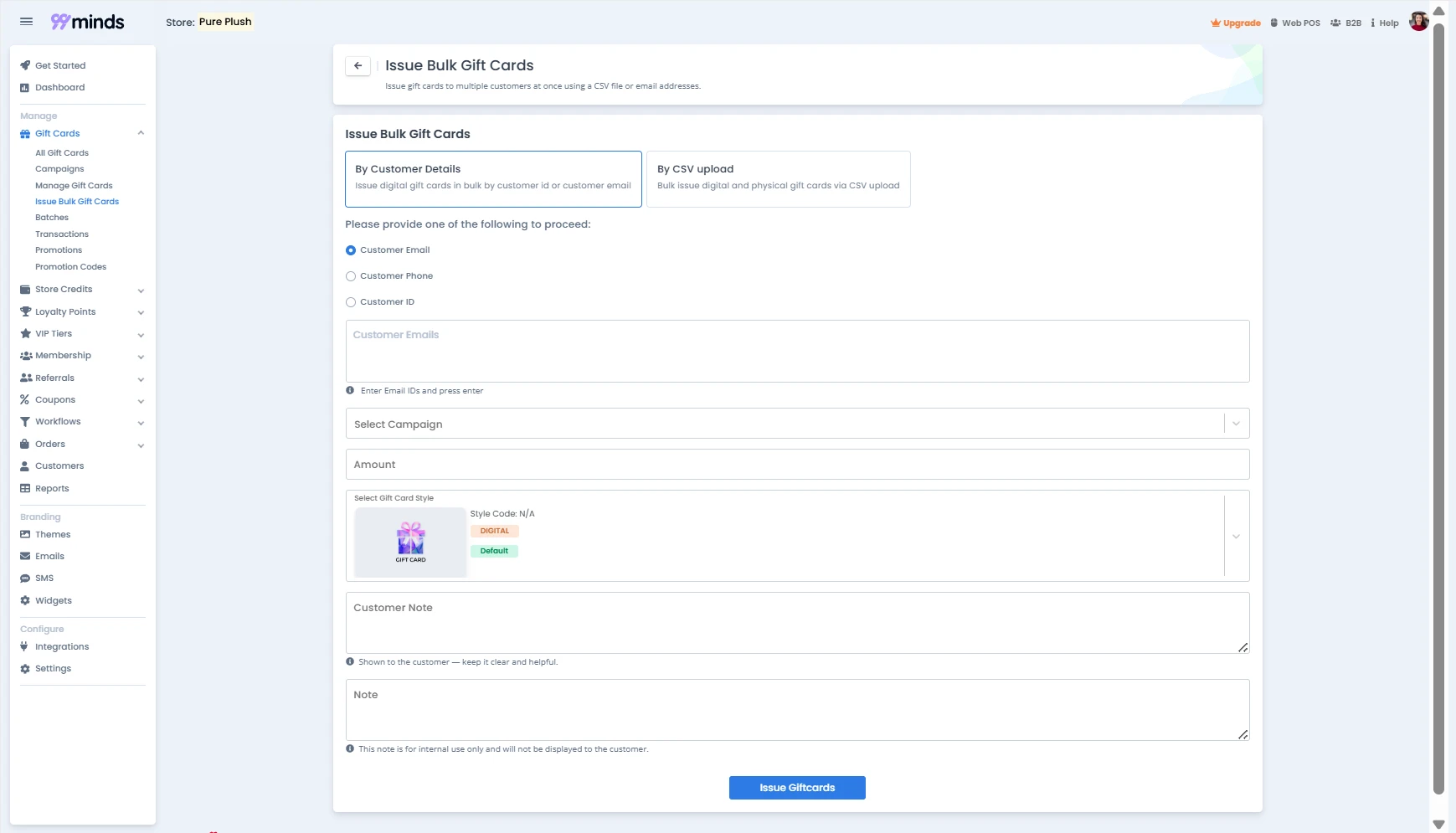
For automated batches, the 99minds gift card API accepts an array of cards in one request. It returns a unique gift card number for each card it creates.
Step 5: Personalize and schedule delivery
Personal touches make a bulk card feel like a gift, not a payment. Add the buyer’s message, choose a branded design, and set a send date.
Scheduling matters most for B2B orders. A company may want its cards to land on a holiday or event date, not on the day it pays. You can also add cards to Apple and Google Wallet with 99minds digital wallet passes. That way, recipients always see their balance.
Prefer to send cards through your email platform? You can send bulk gift cards using Klaviyo or send bulk gift cards with Omnisend.
Step 6: Run security checks and activate
Check every new batch for duplicate codes before it goes out. The check should cover existing digital cards, migrated cards, physical batches, and reorders. A code that clashes with any of them can send value to the wrong card.
Activate physical cards only when they ship or sell, not when they’re printed. An inactive card has no value if it goes missing.
Moving from another platform? Import your existing balances by CSV first. New batches can then be checked against your old cards.
Step 7: Track redemption and reconcile
Every batch needs its own report covering cards issued, delivered, redeemed, and still outstanding. Corporate buyers often ask for these numbers, so keep them easy to share.
In 99minds, the Batches page lists every batch with its campaign, total cards, total value, and creation date. You can filter by date range and download a batch whenever you need it.
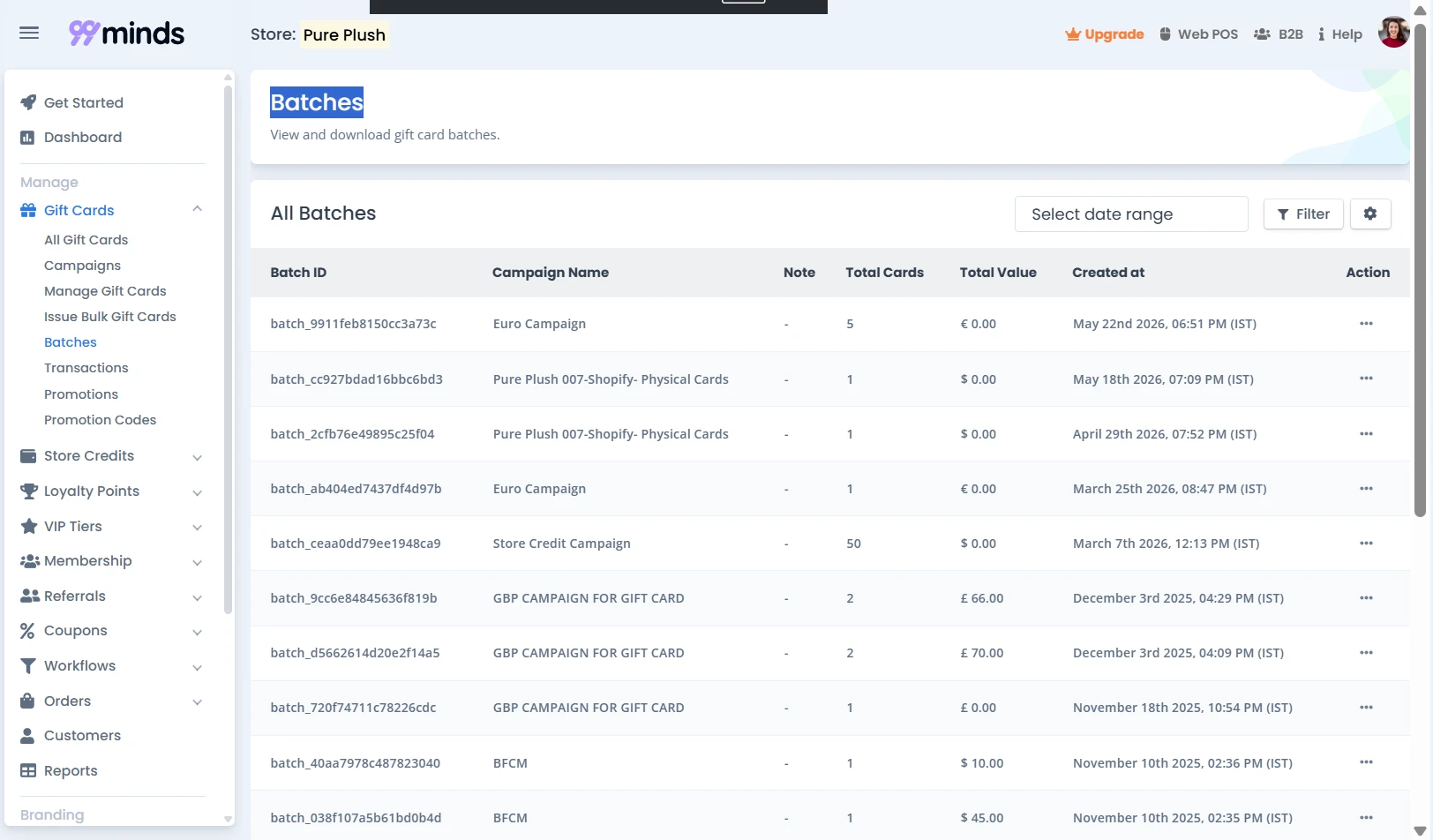
Unredeemed balances stay on your books until they’re spent. Reconcile each batch against your gift card liability so finance isn’t surprised at month end.
Issue Gift Cards in Bulk Without the Spreadsheets
99minds issues digital and physical gift cards in bulk by CSV or API, with campaign tracking and batch reporting built in.
How Do You Sell Gift Cards in Bulk to Corporate Buyers?
You sell gift cards in bulk to corporate buyers with a simple B2B offer: clear pricing, flexible delivery, and reporting. Start with the offer itself:
- Set a minimum order by card count or total value, so small requests still go through your regular checkout
- Offer volume pricing tiers, such as bonus value on larger orders
- Accept invoices, ACH transfers, and credit cards, because finance teams pay in different ways
Next, give buyers a choice of delivery. Some want you to email each recipient directly. Others want a secure code file they can send themselves. Event teams may want boxed physical cards.
Co-branding helps you close deals. Let buyers add their own message to your email template, or offer a custom card design for large orders.
Reporting is the last piece. Buyers want to know which cards were delivered and claimed. They’ll also expect a quick reissue when an employee loses a card.
Then promote the offer. Add a corporate gifting page to your site and link it from your footer. Brief your sales team before the holidays, too.
99minds can handle the ordering side for you. Its B2B gift card program gives your business a branded ordering site where companies buy your gift cards in bulk. Buyers pick eGift cards delivered by email or physical cards shipped by mail, and they can add a personal message. They can also track current and past orders from their own account.
Should You Issue Physical or Digital Bulk Gift Cards?
Digital bulk gift cards suit most orders, because they’re instant, cheaper, and easy to track. Physical cards still win for in-person moments. As with any choice between digital and physical gift cards, the decision comes down to speed and cost. It also depends on how the card reaches the recipient.
| Factor | Physical cards | Digital cards |
|---|---|---|
| Lead time | Days to weeks for printing and shipping | Minutes after the batch is issued |
| Unit cost | Printing, carriers, and shipping add up | No production cost |
| Delivery | Mail, courier, or hand delivery | Email, SMS, or wallet pass |
| Personalization | Card design and printed carrier | Custom message, design, and send date |
| Main fraud risk | Theft in transit or from stock | Phishing and leaked code files |
| Activation | Should happen at sale or dispatch | Active as soon as it's delivered |
| Replacement | Void the card and mail a new one | Void and reissue in minutes |
| Best for | Events, store counters, and holiday cards | Remote teams, instant rewards, and international recipients |
Physical batches need extra controls, because codes leave your system before they reach a customer:
- Generate codes in your gift card software, not at the printer, so every number is unique and on record
- Send code files to the printer through secure file transfer, never as an email attachment
- Activate cards only at sale or dispatch, so stolen stock has no value
- Agree on a replacement process for damaged or lost cards before the order ships
If you sell physical cards in store, the 99minds Shopify POS extension helps. Staff can sell physical gift cards and check balances at the counter.
Many brands use both formats. Physical cards cover events and store handouts, and digital cards cover everything else.
How Do You Prevent Fraud in Bulk Gift Card Orders?
You prevent fraud in bulk gift card orders by locking down how codes are created, checked, and used. A bulk batch concentrates value, so one leaked file can expose every card in the batch at once.
Bulk fraud works differently from the gift card scams that trick shoppers. Instead of fooling a buyer, attackers go after the issuer’s codes and systems. Look for these controls in any platform:
- Unique codes per campaign: pattern-based generation stops anyone from guessing the next card number in a sequence
- Duplicate-code checks: every new batch is checked against digital cards, migrated cards, physical batches, and reorders
- Balance-check protection: a CAPTCHA on public balance pages stops bots from testing card numbers at scale
- Velocity limits: repeated failed redemption attempts trigger a lockout before a card is drained
- Approvals for high-value actions: large issuance, redemptions, refunds, and manual balance changes need a second sign-off
- Role-based permissions: each staff member can only see and do what their job requires
- Audit trails: every issue, edit, and void is logged with who did it and when
- Card freezing: a suspicious card or batch can be frozen right away, then voided or reissued
- Masked data for fraud teams: analysts work with internal card IDs and masked numbers, never full codes and PINs
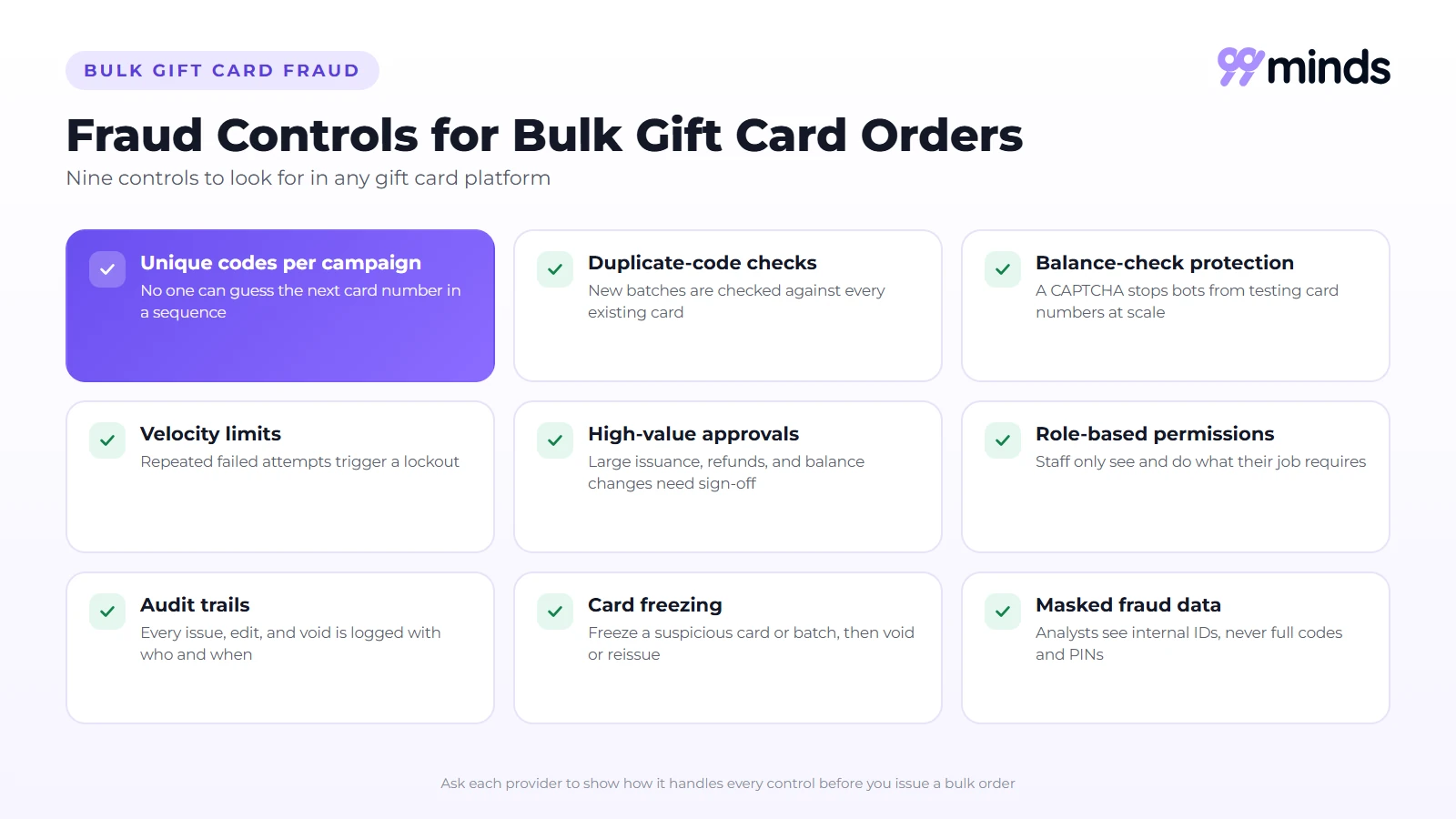
99minds gives every card a unique number and lets you freeze or block cards. When you compare platforms, ask each provider to show you how it handles every item on this list.
What about in-store redemption?
In-store redemption needs its own checks, because cards often move between channels. A card bought online might be partly refunded at a register.
For Shopify POS merchants, controls should cover issuance, redemption, split tender, partial returns, and refunds. They should work both online-to-store and store-to-online. These controls depend on what Shopify POS supports, so test each scenario before launch.
What Tax and Compliance Rules Apply to Bulk Gift Cards?
Bulk gift cards come with four main US rules. They cover federal expiry limits, employee wage tax, a client gift deduction cap, and liability accounting. This is general information, not tax or legal advice, so check your situation with an accountant.
Federal expiry rules and the promotional exemption
Paid gift cards can’t expire within five years of issue or the last load. That rule comes from the federal CARD Act and lives in 12 CFR 1005.20.
Promotional cards are treated differently. Cards issued through a loyalty, award, or promotional program are exempt from the five-year rule. The card must say it’s promotional and show the expiration date on its front.
The promotional exemption can also cover bulk gift card orders. The CFPB’s official interpretation gives an example: a company giving employees gift cards to reward job performance. That’s why step two separates paid and promotional value. Some states go further than federal law, and California, Florida, and Connecticut ban gift card expiration on most paid cards.
Are gift cards taxable to employees?
Yes, gift cards are taxable to employees at any amount. The IRS treats them as cash equivalents. Its guidance on de minimis fringe benefits says cash equivalents never count as tax-free benefits. Employers must include their value in W-2 wages and withhold tax.
Tell corporate buyers that employee gift cards count as taxable wages. Knowing this helps them run bulk orders through payroll correctly.
Can businesses deduct client gift cards?
Businesses can deduct client gifts only up to $25 per recipient per year. IRS Publication 463 sets that cap for business gifts.
The cap still applies when cards go to a company. If the gifts are meant for specific people there, each person counts toward the limit.
How should issuers handle deferred revenue and unclaimed property?
A sold gift card is a liability, not revenue, until it’s redeemed. Under ASC 606, gift card accounting lets you recognize expected breakage as revenue over time.
Some states treat long-dormant balances as unclaimed property that must be reported. Rules vary widely, and several states exempt gift cards.
Sales tax usually applies when a card is redeemed for taxable goods, not when it’s sold.
How Does 99minds Help You Issue Bulk Gift Cards?
The 99minds gift card software gives you one place for issuing, delivering, and tracking bulk gift cards. With it, you can:
- Issue thousands of digital and physical gift cards at once by CSV upload
- Issue digital gift cards in bulk by customer email, phone number, or customer ID
- Automate recurring batches through the gift card API
- Group every order under a campaign, so each batch is easy to find and report on
- Track each batch’s total cards, total value, and creation date on the Batches page
- Schedule delivery with a personal message, and add cards to Apple and Google Wallet
- Sell and redeem gift cards across multiple stores and currencies
- Keep promotional value separate with 99minds store credit, so promotions never mix with paid balances
So, How Do You Get Started With Bulk Gift Cards on 99minds?
Bulk gift cards are more than a gifting chore. When you issue your own, every corporate order becomes cash up front. It also brings a new group of shoppers to your brand. The process is simple once it’s set up. You need a campaign per order, the right format, and a clean way to load recipients.
The details are what protect you. Unique codes, duplicate checks, and activation at dispatch keep fraud out of your batches. Separating paid and promotional value keeps you on the right side of federal expiry rules. Telling buyers that employee gift cards are taxable wages saves them a payroll headache.
Want to see bulk issuance by CSV or API, campaign tracking, and batch reporting in action? Book a demo with our team.
Frequently Asked Questions About Bulk Gift Cards
Where can I buy gift cards in bulk?
You can buy gift cards in bulk from a retailer's corporate program, from warehouse clubs, or from multi-brand platforms. For cards from one specific store, contact that brand directly, since many sell their own gift cards in bulk. Brands that sell directly often offer branded designs, scheduled delivery, and batch reporting.Is it cheaper to buy gift cards in bulk?
Buying gift cards in bulk can be cheaper, because some sellers offer volume discounts or bonus value on large orders. The savings depend on fees, though. Open-loop prepaid cards often carry a purchase or activation fee per card, while branded store cards usually don't. Compare the total cost per card, including fees and shipping, before you order.Can you buy Visa gift cards in bulk?
Yes, businesses can buy Visa gift cards in bulk through corporate prepaid card programs. These programs often charge a purchase or activation fee for each card. Like any gift card, a Visa gift card given to an employee counts as taxable wages.Can I buy a $5,000 gift card?
Whether you can buy a $5,000 gift card depends on the issuer. Each brand or card provider sets its own maximum value per card, and many cap cards well below $5,000. For large amounts, businesses usually split the value across several cards. Federal anti-money-laundering rules also add extra requirements for some high-value prepaid products.How many gift cards can you issue at once?
How many gift cards you can issue at once depends on your gift card platform. With 99minds, you can issue thousands of digital and physical gift cards in one batch by CSV upload. Recurring or very large programs can also issue cards automatically through the gift card API.Are gift cards taxable to employees?
Yes, gift cards are taxable to employees at any amount. The IRS treats gift cards as cash equivalents, which can never be excluded as tax-free de minimis fringe benefits. Employers must include the value of employee gift cards in W-2 wages and withhold income and payroll taxes.Do bulk gift cards expire?
Paid bulk gift cards can't expire within five years of issue or the last load under federal law. Promotional and reward cards, including cards a company gives employees as rewards, can expire sooner. The card must state that it is promotional and show its expiration date on the front. Some states, including California, Florida, and Connecticut, ban expiration on most paid gift cards.Can bulk gift cards be customized with a company logo or message?
Yes, most issuers let you customize bulk gift cards for corporate orders. Digital bulk gift cards can include a branded design, a personal message from the buyer, and a scheduled send date. Physical bulk gift cards can use a custom card design or a printed carrier with the company's logo.What happens if a bulk gift card is lost or never delivered?
If a bulk gift card is lost or never delivered, the issuer should freeze the card and issue a replacement. Delivery status and audit trails make it easy to confirm which cards were sent and claimed. Physical cards that were never activated have no value, so a lost unactivated card carries little risk.Boost Customer Engagement with 99minds. The Ultimate Gift Card & Loyalty Solution!
Sign up for free